

The 61st edition of the Venice Biennale, In Minor Keys, curated by the late Koyo Kouoh (1967-2025), is now open. It will run until 22 November at the Giardini, the Arsenale and in various locations around the city. Here is Aesthetica‘s run-down of 10 standout national pavilions to discover this year – paying attention to timely themes such as communication, connection, ecology, identity and legacy.
Swiss Pavilion | The Unfinished Business of Living Together
In April 1978, an episode of the Swiss public programme Telearena aired. The live broadcast debated the “problem of homosexuality”, and, whilst controversial, marked one of the first occasions when individuals from the LGBTQ+ community gained a mainstream public voice in Switzerland. The 2026 Pavilion takes this moment as a jumping-off point, to examine how social norms determine who can speak and be heard. The exhibition is conceived by curators Gianmaria Andreetta, Luca Beeler, together with artist
Nina Wakeford, and developed in collaboration with Miriam Laura Leonardi, Lithic Alliance and Yul Tomatala. The exhibition uses a spatialised video production, which mixes archival footage with new images and sound, re-enacting TV talk shows to open up broader questions about media infrastructures.
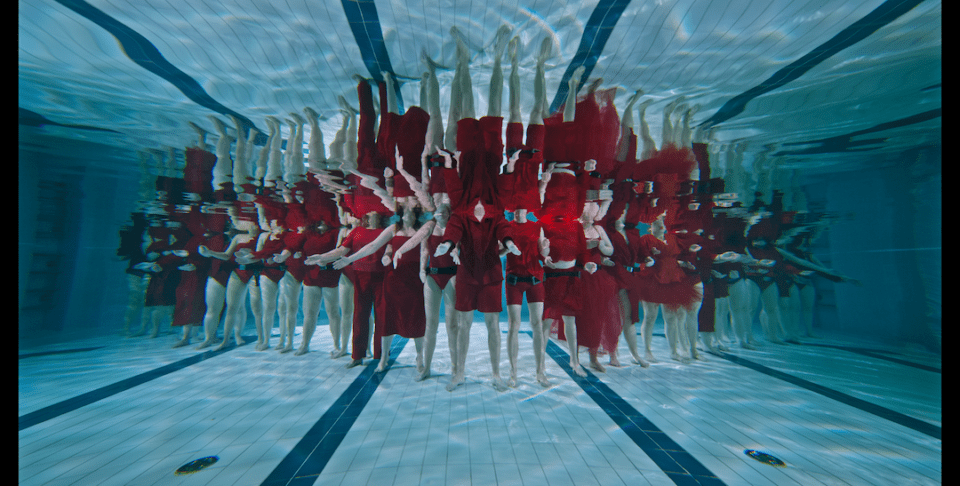
Polish Pavilion | Liquid Tongues
Liquid Tongues is an audiovisual installation by artists Bogna Burska and Daniel Kotowski, in which the community Choir in Motion (Chór w Ruchu) interprets the songs of whales through both spoken and sign language. The film features a group of thirty performers, comprising both hearing and Deaf individuals, and takes place in two settings: underwater and on the surface. According to curators Ewa Chomicka and Jolanta Woszczenko, “the project draws attention to voices that are overlooked in dominant narratives; in this work, they become heard: audible and visible. A change in perspective – moving between the worlds above and below the water – shows that what we normally consider the primary mode of communication may not work in other conditions. In turn, voices that were previously inaudible may acquire new strength.”
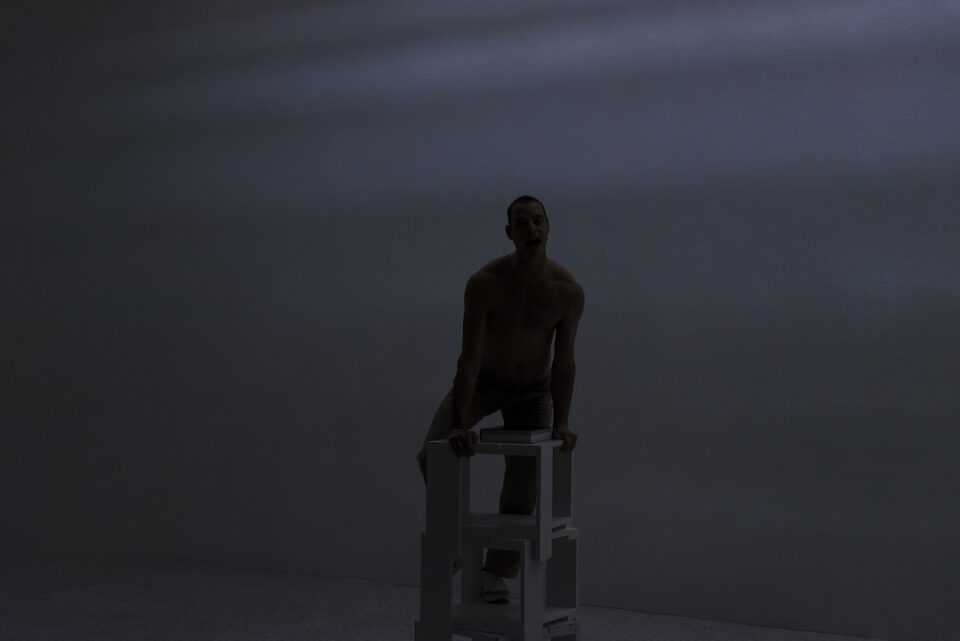
The Netherlands Pavilion | The Fortress
The 61st International Art Exhibition marks a historic moment for the Netherlands: it is the first time the country has represented at the Biennale Arte with a performance, and the only occasion where the Dutch Pavilion has become an integral part of the artwork. Artist Dries Verhoeven and curator Rieke Vos have transformed the space into a dark, fortress-like enclosure, as a way “to confront the contradictions embedded within the structure of La Biennale di Venezia.” Designed by Gerrit Rietveld and built in the optimistic post-war years of the 1950s, the structure represents the epitome of openness, progress and faith in the future. Now, however, this modernist monument is the antithesis of itself: shuttered and devoid of light. Inside, audiences will experience a visceral vocal performance.
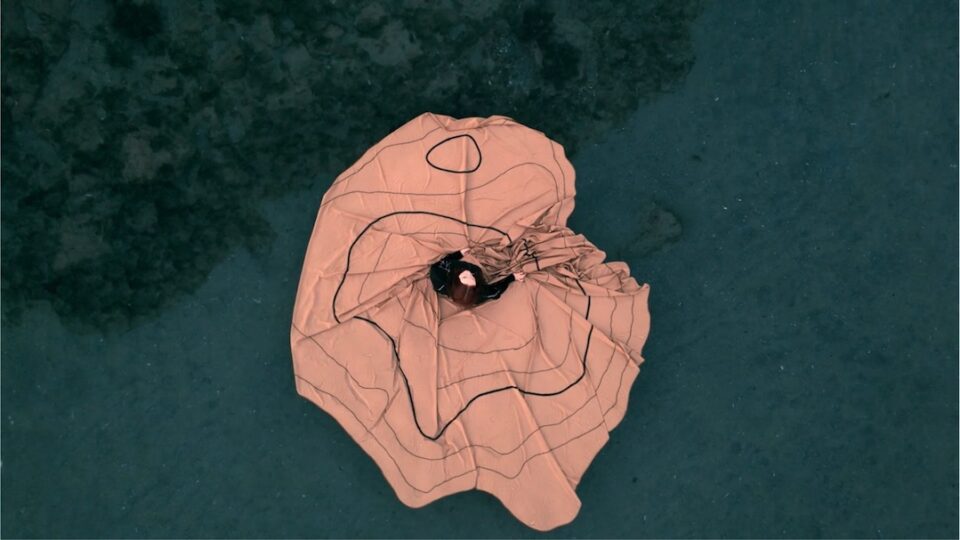
Romanian Pavilion | Black Seas – Scores for the Sonic Eye
This year, Romania is represented by Anca Benera and Arnold Estefán, who contribute a a large-scale, audiovisual and sculptural installation dedicated to the Black Sea. Ecology and environmental politics are key here, as the pavilion continues Benera and Estefán’s ongoing research into patterns of extraction, territorial tension and ecological resilience. The project interprets the Black Sea as shaped by the rivers that flow into it – the Danube, the Don and the Dnieper – symbolising Europe’s intertwined colonial and political histories. Oceanographic data — including wave turbulence, drifting buoys and undercurrents — translates into vibrations that reverberate around the space, providing a multisensory encounter with the Black Sea and repositioning it as an active force within global systems of power.
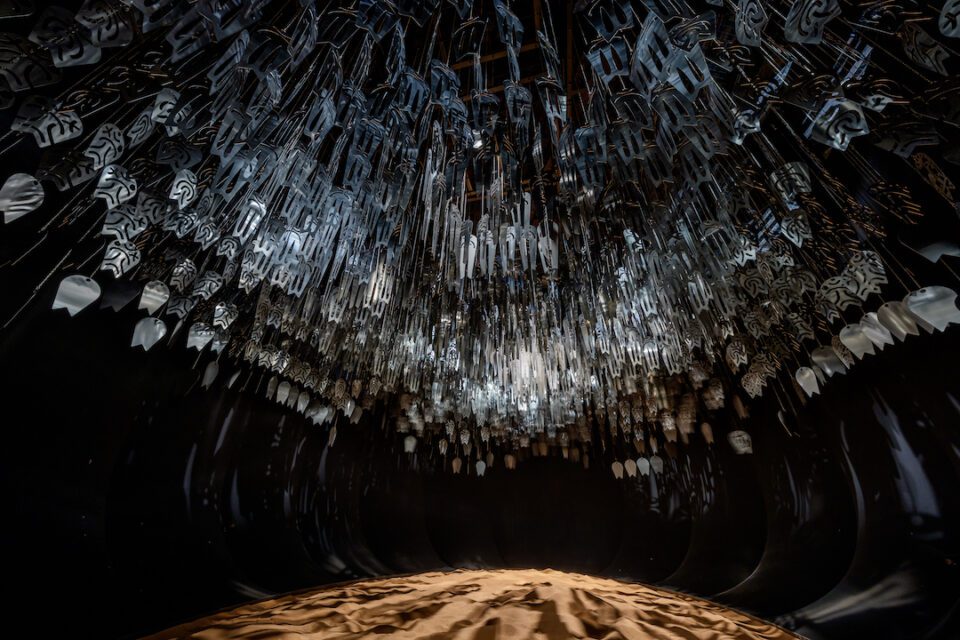
Oman Pavilion |Zīnah (Adornment)
Al-zaanah is the Omani tradition of adorning horses and riders with silver. The practice is seen as an affirmation that the horse is an extension of the rider, and should be granted with the same sense of worth. For the 2026 Biennale, artist and curator Haitham Al Busafi transforms this custom into a participatory artwork. Visitors enter through a dark pathway, beyond which lies a field of Omani desert sand, suspended beneath a canopy of silver. As audiences move, their motion is transformed into sound, causing the metal to sway and chime. It evokes the sonic elements of al-zaanah, where silver collides against silver when horse and rider are in motion. “In a world that privileges speed and spectacle,” says Al Busafi, “this work turns toward something quieter: the act of recognising another being as worthy of beauty, dignity and presence.”
Nauru Pavilion | AIM Inundated, Imagining Life After Land
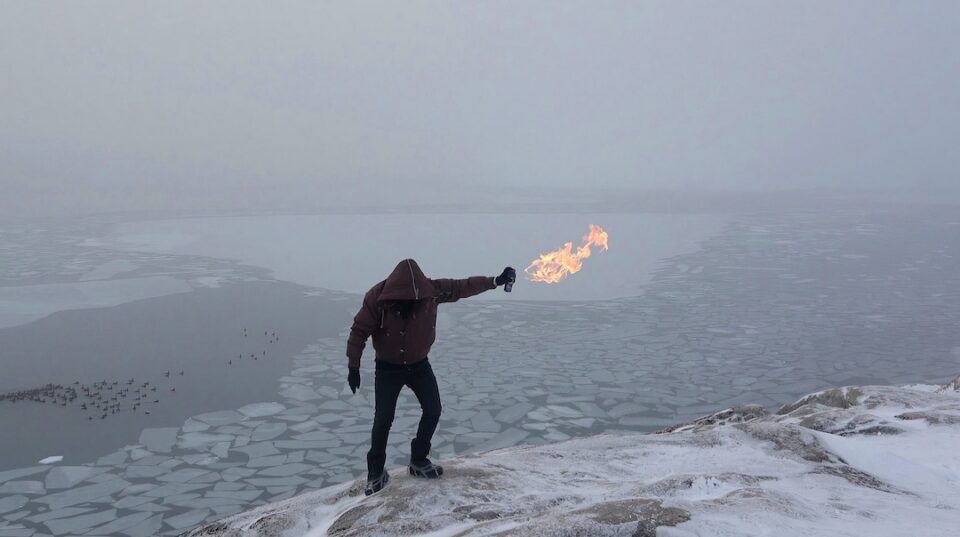
Nauru is the world’s smallest island country. It makes its Venice debut with AIM Inundated, Imagining Life After Land, a group exhibition that positions Nauru – a microstate in the South Pacific Ocean – as an example of ecological precarity. Nauru is experiencing the effects of climate crisis from different angles: rising sea levels, environmental exhaustion and the enduring legacies of colonial extractivism. It is recovering from decades of intensive phosphate mining, which transformed the island’s landscape and economy. Its pavilion is thus described as “a warning and guide for a shared future,” with contributions from Kauw Tsitsi, CPS (Khaled Ramadan, Alfredo Cramerotti), Patricia Jacomella Bonola, Tedo Rekhviashvili, Sylvia Grace Borda, Ron Laboray, Dorian Batycka, Khaled Hafez, Iv Toshain and Stefano Cagol.
Australia Pavilion | Conference of One’s Self
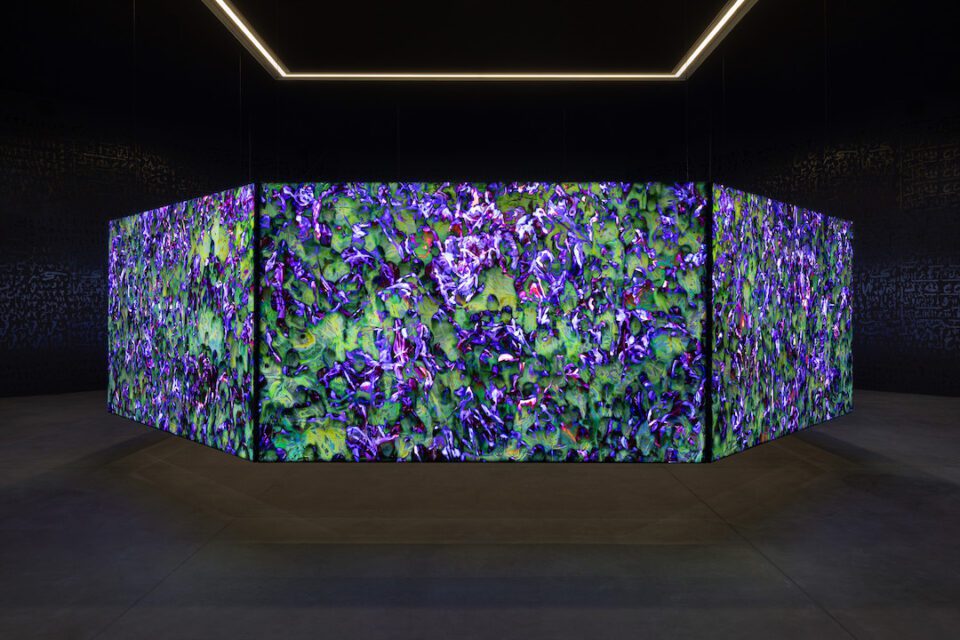
Inside the Australia Pavilion, Khaled Sabsabi – an artist known for his explorations of migration and the complexities of belonging – presents conference of one’s self, an immersive multisensory installation which explores spirituality, collective journeys and shared humanity. At its centre are eight monumental canvas paintings, inspired by the 12th century Sufi allegory The Conference of the Birds by Farid al-Din Attar. They are arranged in an octagonal formation, whilst suspended video projectors cast moving imagery onto the painted surfaces. The artwork is accompanied by everyday sounds recorded on analogue tape. The installation reflects the multicultural and multi-faith character of contemporary Australia, drawing on spiritual traditions spanning various cultural and religious contexts.
Lithuania Pavilion | animism sings anarchy
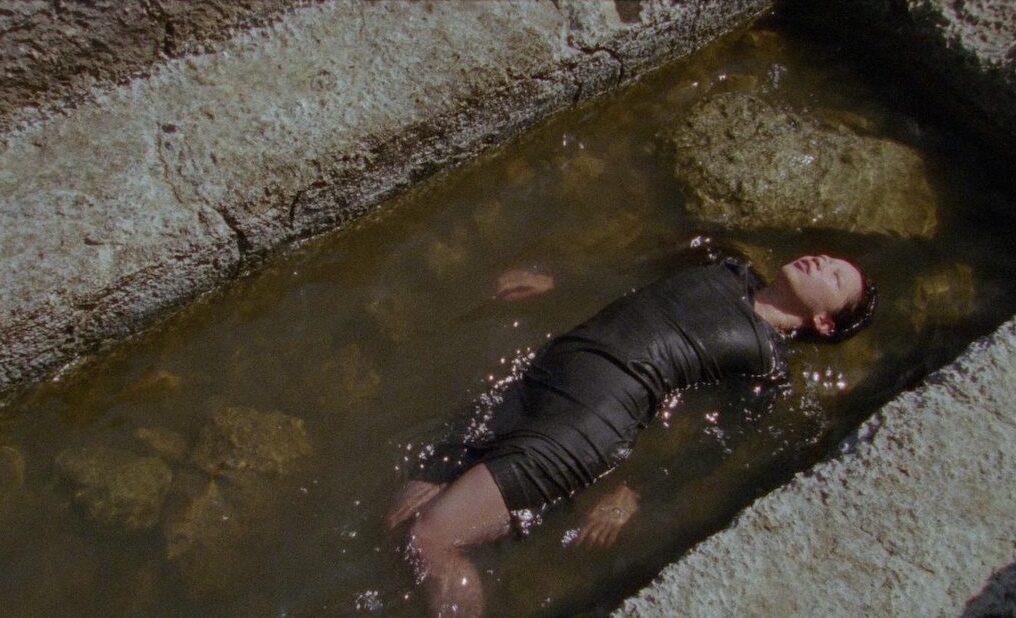
Eglė Budvytytė represents Lithuania at this year’s Biennale, exhibiting a new multi-channel 16mm film installation titled animism sings anarchy. It draws on the late Lithuanian anthropologist and archaeologist Marija Gimbutas’s research into Neolithic matrilineal, animist societies – a source of inspiration for artists, academics and environmentalists associated with second-wave feminism. Filming to date has taken place in the southeast of Italy near Grotta Scaloria, the site of a Neolithic water cult where Gimbutas undertook excavations in the late 1970s. Building on her practice of working through the body and with place, Budvytytė structures the film’s scenes – which unfold like ritual movements – around museum interiors and an Apulian coastline populated by ancient caves and watery burial grounds.
Latvian Pavilion | Untamed Assembly: Backstage of Utopia
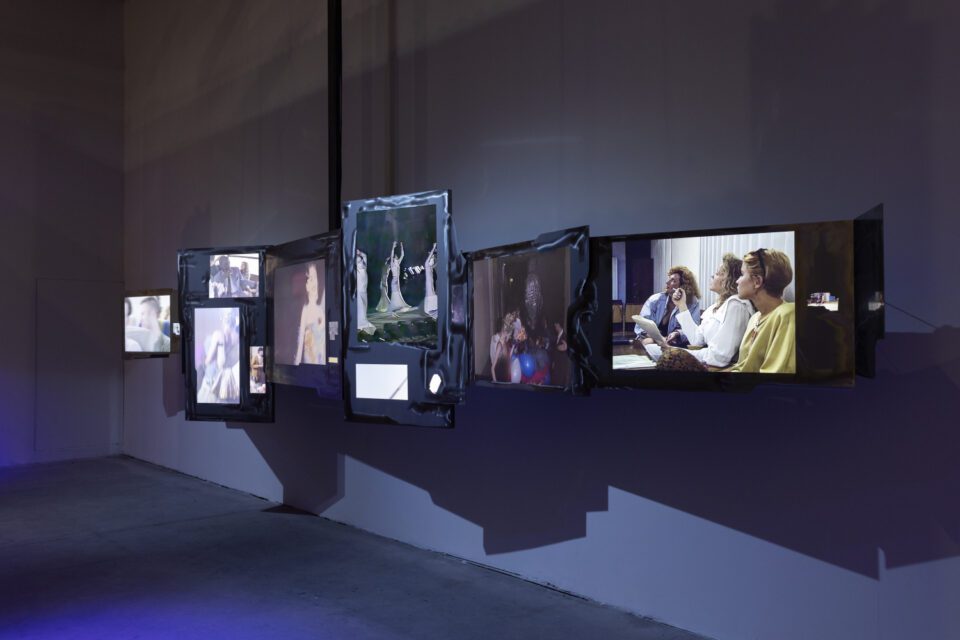
The Untamed Fashion Assemblies (UFA) were experimental festivals of fashion, art and performance and held in Latvia during the 1990s. They emerged during the “unstable interval” between the Soviet empire’s collapse and the rise global capitalism, and are remembered for dissolving the boundaries between fashion and visual art through intersections with club culture, dance, drag and music. They also functioned as a launchpad for young Baltic designers, whose work appeared alongside the likes of Vivienne Westwood and Viktor & Rolf, who also passed through the festivals as students and went on to become global icons. For the Biennale Art 2026, interdisciplinary artist duo MAREUNROL responds to UFA’s archives, redressing the pavilion as a backstage space where clothing racks hold artefacts and stories.
British Pavilion | Predicting History: Testing Translation
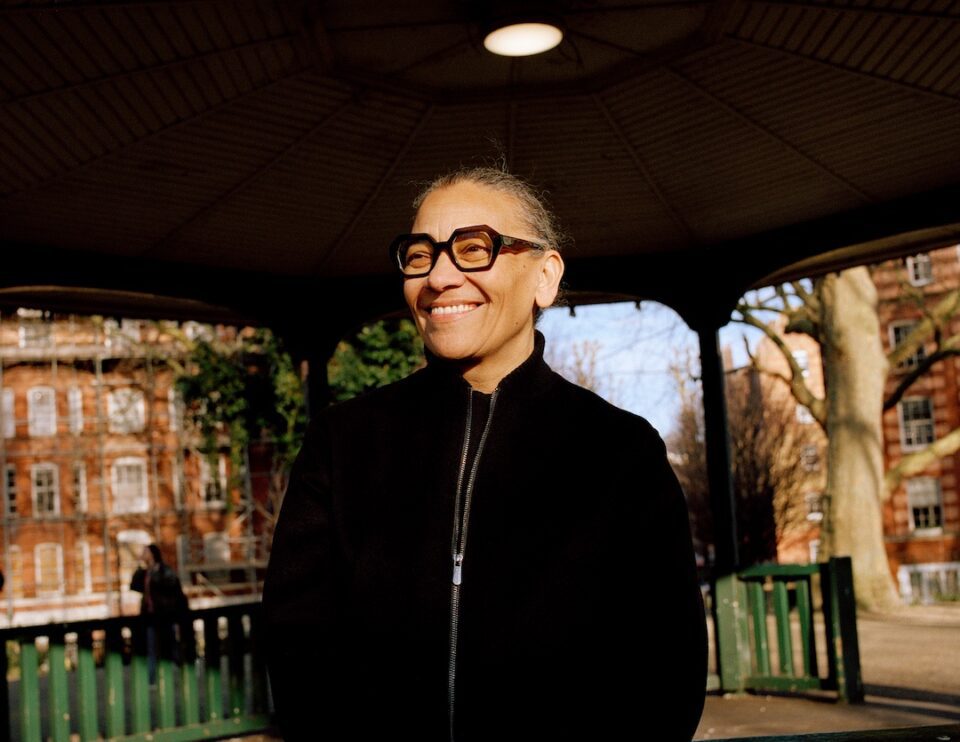
In Predicting History: Testing Translation, Turner Prize-winner Lubaina Himid explores what it means to make a home in a new place. The exhibition brings together large-scale, multi-panel paintings – titled Architects, Tailors, Chefs, Boatbuilders and Gardeners – alongside works on found objects, East African kanga textiles and a soundscape made in collaboration with artist Magda Stawarska. Combined, these form an immersive experience that questions what it means to inhabit a space not built for you, and to assert oneself in a world where some can move freely while others are “out of place.” Informed by her background in theatre and love of opera, Himid transforms the building into an immersive, multi-sensory space, encouraging visitors to engage with the characters in her work. Following Venice, the commission will tour the UK.
Biennale Arte 2026 runs in various locations across Venice until 22 November.
Words: Eleanor Sutherland
Image Credits:
1. Khaled Sabsabi, conference of one’ s self, 2026, Australia Pavilion at La Biennale di Venezia. Photo: Andrea Rossetti. Courtesy the artist and Milani Gallery
2. Yul Tomatala, Hors-champ, Camera 1, Cues, 2026, multichannel video, 19:33 min.
3. Bogna Burska, Daniel Kotowski, Liquid Tongues, 2026, video, Zachęta Archive.
4. The Fortress, Dries Verhoeven (2026). Photo by Willem Popelier.
5. Anca Benera and Arnold Estefán, ‘How to Mend a Broken Sea?’ film still. Courtesy the artists.
6. Haitham Al Busafi, Zīnah (Adornment), 2026. Pavilion of the Sultanate of Oman at Biennale Arte 2026. Courtesy Ministry of Culture, Sports and Youth, Sultanate of Oman. Photo Andrea Avezzu.
7. Stefano Cagol: We are All Nauru. Greenland, 2024-2025
8. Khaled Sabsabi, conference of one’ s self, 2026, Australia Pavilion at La Biennale di Venezia. Photo: Andrea Rossetti. Courtesy the artist and Milani Gallery
9. Eglė Budvytytė, animism sings anarchy, 2026. Three-channel film installation, 16 mm film transferred to 4K projections, 40 min. ©Eglė Budvytytė, 2026.
10. Dedication to Cameramen (in order of appearance) Bus from London, 1992, Misunderstanding1990-94, Parties 1990-4, Fashion Shows 1990-99, Opening Day 1992, Openings Dome Square 1991, Motor Museum 1994, Backstage 1990-94.
11. Portrait of Lubaina Himid. Photo by Adama Jalloh. Courtesy of the British Council.


