

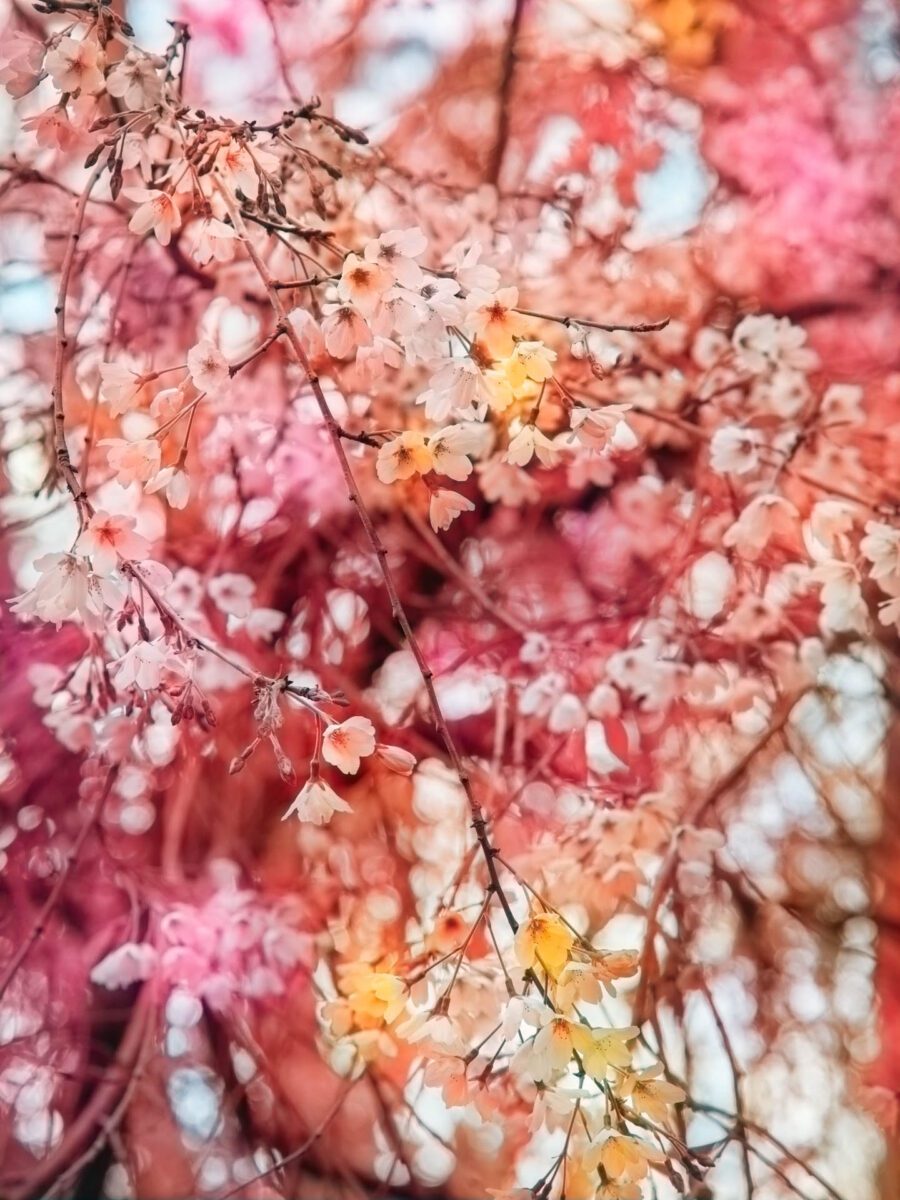
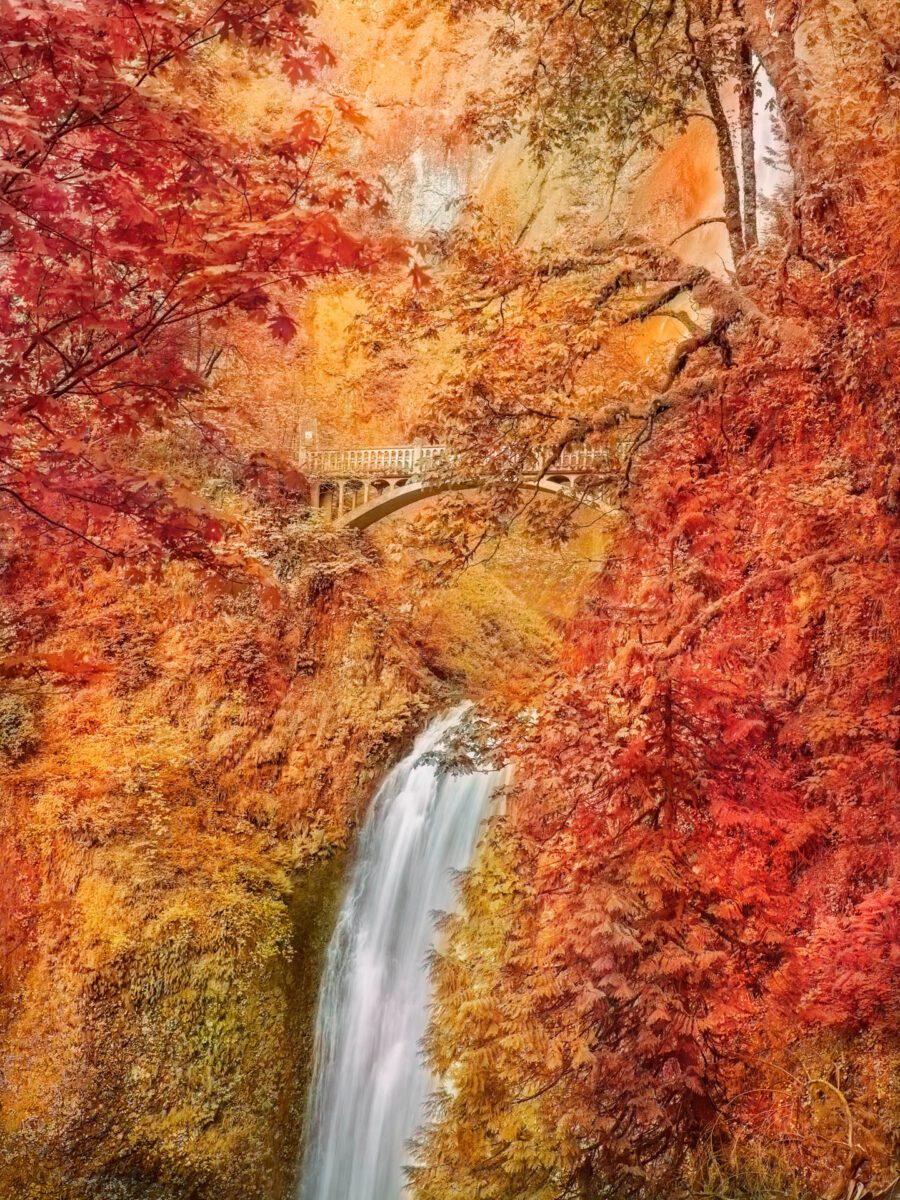
American artist Trevor Paglen (b. 1974) has investigated the politics of images for years – examining the machinations of AI, data sets and surveillance through series like Bloom, which appears on the cover of his new book, How to See Like a Machine: Images After AI, published by Verso Books. Bloom (2020) is a series of large-scale images of flowers that have been reinterpreted by computer vision algorithms from original photographs taken during the spring lockdown. He’s also been doing a similar thing with landscapes of the American West, as well in Clouds, where skyscapes are overlaid with lines indicating what algorithms – such as those in guided missiles, drones and self-driving cars – “see” when they scrape images for patterns.
Paglen is perhaps best known for the ImageNet Roulette, a project about AI labelling, realised in collaboration with researcher, writer and academic Kate Crawford. He describes it as “part of a broader project to draw attention to the things that can – and regularly do – go wrong when artificial intelligence models are trained on problematic training data.” The system is based on the “person” classifications of one of the most ubiquitous training sets in machine learning. When left to its own devices, it reveals the “racist, misogynistic, cruel, and simply absurd categorisations” entrenched within AI models – all by itself.
In March, this culminated in major recognition. Paglen was announced as the winner of the 2026 LG Guggenheim Award, a prestigious prize celebrating creatives at the intersection of art and technology. “Over the course of his career, Paglen has undertaken foundational investigations into the infrastructures of surveillance, artificial intelligence, data extraction and state secrecy that shape contemporary life,” said Naomi Beckwith, Deputy Director and Jennifer and David Stockman Chief Curator at Guggenheim New York. “By transforming opaque technological systems into perceptible forms, he cultivates public awareness and civic agency. His art invites us to confront the invisible architectures that govern our lives and to recognise our shared responsibility within them. In illuminating these often unseen forces, Paglen empowers audiences not only to see the world differently but also to imagine how it might be shaped.”

As such, Paglen is uniquely placed to deliver How to See Like a Machine: Images After AI, a collection of accessible, entertaining yet densely informative essays that navigate visual culture in an age of computer vision – where our activity is captured and monitored by social media companies and states alike. Barely two pages into the first chapter of this book, Paglen makes a startling revelation: “the vast majority of images are now made by machines, for other machines.” And he’s not just talking about AI generation – although that’s a key point – he’s referencing the five billion smartphone shots taken every day, too. Pictures made with digital cameras are immaterial – they can only be seen by humans under specific circumstances, returning to code when screens are switched off. Crucially, unlike analogue negatives, they don’t need to be seen by humans to be manipulated, disseminated and harvested. It’s a state of play that has been sneaking up on us for decades, and it’s this reality that underpins How to See Like a Machine.
Inside, Paglen breaks down how AI systems work and how they came to be. In doing so, he joins other creatives and thinkers of his generation, like Felicity Hammond, whose project Variations toured the UK last year. The four-part installation laid bare an array of truths about the brutal process that that enable AI tools to operate at scale: from the extraction of rare earth minerals to aggressive surveillance systems and the scraping of personal data. Then there’s Hito Steyerl, the author of many films and critical written pieces concerned with the global circulation of images. She calls How to See Like a Machine “required reading.”

The book’s tagline – “we once looked at pictures. Then, with the advent of computer vision and machine learning, pictures started looking at us” – reads like the opening of a sci-fi novel, reminiscent of H.G Wells’ War of the Worlds. In many ways, How to See Like a Machine reminds us of how close to the stuff of fiction we truly are. It includes an array of early – and at times, bizarre – stories, taking us back to the 1950s and into the worlds of mind control, MKUltra, magic, psyops and UFOs. This is an engaging and surprisingly readable book, democratising a subject matter that is often – and perhaps deliberately – opaque. It pries the black box of AI wide open, giving us the information needed to navigate today’s image culture, where presidents habitually post “AI slop”, and we must question everything we see and scroll past.
How to See Like a Machine: Images After AI is published by Verso Books.
Words: Eleanor Sutherland
Image Credits:
1. Bloom (#bb837e), 2022. Dye sublimation on aluminum print. 54 × 40 ½ in. Copyright Trevor Paglen. Courtesy of The Artist and Jessica Silverman Gallery, San Francisco and Pace Gallery, New York.
2. Near Rock Point Deep Semantic Image Segments, 2022. Dye sublimation on aluminum print 32 × 42 ½ in. Copyright Trevor Paglen. Courtesy of The Artist and Jessica Silverman Gallery, San Francisco and Pace Gallery, New York.
3. Bloom (#7c5756), 2020. Dye sublimation on aluminum print 40 ½ × 54 in. Copyright Trevor Paglen. Courtesy of The Artist and Jessica Silverman Gallery, San Francisco and Pace Gallery, New York.
4. CLOUD #902 Scale Invariant Feature Transform; Watershed, 2019. Dye sublimation on aluminum print 48 × 62 ½ in. Copyright Trevor Paglen. Courtesy of The Artist and Jessica Silverman Gallery, San Francisco and Pace Gallery, New York.
5. Multnomah Falls Deep Semantic Image Segments, 2022. Dye sublimation on aluminum print 54 × 40 ½ in. Copyright Trevor Paglen. Courtesy of The Artist and Jessica Silverman Gallery, San Francisco and Pace Gallery, New York.
6. Trevor Paglen CLOUD #395 Maximally Stable Extremal Regions; Hough Circle Transform, 2025. Dye Sublimation Print 48 × 64 in. (121.92 × 162.56 cm). Copyright Trevor Paglen. Courtesy of The Artist and Jessica Silverman Gallery, San Francisco and Pace Gallery, New York.


