

The Library of the Four Winds is an enquiry into how space becomes thought, and how architecture can temporarily shift from monument to meeting ground. Conceived by Es Devlin for the Temple of the Four Winds at Castle Howard, the work reframes Vanbrugh’s baroque architecture as a vessel for collective reading, speaking and listening. Rather than treating the Temple as a static historical artefact, Devlin activates it as a living editorial space, where books, voices and bodies circulate as equal material. The installation proposes that knowledge is not archived but continually re-authored through proximity and participation. In doing so, it extends Devlin’s long-standing interest in temporary societies, where audience, performer and architecture collapse into a shared condition of authorship. Here, the idea of a library is not storage, but weather system – shifting, porous and responsive.
Devlin’s artistic practice is rooted in a rare intersection of theatre design, large-scale public sculpture and collective choreography. Born in London in 1971, she has built an international reputation for transforming performance environments into immersive narrative architectures that invite civic engagement rather than passive spectatorship. Her work has consistently redefined the relationship between text and space, whether through stadium-scale performances or intimate installations that foreground language as a sculptural material. Across projects such as Come Home Again and Congregation, she has developed a visual grammar in which words are experienced spatially, as constellations of meaning. This approach positions her as one of the most significant contemporary British artists working at the threshold of design, literature and public art. In Library of the Four Winds, these concerns are refined into a quieter register.
Devlin’s contribution is distinguished not only because of its scale but also a sustained commitment to participation as aesthetic structure rather than curatorial add-on. Her installations often function as systems of exchange, where visitors contribute language, memory or presence into a shared composition. The result is never fixed; it is contingent on the density and rhythm of engagement. In the Temple of the Four Winds, this ethos finds a particularly resonant form, as books drawn from both Vanbrugh’s and Devlin’s personal reference worlds are assembled into a central sculptural core. This gesture collapses historical distance, allowing architectural heritage and contemporary authorship to coexist within the same material field. The work becomes a negotiation between two modes of creative thinking.
The significance of this intervention is heightened by the context of Castle Howard itself, a site already saturated with narrative, performance and visual excess. As one of Britain’s most recognisable country houses, the estate operates as both historical document and cinematic backdrop, embedded in collective cultural memory through productions such as Brideshead Revisited and Bridgerton. Howeverm beneath this popular familiarity lies a complex architectural lineage shaped by ambition, loss and continual reinvention. Designed by Sir John Vanbrugh alongside Nicholas Hawksmoor, the house has always been defined by unfinishedness and adaptation. Devlin’s work enters this condition not as interruption but as continuation, extending the estate’s long history of interpretative layering. The Temple of the Four Winds becomes a site where that layered history is temporarily made legible through participation.
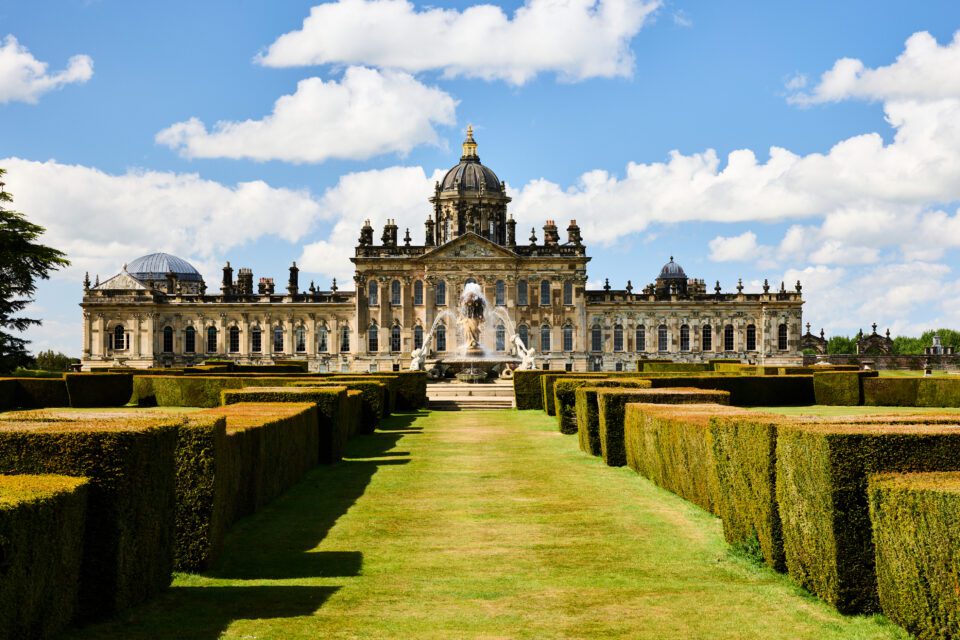
Castle Howard’s commitment to contemporary art has, in recent years, repositioned the estate as a site of curatorial experimentation rather than preservation alone. Its inaugural major collaboration in this direction with sculptor Tony Cragg marked a decisive shift, demonstrating that the stately home could function as an active platform for contemporary sculptural dialogue. That exhibition reconfigured the relationship between collection and landscape, placing abstract form within the estate’s baroque geometry and inviting viewers to reconsider the grounds as an evolving aesthetic field. The success of that presentation established a precedent: that historical architecture can operate as co-author to art. The current programme emerges not as an expansion of an already established curatorial ambition. The estate becomes a site where temporalities overlap rather than compete.
Within this evolving framework, Devlin’s project marks a shift from object-based installation to an explicitly social architecture. Whereas previous interventions engaged primarily with sculptural form, Library of the Four Winds privileges encounter, conversation and duration as its primary materials. The concentric tables surrounding the Temple are not decorative extensions but functional invitations to inhabit time differently. Visitors are encouraged to read, draw, speak and listen in a structure that resists hierarchy, allowing multiple modes of attention to coexist. This spatial choreography echoes Devlin’s broader interest in dissolving the boundary between observer and participant. The result is a work that is less about viewing than about sustained presence within a shared field of attention.
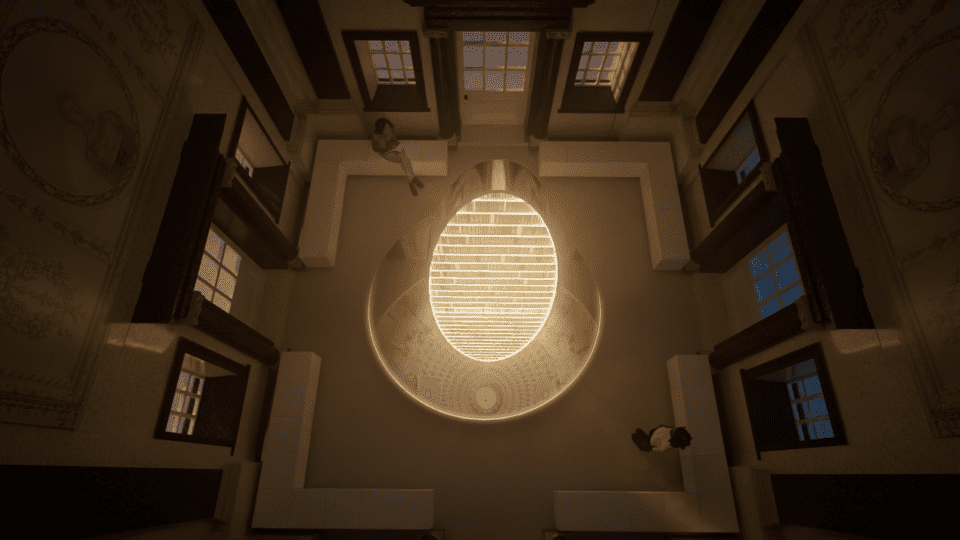
The choice of books as central sculptural material is particularly significant in this context, as it reframes reading as a spatial and communal act rather than an isolated intellectual exercise. Books are no longer positioned as static repositories of knowledge but as physical nodes within a circulating system of voices. By drawing from both Vanbrugh’s historical milieu and Devlin’s contemporary references, the installation constructs an unexpected dialogue across centuries. This is an active recomposition of intellectual lineage. The Temple becomes a site where reading is not silent consumption but audible participation, where knowledge is held collectively rather than individually. The work aligns closely with the broader themes of the National Year of Reading, while extending them into sculptural form.
There is also a subtle architectural intelligence in the way Devlin responds to the Temple itself, a structure originally intended as a place of rest and contemplation within the landscape. Rather than overwhelming its proportions, she works with its circular logic, amplifying its centripetal qualities through concentric spatial arrangements. The architecture does not disappear; instead, it becomes a frame for intensified attention. Light, text and human presence are treated as interchangeable elements within a single system. This sensitivity to existing form reflects Devlin’s ability to operate within historically charged environments without reducing them to backdrop. Instead, she activates their performative potential.
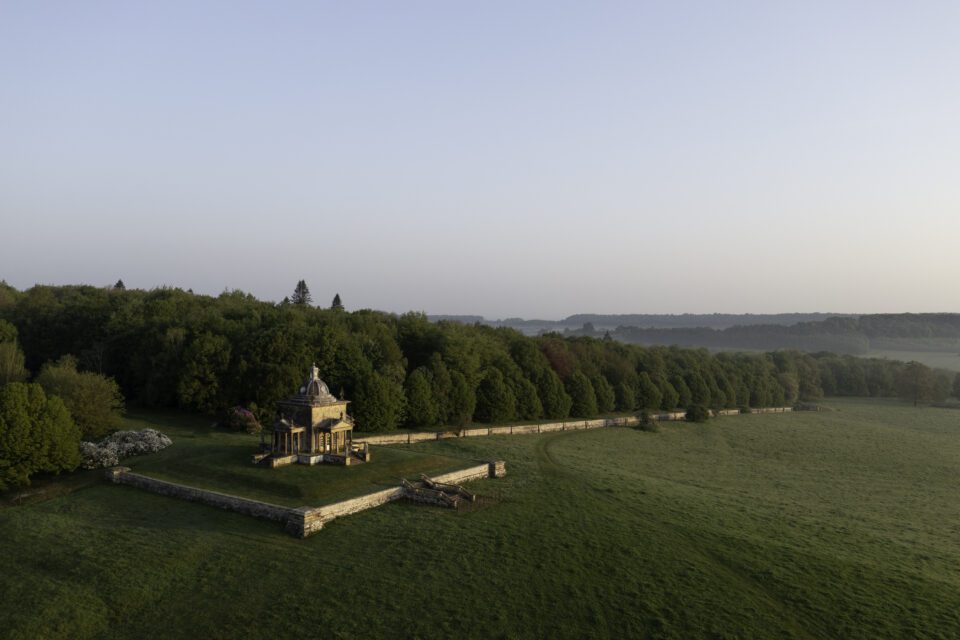
As a continuation of Castle Howard’s contemporary art programme, the project also signals a broader recalibration of how heritage sites engage with living artistic practice. The success of the earlier Tony Cragg presentation demonstrated that audiences are willing to encounter sculpture in dialogue with historical space, rather than as isolated intervention. Devlin’s contribution extends this logic into the social and linguistic realm, where meaning is generated through shared activity rather than singular contemplation. In doing so, it positions the estate as an evolving cultural instrument rather than a fixed monument. The implications of this shift are considerable, suggesting new models for how historic sites might function as platforms for contemporary production.
Library of the Four Winds is less an installation than a temporary civic condition, one in which reading becomes collective architecture and architecture becomes readable. It proposes that the act of gathering around text can itself be a form of design. Within the broader context of Devlin’s practice, it represents a refinement of her long-standing interest in communal authorship, stripped of spectacle and focused instead on duration and exchange. At Castle Howard, this approach finds a particularly resonant setting, where history is already layered, porous and continuously reinterpreted. The work does not resolve that complexity but makes it habitable, offering a structure in which attention itself becomes the medium.
Library of the Four Winds is at Castle Howard, York from 13 June – 27 September: castlehoward.co.uk
Words: Anna Müller
Image Credits:
1&5. The Temple of the Four Winds at Castle Howard. Photo by Mattia Aquila.
2. Library of the Four Winds, Es Devlin Studio visual, Courtesy Es Devlin.
3. Castle Howard. Photo by David Lindsay.
4. Library of the Four Winds, Es Devlin Studio visual, Courtesy Es Devlin.


