

Time has become one of the defining anxieties of the contemporary age. Climate scientists speak in countdowns, governments negotiate against shrinking deadlines, and daily life unfolds beneath a constant awareness that ecological systems are changing faster than human institutions can respond. However, art has the capacity to recalibrate those pressures, shifting attention away from urgency alone and towards deeper, older rhythms embedded within landscape, memory and collective experience. Climate Clock, unveiled as part of Oulu2026, approaches environmental consciousness through this expanded understanding of time. Rather than framing climate change solely as catastrophe, the project considers duration, coexistence and interdependence, asking audiences to encounter the natural world through slowness, observation and embodied attention. Launching this June, the ambitious public art trail transforms Northern Finland into a site where contemporary art, scientific inquiry and ecological awareness intersect. Across forests, rivers, urban squares and coastal landscapes, seven major works invite viewers to reconsider how humanity measures its place within the living world.
Finland has long occupied a singular position within global conversations around design, architecture and cultural innovation. From the human-centred modernism of Alvar Aalto to the nation’s enduring relationship with material simplicity and environmental sensitivity, Finnish creative practice has consistently demonstrated how aesthetics can emerge from intimacy with landscape. In recent decades, the country has become equally recognised for its progressive intersections of technology, sustainability and public culture, cultivating an atmosphere in which experimentation is embedded within civic life. Northern Finland, in particular, embodies striking contrasts: Arctic light and industrial infrastructure, dense forests and rapidly evolving urban centres, ancient Indigenous histories and cutting-edge technological research. The city of Oulu exemplifies this dynamic synthesis. Positioned close to the Arctic Circle and shaped by accelerating climate transformation, Oulu is a place where environmental realities are impossible to ignore, yet where creativity continues to flourish. Climate Clock emerges directly from this cultural landscape, grounding contemporary art within the region’s ecological and social conditions.
Oulu’s designation as a UNESCO City of Media Arts further reinforces its status as an international centre for interdisciplinary innovation. The recognition acknowledges not only the city’s thriving digital culture and technological expertise, but also its commitment to accessibility, collaboration and experimental artistic practice. In this context, Climate Clock feels especially resonant: a project that bridges scientific research with public engagement through immersive aesthetic encounters. Oulu’s cultural dialogue extends beyond Finland itself, connecting with other UNESCO Creative Cities including York, whose own focus on media arts has foregrounded the relationship between heritage, storytelling and contemporary innovation. Both cities understand culture not as static preservation but as an active force capable of shaping civic identity and environmental consciousness. Climate Clock embodies that philosophy through works that are at once locally rooted and internationally engaged. The trail positions Oulu within a wider European conversation about how art can respond meaningfully to ecological instability whilst remaining deeply connected to community histories and regional distinctiveness. In doing so, the project establishes Northern Finland as a significant destination for contemporary environmental art.
Curated by Alice Sharp, founder of the UK-based organisation Invisible Dust, Climate Clock unfolds as both exhibition and evolving ecological meditation. The project’s title evokes the now-familiar language of countdowns and planetary deadlines, yet the artworks themselves resist simplistic narratives of doom. Instead, they encourage a renewed awareness of cyclical time — seasonal, geological and ancestral — emphasising humanity’s embeddedness within broader environmental systems. Sharp has worked closely with each participating artist alongside a network of scientists including glaciologists, archaeologists, hydrologists and climate researchers from universities across Finland and Sweden. These collaborations deepen the conceptual foundations of each commission, ensuring that scientific understanding becomes materially integrated into the artworks rather than merely illustrative. Importantly, the trail is permanent, establishing a long-term cultural legacy that will continue beyond Oulu2026 itself. The result is a constellation of site-specific works that respond intimately to local histories, topographies and ecology.
Amongst the most compelling commissions is British-Nigerian artist Ranti Bam’s Ilé-Ìlá, situated within the forests surrounding Kierikki Stone Age Village in Yli-Ii. Eight monumental clay vessels rise among the trees, their forms drawing upon prehistoric ceramics whilst also reflecting Bam’s engagement with Ifá, the Yoruba system of knowledge and divination connected to her Nigerian heritage. Standing at 2.5 metres high, the sculptures possess a powerful physicality, appearing simultaneously ancient and contemporary within the wooded landscape. Clay becomes both material and metaphor: a substance shaped directly by human touch yet inseparable from the earth itself. Bam’s work foregrounds tactility and spiritual resonance, linking archaeological memory with living ecological consciousness. Positioned near the lakeshore, the vessels seem to emerge organically from the terrain, emphasising humanity’s long relationship with land, ritual and craft. The installation establishes one of the trail’s central themes: the continuity between environmental history and contemporary climate awareness.
In the centre of Oulu, British-Bangladeshi artist Rana Begum transforms Kauppurienaukio Square through No.1574 Stone, a series of monumental sculptural forms inspired by glaciers and Arctic sea ice. Begum’s practice has long explored geometry, light and colour, and here those concerns acquire urgent environmental significance. Developed in dialogue with glaciologist Professor Alun Hubbard, the installation reflects the precarious beauty of rapidly melting polar landscapes. Textured surfaces and shifting colours refract the northern light, creating subtle optical changes throughout the day and across the seasons. Emerging from beneath the square’s paving, the sculptures appear as though fragments of geological time have surfaced within the urban environment itself. Begum’s intervention collapses distinctions between city and wilderness, reminding viewers that climate transformation extends into every aspect of daily life. The work balances visual elegance with ecological unease.

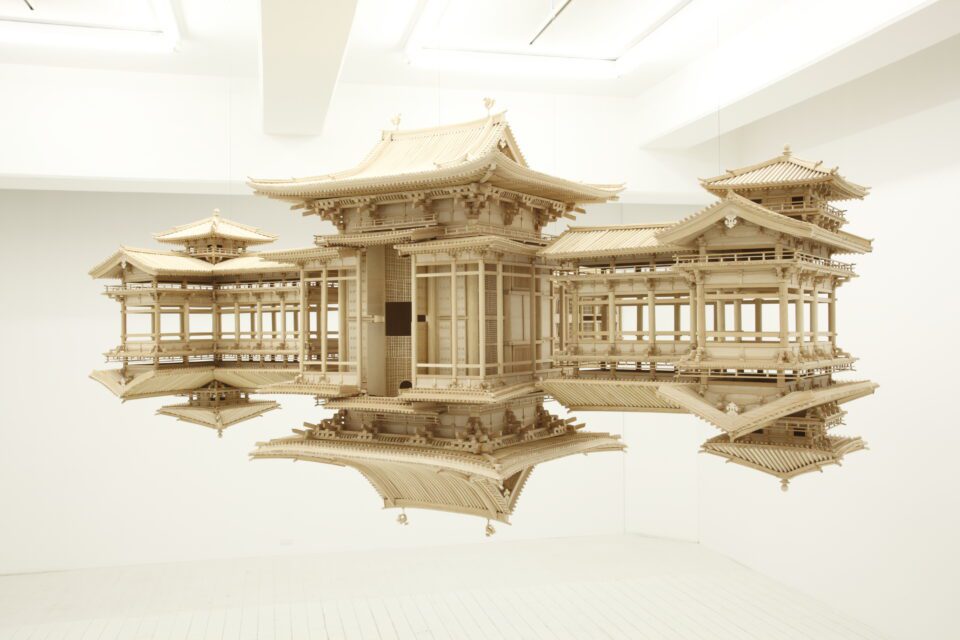
Japanese artist Takahiro Iwasaki contributes one of the trail’s most delicate and contemplative installations. Architectural Snowflakes: Letters from Heaven occupies a traditional wooden tar barrel on the beach at Ylikiiminki, referencing both Oulu’s industrial heritage and the fragility of Arctic snowfall. Visitors peer through small openings into a darkened interior illuminated by hundreds of intricate snowflake forms resembling the architecture of local churches. Inspired by the research of snow hydrologist Associate Professor Pertti Ala-aho, the work merges scientific observation with spiritual wonder. The title references Japanese scientist Ukichiro Nakaya, whose pioneering snow crystal research transformed microscopic structures into objects of poetic fascination. Iwasaki’s installation operates like a miniature observatory, encouraging viewers to pause and attend closely to ephemeral details. Light, symmetry and material fragility become meditations on environmental precarity and cultural memory.
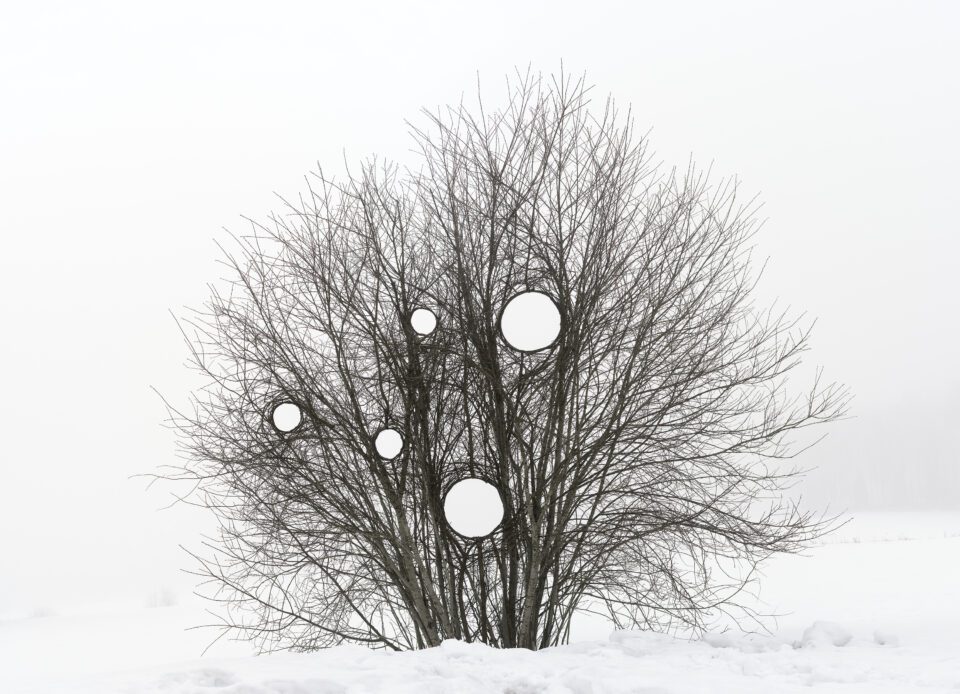
Elsewhere, Mexican-Belgian artist Gabriel Kuri transforms the route between Oulu city and the airport into a vivid landscape of climate data. Risk Assessing Risk Assessment applies the visual language of risk charts directly onto public infrastructure, painting lampposts, benches and rocks in graduated bands of green, orange and red according to their elevation levels. Developed following discussions with climate scientist Professor Kevin Anderson, the installation immerses commuters within an environment coded by uncertainty and environmental vulnerability. Finnish artist Antti Laitinen meanwhile offers a quieter intervention in the forests of Kiiminki through Olet Tässä (You Are Here). Circular openings twisted from branches frame the surrounding landscape, whilst suspended lichen-covered spheres rotate slowly in the wind like living pendulums. Through lichen — organisms capable of surviving for centuries — Laitinen materialises ecological duration itself, asking audiences to encounter time as something biological. Both works reveal how environmental awareness is shaped through movement, orientation and attention.
The trail concludes with projects that explicitly reconsider how societies measure value and duration. Danish collective SUPERFLEX presents Super Kello along the coast of Haukipudas: a pink marble structure functioning simultaneously as sculpture, shelter and marine habitat. Inside, visitors hear one word per hour from a Finnish translation of Homer’s Odyssey, spoken by a local fisherwoman across a ten-year timeframe. The work radically slows narrative consumption, proposing patience and attentiveness as ecological acts. Equally participatory is The Most Valuable Clock in the World by Finnish artists Tellervo Kalleinen and Oliver Kochta-Kalleinen, developed collaboratively with communities across the Oulu region. Combining moving image, mechanics and public contribution, the travelling clock records moments that local residents consider precious within everyday life. Together, these final works crystallise Climate Clock’s wider ambition: to transform how time itself is understood. Across Northern Finland, art becomes a means of listening more carefully to landscapes, communities and futures that demand collective care.
Climate Clock launches on 13 June as part of Oulu2026, European Capital of Culture: oulu2026.eu
Words: Simon Cartwright
Image Credits:
1. Ranti Bam, Into Heartland, 2022. Photo by Andrew Eseibo.
2. Harri Tarvianen.
3. Antti Laitinen, Broken Landscape VI, 2019, Courtesy of Antti Laitinen.
4. Ranti Bam, Into Heartland, 2022. Photo by Andrew Eseibo.
5. Takahiro Iwasaki, Reflection Model (Perfect Bliss), 2010-2012, Japanese cypress, plywood, wire, 150x280x194cm. Collection of Gallery of Modern Art, Brisbane, Australia. Photo by Kioki Keizo.


