

Christo (1935–2020) never treated space as neutral. Across a practice developed in tandem with Jeanne-Claude, he recast it as something provisional – something that could be tightened, sealed, withheld or briefly made strange. Born in Bulgaria and later based in Paris, his early years under political constraint shaped a lifelong interest in restriction as material condition. What might appear, at first glance, as acts of concealment were in fact acts of disclosure: buildings wrapped, coastlines interrupted, monuments turned temporarily unreadable. In each case, the familiar was not erased but delayed, forcing attention back onto the act of looking itself. The work did not sit in space so much as recalibrate it.
This recalibration is where Christo and Jeanne-Claude’s real legacy begins. Their projects replaced the stability of the object with the volatility of encounter, insisting that meaning is not held within form but produced through duration, movement and anticipation. Wrapped structures and environmental interventions became less about transformation than suspension – a holding pattern in which perception is slowed just enough to become visible to itself. The viewer is never outside this system. They are absorbed into it, moving through architectures that refuse to settle into legibility.
That logic extends into contemporary practice with particular clarity in Olafur Eliasson’s work. Yet Eliasson does not inherit Christo so much as refract him. Where Christo conceals, Eliasson exposes – light, moisture, colour, atmospheric instability – but both artists are ultimately concerned with how environments construct perception rather than simply hosting it. In installations such as The Weather Project, institutional space becomes unstable, less a container than a condition. People gather not in front of an artwork but inside it, their movements registering as part of its unfolding. The continuity with Christo lies not in material strategy but in a shared refusal of passive spectatorship.
A quieter but equally precise lineage appears in Ann Hamilton’s installations, where surface, textile and sound operate as slow instruments of attention. If Christo works at the scale of interruption, Hamilton works at the scale of sediment. Her environments do not announce themselves; they accumulate. Fabric drifts, text fragments appear and recede, sound lingers at the edge of comprehension. Yet the underlying proposition remains aligned: space is not given, it is produced through bodily negotiation. In Hamilton’s work, covering thicken perception, drawing the viewer into closer contact with material and time. The effect is a recalibration of how long looking can last before it becomes something else.
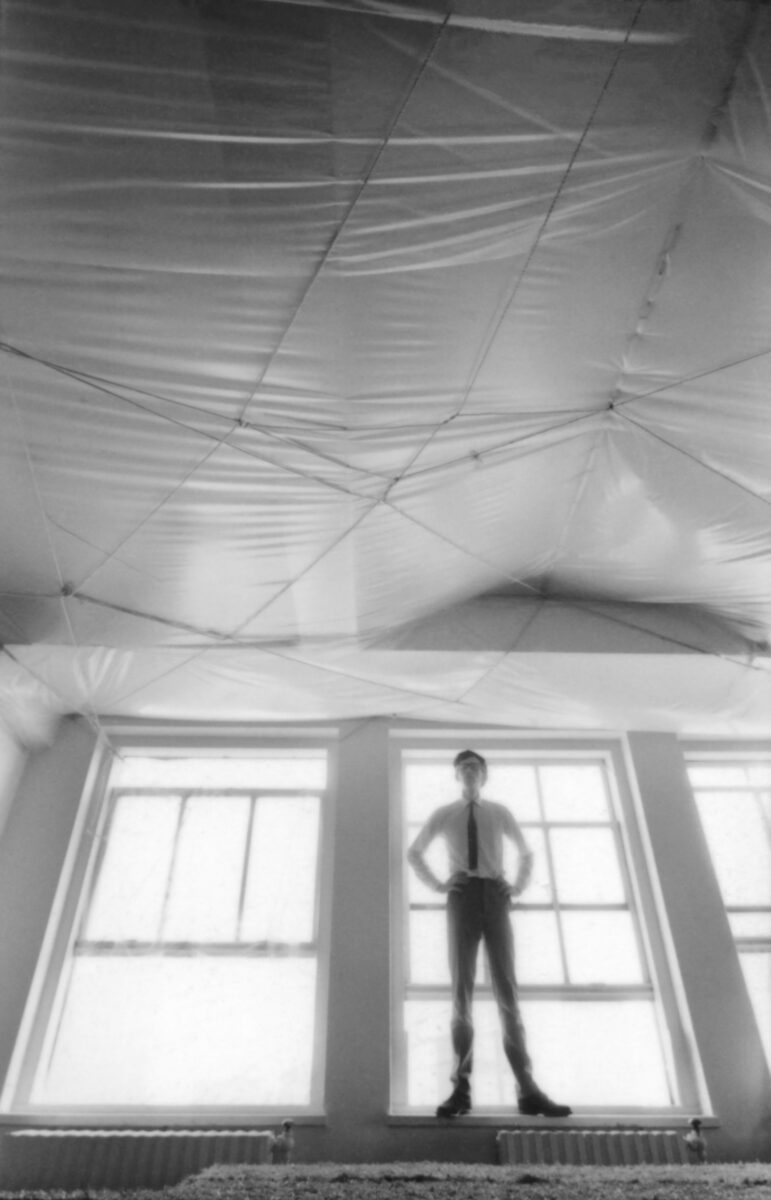
It is against this expanded field of influence that CHRISTO: AIR at Gagosian Grosvenor Hill should be understood. The exhibition does not simply revisit historical works; it returns to a set of unresolved propositions around material absence and spatial pressure. At its centre is Air Package on a Ceiling, first conceived in 1968 for the Institute of Contemporary Art in Philadelphia but never realised. The ICA commission itself emerged during a period when Christo and Jeanne-Claude were shifting from object-based wrapping toward architectural-scale propositions that tested institutional limits. Its non-realisation was not failure but delay – a suspension that now, decades later, reads as structurally integral to the work’s meaning. Installed for the first time here, the piece takes the form of a vast illuminated volume suspended within the gallery – 16 metres in length, 10 in width, hovering just above head height.
Its presence is not monumental in the conventional sense. It asserts itself through proximity rather than mass, through the discomfort of scale without solidity. Moving beneath it, the viewer becomes acutely aware of their own spatial position, as if the room has been subtly re-engineered around a substance that cannot be fully seen. The work does not depict air; it behaves as if air has acquired structure. It returns to Christo and Jeanne-Claude’s early experiments with wrapped polyethylene forms, where sealed volumes rendered emptiness legible. What once existed as portable gesture expands into architectural condition.
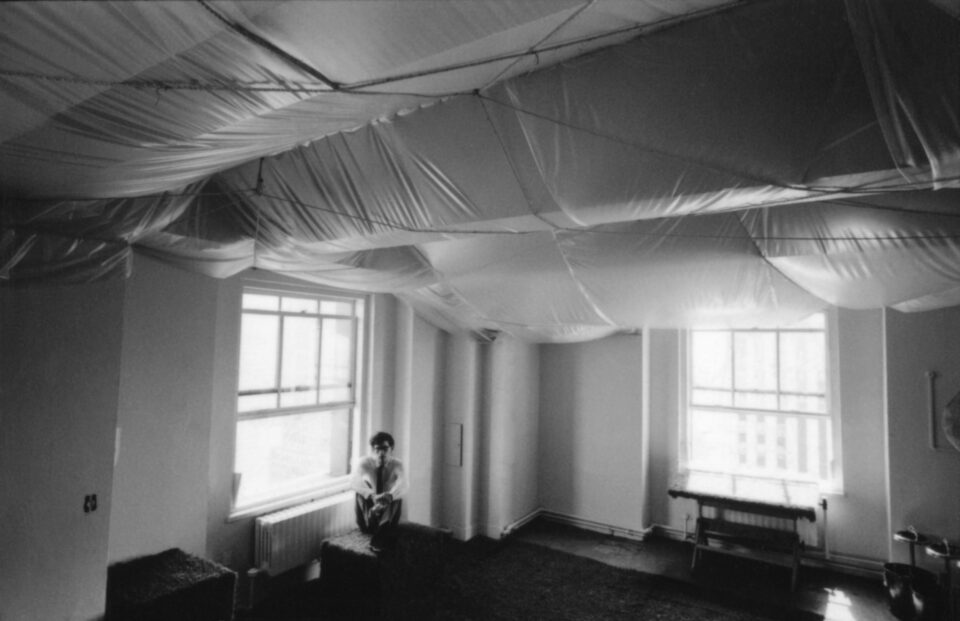
The exhibition is strengthened by the presence of archival material – drawings, collages and early models – which resist the role of background documentation and instead read as part of the work’s conceptual engine. These are not preparatory in a linear sense. They show a practice built through revision, negotiation and recalibration, where each iteration is a shift in how space might be held or released. The distance between drawing and realisation is a structural principle within the work itself. Even the act of planning becomes spatial thinking, where paper operates as a testing ground for volumetric possibility.
In a second gallery, Wrapped Automobile – Volvo, Model PV-544 (1981) offers a counterpoint at the scale of the intimate. Once belonging to a friend of the artists, the car was wrapped not to elevate it into monument but to interrupt its trajectory as object of use and sentiment. Covered and bound, it becomes unreadable as function while remaining insistently present as form. Unlike the environmental projects, which unfold across civic or natural space, here the intervention turns inward, toward memory and attachment. The act of wrapping does not preserve the object so much as place it in suspension between recognition and disappearance. What remains is a kind of perceptual hesitation, where familiarity is continually deferred.
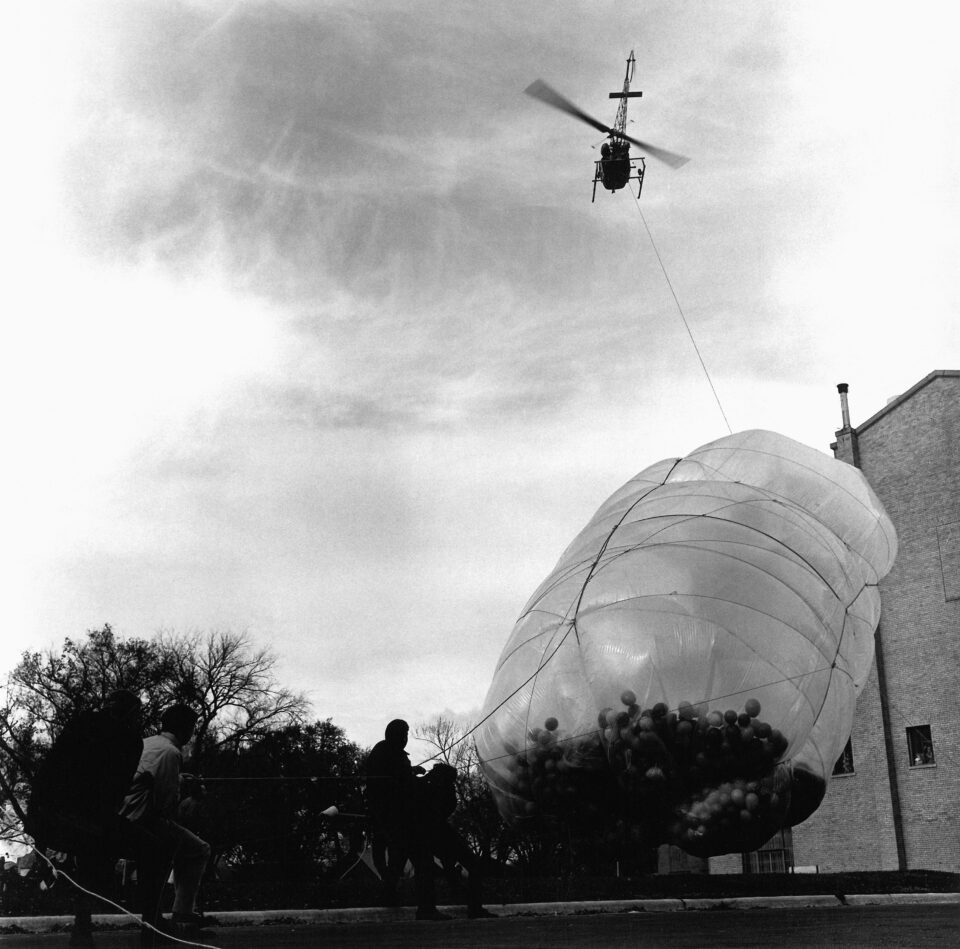
Coinciding with the exhibition, Gagosian’s Burlington Arcade presentation extends the project beyond the gallery into a different register of circulation. Works on paper and publications trace the infrastructural side of Christo and Jeanne-Claude’s practice – the drawings, negotiations and visual propositions that made large-scale interventions possible. These materials reveal that the work was never separate from its administrative or logistical dimensions; bureaucracy was not external to the art but part of its formal structure. The exhibition expands sideways, suggesting that Christo’s practice cannot be contained within installation alone but must be understood as a network of planning, persuasion and temporal deferral.
Seen together, these works clarify what Christo and Jeanne-Claude consistently refused to resolve: the tension between visibility and withdrawal. CHRISTO: AIR does not offer resolution to that tension. Instead, it sustains it, allowing air itself to operate as both subject and medium. The exhibition’s power lies in this refusal to stabilise meaning into objecthood. What is encountered is not a collection of works but a series of spatial conditions that briefly reorganise how attention behaves.
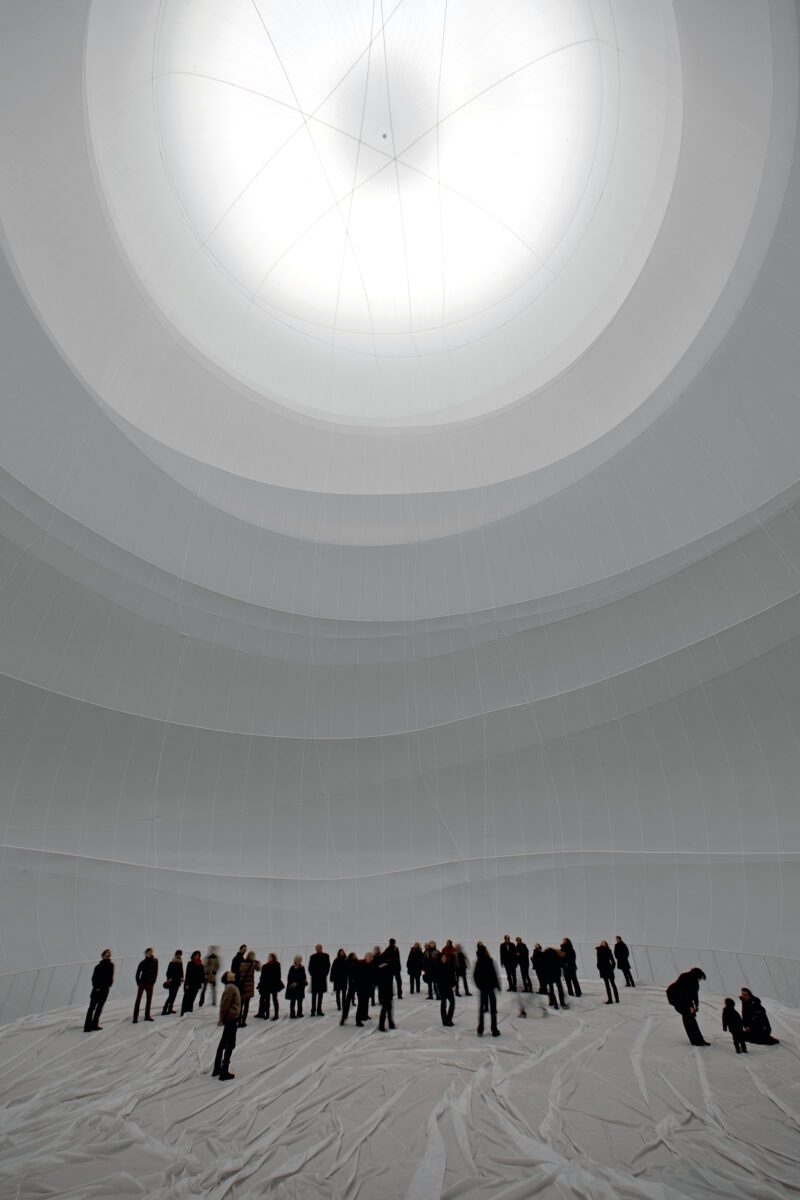
In a contemporary moment defined by image excess and immediate consumption, such slowness feels increasingly radical. Christo’s practice – in collaboration with Jeanne-Claude – asks for duration rather than attention, for movement rather than consumption. The work does not remain. It passes, and in passing it alters the terms under which space is understood. What persists is not form, but a recalibrated awareness of how fragile perception can be when it is no longer anchored to objects that stay still. In this sense, CHRISTO: AIR does not simply revisit a legacy – it reactivates it, allowing unresolved ideas about air, absence and spatial instability to circulate once again within the present tense of experience.
CHRISTO: AIR is at Gagosian Grosvenor Hill, London from 21 May – 21 August: gagosian.com
Words: Simon Cartwright
Image Credits:
1&6. CHRISTO AND JEANNE-CLAUDE, Big Air Package. Installation view: Gasometer Oberhausen, Germany, 2010-13 Artwork © Christo and Jeanne-Claude Foundation. Photo: Wolfgang Volz. Courtesy Christo and Jeanne-Claude Foundation and Gagosian.
2. CHRISTO, 5,600 Cubicmeter Package (first skin). Installation view: Kassel, 1968. Artwork © Christo and Jeanne-Claude Foundation. Photo: Klaus Baum. Courtesy Christo and Jeanne-Claude Foundation and Gagosian.
3. Christo with his “Wrapped Ceiling” (1965) in a Midtown Manhattan office building, New York, 1965. Artwork © Christo and Jeanne-Claude Foundation. Photo: Thomas Cugini. Courtesy Christo and Jeanne-Claude Foundation and Gagosian.
4. Christo with his “Wrapped Ceiling” (1965) in a Midtown Manhattan office building, New York, 1965. Artwork © Christo and Jeanne-Claude Foundation. Photo: Thomas Cugini. Courtesy Christo and Jeanne-Claude Foundation and Gagosian.
5. CHRISTO AND JEANNE-CLAUDE, 42,390 Cubic Feet Package. Installation view: Minneapolis, Minnesota, 1966. Artwork © Christo and Jeanne-Claude Foundation. Photo: Carroll T. Hartwell. Courtesy Christo and Jeanne-Claude Foundation and Gagosian
The post The Shape of the Invisible appeared first on Aesthetica Magazine.


