

Wallace Chan, the Hong Kong-based jeweller and sculptor, has taken over two of Venice’s most distinctive historic sites for a dual presentation timed to this year’s Venice Biennale, bringing his titanium sculptures into dialogue with the city’s heritage.
Chan is a jeweller known for contemporary pieces that blend traditional stones and settings with unique shapes and colours inspired by nature. Decades before he began working in jewellery, he practiced traditional stone carving in Hong Kong, using minerals like jade to carve classic Chinese subjects. He began working in jewellery in 2011 after a six-month hiatus he spent studying as a Buddhist monk. The dual presentation in Venice, which opened during the Venice Biennale’s vernissage week, blends Chan’s experience in sculpture, jewellery-making and spirituality.
At Palazzo Contarini del Bovolo, the 15th-century Venetian palazzo famed for its multi-storey spiral staircase, Chan presents Mythos, a site-specific installation of suspended sculptures that draws inspiration from Venetian Renaissance painting and classical mythology. Mounted along the building’s exterior loggia are four sculptures exploring cosmology through the lens of Tintoretto’s The Three Graces and Mercury (1576-77), which hangs in the Doge’s Palace. In Tintoretto’s allegorical composition, the Three Graces—symbols of beauty and joy—flank Mercury, the god of commerce and travel, celebrating Venice’s prosperity and maritime power.
The famous spiral staircase at Palazzo Contarini del Bovolo. Photo by Federico Sutera
Chan, who through an interpreter told The Art Newspaper he has been fascinated by the myth for much of his life, has reimagined the figures from their classical idealised nude depictions. Instead, the Three Graces appear as twisting, abstract faces, while Mercury is transformed into a celestial body. Chan says he wanted to show the spirit and beauty of the mind over the physical form. The distorted faces appear to dissolve through motion, suggesting an endless process of transformation. Chan compares this perpetual movement to the spiral staircase itself, making the shapes a metaphor for an unending pursuit.
The cosmological aspects of the installation also engage with the building’s lesser-known scientific importance—because of its commanding height above much of the Venetian skyline, the tower served as an astronomical observation point during the 19th century. The German astronomer Ernst Wilhelm Tempel made several discoveries from its rooftop, including a comet and a nebula.
Inside the palazzo, three sculptures are suspended in dialogue with another Tintoretto masterpiece, Paradise. Hovering beneath the painted vision of heaven, the works are accompanied by a soundscape featuring recordings from Chan’s Shanghai workshop, where the titanium forms are hammered and polished. The industrial sounds provide a striking counterpoint to the installation’s ethereal atmosphere. In a separate gallery, a large quartz crystal is paired with a poem written and recited by Chan. The recording is softly broadcast through discreet speakers, noticeable only when visitors pass directly beneath them.
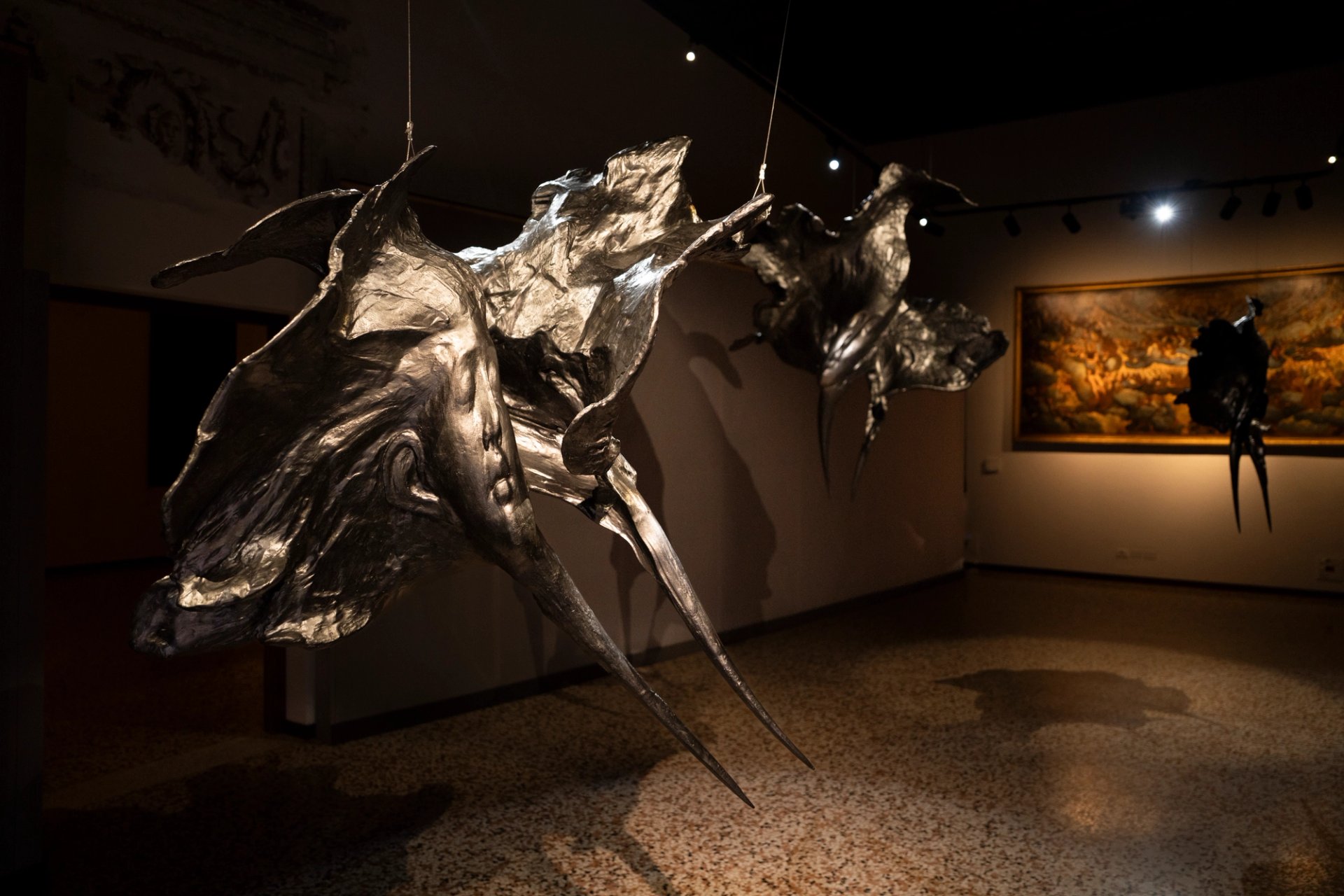
Chans’ sculptures and Tintoretto’s painting. Photo by Federico Sutera
The exhibition is curated by James Putnam, who for decades has placed contemporary art in dialogue with historical collections, long before it became a common curatorial practice. While serving as curator of Egyptian antiquities at the British Museum, he began installing contemporary works alongside objects from the permanent collection, a move he says allowed the two sides to “energise each other”.
For Putnam, such juxtapositions are ultimately about broadening visitors’ horizons. “It brings younger people into the museum and rejects (the idea of it) as a boring place that they’re taken to when they’re at school,” he says.
The pairing of Chan’s sculptures with Tintoretto’s paintings emerged organically, Putnam says. He recalls seeing three of the works in Chan’s Shanghai studio and immediately sensing their affinity with the Renaissance master’s compositions.
“I saw three sculptures that I thought fit in really well in his studio in Shanghai, and then could have a dialogue with the Tintoretto painting. It all tied in really nicely in a kind of accidental way,” he says. “But, you know with Mr Chan, of course, everything is connected.”
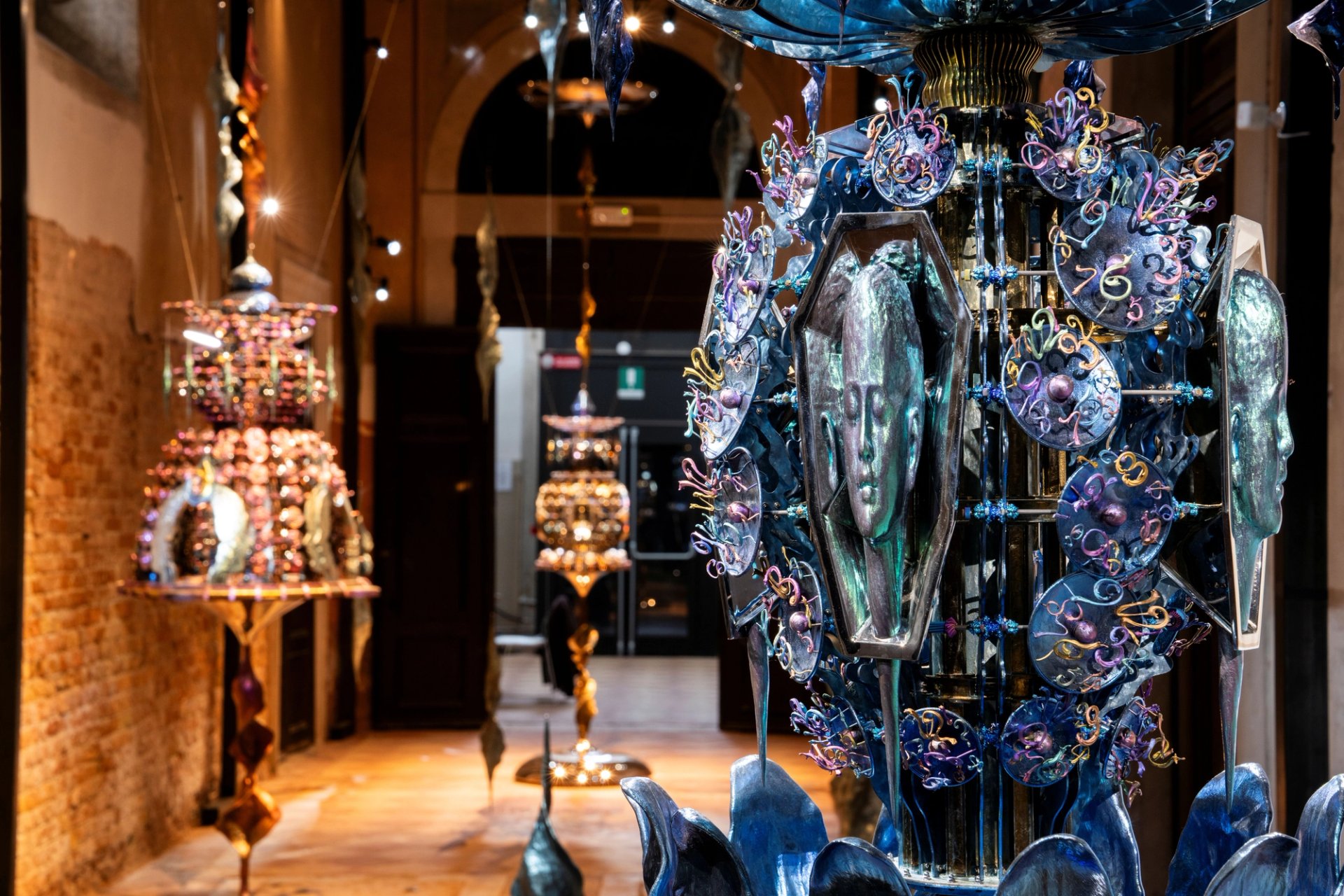
Chan’s sculptures suspended inside the Chapel of Santa Maria della Pietà. Photo by Federico Sutera
A 15-minute walk away, Chan’s second presentation, Vessels of Other Worlds, occupies the Chapel of Santa Maria della Pietà, the prominent 18th-century sanctuary on Venice’s waterfront in the Castello district. The church is perhaps equally familiar to Biennale visitors for its proximity to the Hotel Metropole, whose garden has long hosted vernissage parties during opening week.
Chan previously exhibited at the chapel during the 2024 Venice Biennale. This year, he returns with three suspended sculptures inspired by sacred oil vessels used in Catholic rituals. Their biomorphic forms also draw on the fantastical, surreal imagery of Hieronymus Bosch, combining liturgical references with otherworldly visuals. The historical and spiritual significance of the chapel informed the installation, Chan says. His goal was for the sculptures to exist in harmony with the space, extending the site’s historical resonance and the works’ meaning.
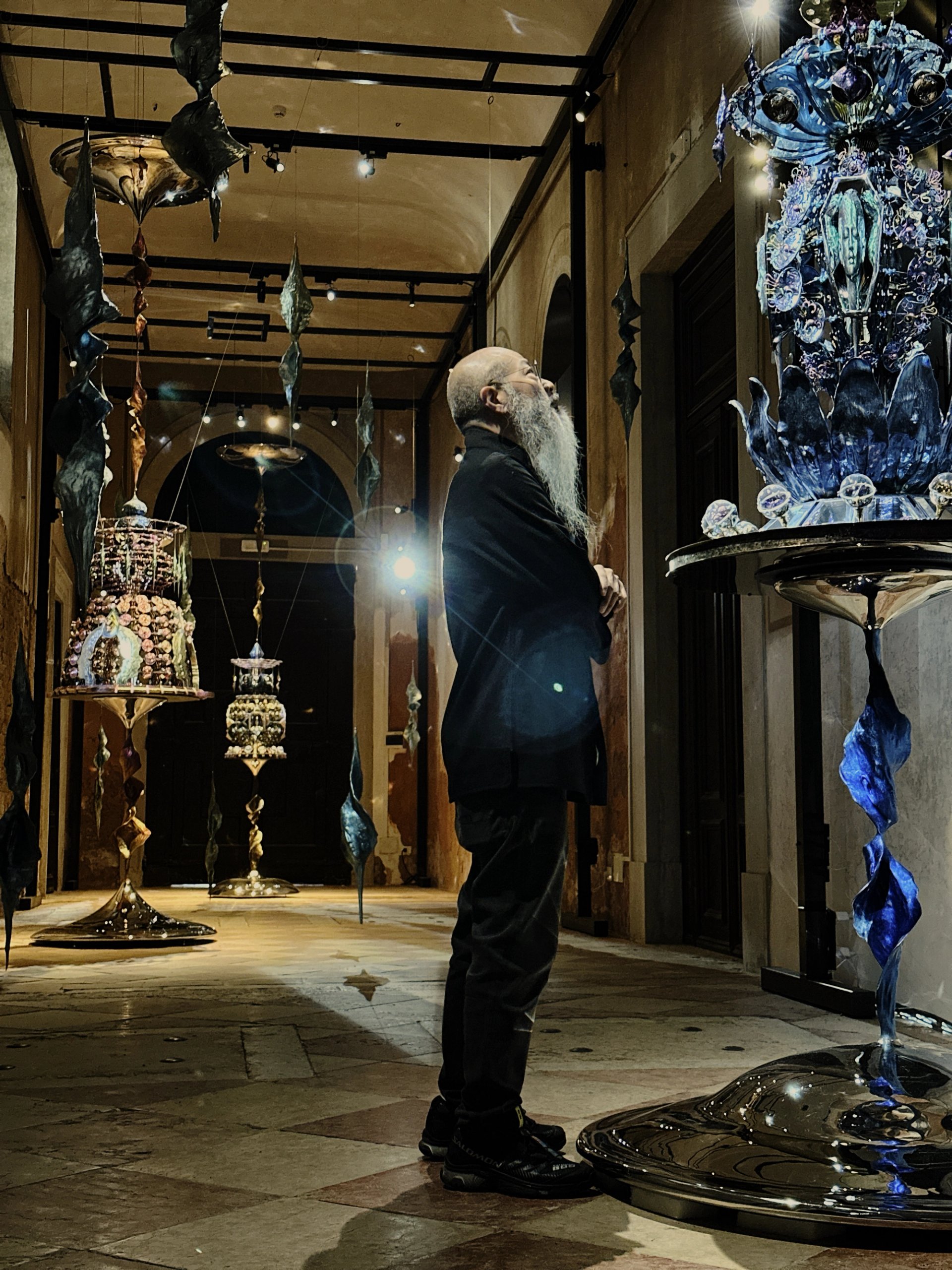
Wallace Chan. Photo by EM Studio
Each vessel stands approximately 1.5m high and offers a preview of a forthcoming exhibition at the Long Museum in Shanghai, opening on 18 July. There, the forms will be realised on a monumental scale as sculptures reaching up to 10m in height, large enough for visitors to enter and experience their revolving interiors. Together, the Venice presentations and the Shanghai project establish a dialogue between two cities, both shaped by maritime trade and cultural exchange. In both, water serves as a recurring conceptual thread, both as a reflective surface and as a force of transformation.
The sculptures are fashioned from titanium, a material prized for its exceptional strength-to-weight ratio. For Chan, the metal carries a symbolic dimension as well. He regards titanium as the material closest to eternity, lending permanence to works preoccupied with cosmology, history and the passage of time, all major themes of his presentations.
- Wallace Chan: Mythos, until 18 October, Scala Contarini del Bovolo, Venice
- Wallace Chan: Vessels of Other Worlds, until 18 October, Chapel of Santa Maria della Pietà, Venice
- Wallace Chan: Vessels of Other Worlds, 18 July-25 October, Long Museum, Shanghai


