

Light becomes form. Sound becomes space. These are the building blocks of Squidsoup, a pioneering collective whose immersive environments invite us to enter fields of data-driven light and spatialised sound. Since its formation in 1997, Squidsoup has redefined the potential of digital installation, creating multi-sensory experiences that blur boundaries between architecture, performance, sculpture and technology.
Their landmark work Submergence – a shimmering matrix of thousands of suspended LEDs – has toured the world, exhibited at major venues including Burning Man Festival, Canary Wharf and Vivid Sydney, as well as in front of thousands at Alexandra Palace and Sydney Opera House in collaboration with musician Four Tet. Their installations are transformed by the context they inhabit and the people who pass through them – whether in a Gothic cathedral or a desert nightscape.
Squidsoup stands alongside collectives like teamLab and artists such as James Turrell, Pipilotti Rist and Refik Anadol in shaping a new kind of visual language – one that is immersive, reactive and participatory. These works do not sit passively on walls. Instead, they breathe, shift and respond. The boundaries between art and tech have never been more blurred.
In a review of Electric Dreams: Art and Technology Before the Internet at London’s Tate Modern, Guardian art critic Laura Cumming described: “A poignant and often beautiful vision of human creativity engaging with machines.” This is the essence of Squidsoup: they are collaborating, ideating and playing with technology – bringing people closer together in the process. Here, Founder Anthony Rowe speaks in-depth ahead of Submergence coming to York Art Gallery.
A: How did Squidsoup begin? What was the first project?
AR: Squidsoup started in 1997. It’s been through a few iterations – morphing, growing and shrinking with the times. Its aim has always been to create meaningful, digitally mediated experiences that elicit an emotional response. Early projects used the media of the time: CD-ROMs, websites, screen and projection. Our first exhibited work, Altzero, was a series of navigable virtual sound environments that took various forms, including an interactive flythrough experience at the ICA (1999). The current incarnation of Squidsoup began when Submergence launched at Galleri ROM, Oslo, in 2013. As the piece gained momentum, a team coalesced around large-scale walkthrough LED installations and performances. This required a wide range of skills: art, design, technical production, coding, event production – and a particular mindset.
A: Where do you start with making one of these pieces?
AR: It’s a many-staged process. Most of our works originate from a single idea – an abstract or generic concept – that we then iterate and experiment with until something fully formed emerges. That can then be adapted into several distinct works. In some senses, the technology and hardware are the canvas, paint and brushes. The artwork is like a painting in space and time, underpinned by a conceptual framework.
A: Can you walk us though an example of this process?
AR: We developed an audiovisual unit called AudioWAVE, because we wanted a sound to match each individual point of light in our works, and we also wanted the audio to physically move. Our ears are just as adept as our eyes at detecting location, so stereo speakers just don’t cut it. We imagined voices moving through space. Eventually, this became Wave, commissioned for Salisbury Cathedral’s From Darkness to Light (2018–2019) show. It contained over 500 speakers and spawned choral melodies and harmonies. This spatialised sound system has given rise to other ideas and projects.

A: What’s the story behind Submergence? How is it constructed, and what is it like to experience the work in-situ?
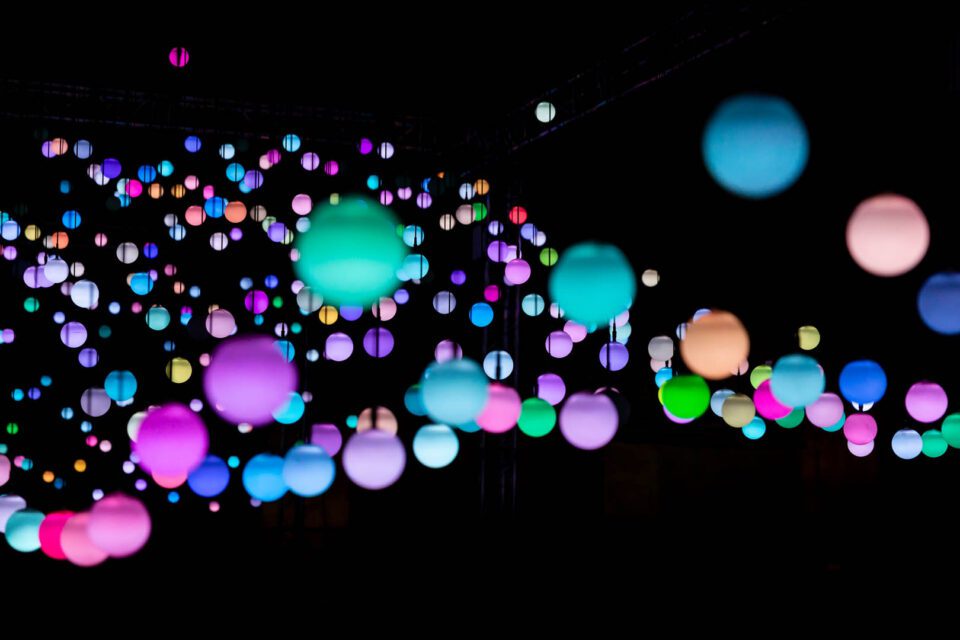
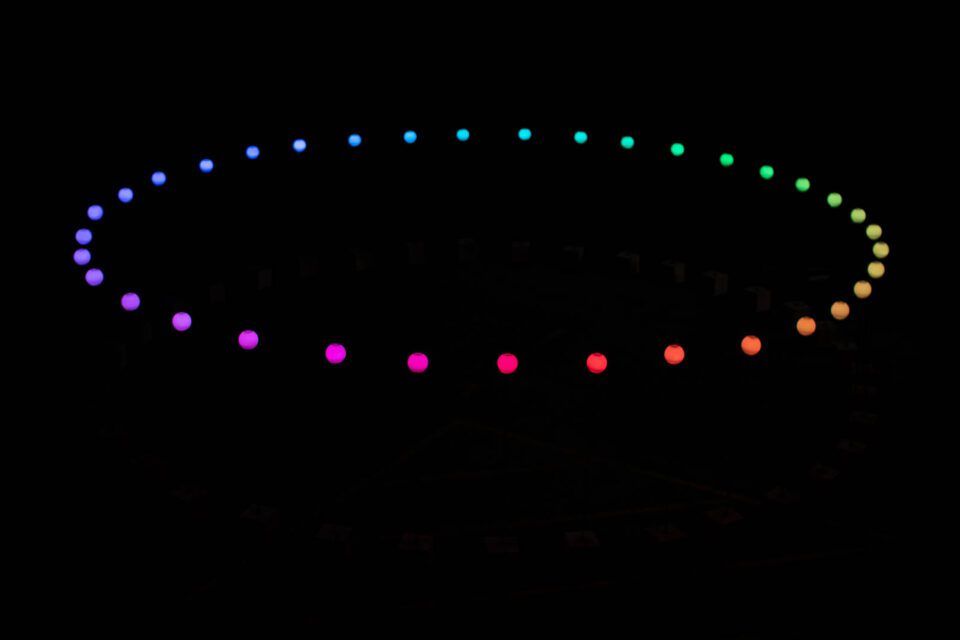
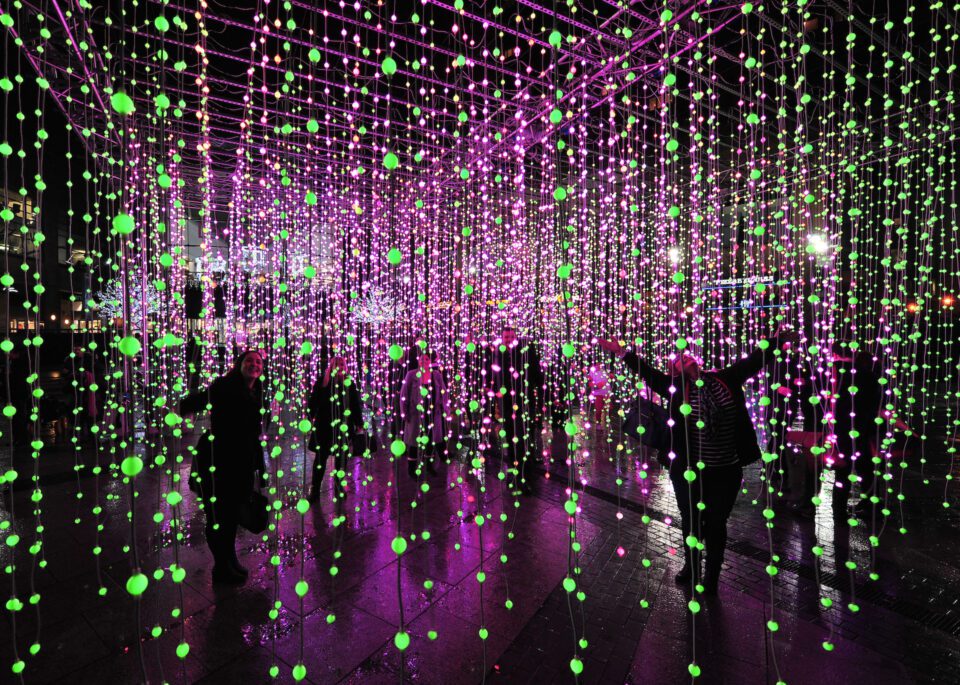
AR: I remember looking at a tiny 3 x 3 x 3 LED cube in about 2001 and thinking: that is a 3D medium! Imagine if it was huge, and I could walk through it. Imagine if, rather than blinking red, green and blue (which is all they could do at the time), the LEDs could be controlled like an exploded screen, in a shared space. It took several attempts and prototypes, as well as my PhD, to get it to work reliably (and not electrocute audiences). When we finally switched on the original version of Submergence, we knew it was interesting. It completely transformed the gallery. This was liquid architecture: virtual form in physical space. The piece comprises hundreds of suspended strands of individually controllable LED orbs. It uses standard technologies but in numbers that, at the time, raised a few eyebrows. It’s a walkthrough experience, so it fills up and dominates a space, but people can navigate it freely.
A: Submergence has been exhibited over 100 times on six continents. Which locations or venues stand out to you?
AR: There are so many amazing memories. The first one was in Oslo, at Galleri ROM in 2013. Then we put Submergence on floating pontoons for Leeds Light Night and took it to Secret Garden Party. The first time in a cathedral was Salisbury in 2015. It’s been shown in several weird places: on a bridge almost half a mile above the river in Cleveland, Ohio; on an armoured car in the middle of the desert for Burning Man; and suspended from a giant geodesic dome in Athens. There’s also the enormity and joy of performing live events with Four Tet, particularly at Alexandra Palace. But it’s the people we’ve met, the amazing cultures and the friendships from across those six continents, that we cherish most of all.
A: What kind of reactions does it receive, and why is that?
AR: In terms of visitor experience, I think the piece works at several levels, which is possibly why people like it. From a distance it is aesthetically pleasing – a 3D moving chimaeric light work, almost like a massive hologram, with digitally generated forms and textures moving through it. Once inside, the experience transforms into something more visceral, tactile and shared: entrancing, engaging and immersive. Finally, and this applies to much of our work, its dynamic but abstract nature means that it is open to individual interpretation. People draw commonalities in its atmospheres and presence, but the exact meaning seems to vary from person to person.
A: You’ve exhibited on some of the biggest stages worldwide. How does the context – cultural, architectural, or geographic – affect how you adapt or present a project?
AR: Our projects are nearly all modular, consisting of numerous – hundreds, thousands – of identical units that work together to create large-scale choreographed productions. They can be assembled in response to a particular space. During the planning phase, we will take the architectural and spatial features, people flow, anticipated audience sizes and type of event into account. Aside from the obvious – ambient sound levels, entry and exit points and so on – we also consider why people are there. An urban intervention where people are passing through a transitional space would need a very different approach to a live music event, or installation in an art gallery. Our work is usually quite abstract, inviting dialogue and asking people to extract their own meaning and emotional responses. These discussions and interpretations vary across the world, and from one person to another.
A: What are your thoughts on unconventional arts spaces?
AR: The gallery has several advantages as a venue for exhibition, and we love showing our work in these spaces. But it also has limitations. A gallery is a highly controlled place – effectively a pilgrimage site, where people are already mentally prepared and receptive. It is controlled and monitored; works are unlikely to get damaged or be overcome by ambient noise, uncontrolled crowds or vandalism. However, it caters primarily to a specific demographic, and you are often restricted in what you can do – for example, whether smoke and haze are allowed. We want as many people from as many different backgrounds as possible to see our work.
A: How do you achieve that? What methods do you use?
AR: We deliberately make our projects as robust and as element-proof as possible, so we can show them outdoors and in a wide range of places. Each time we put a piece up it is unique; it is in dialogue with its surroundings, is porous and mixes with its environment and the people in it, creating a different result each time. We show at winter light festivals, around stately homes or botanical gardens where it forms an interesting contrast to the organic forms of trees and plants; in cathedrals and building sites, on water and in deserts. Each instance brings its own surprises, synergies and relationships.
A: What does the immersive art space look like today?
AR: Winter light festivals and indoor “immersive experiences” are both interesting developments; we actively engage with both. We’ve done solo indoor shows in Bristol and London that have been well attended and well received. We have learnt a lot from them and are currently planning to take the exhibition on tour. Competition is increasing though, and not all “immersive” events are of the same quality. As these experiences become more familiar, audiences will demand ever more wow factor, requiring higher budgets and investments.
A: How do you, as artists, navigate a changing world?
AR: We strongly believe it’s important to not get overly stuck on the technology – innovation and investment are only one part of the picture. As artists, we need to remember that the art is more than the equipment used to build it, and audiences are amenable to a finely executed delicate idea as well as a huge pyrotechnic extravaganza. We are using the opportunities of showing multiple works concurrently to take visitors on a journey, to be transported to somewhere different and give them the chance to breathe and see the world from a slightly different perspective. We are trying not to get involved in a technological arms race – although our work is dependent on these tools, it is not about the hardware, and nor is it foregrounded; we would like audiences to look beyond all of that, and see the emotional content beneath.
Future Tense York Art Gallery 19 September – 25 January
Words: Anna Müller
Image credits:
1. Submergence, (2023). City of Light Jyvälskylä, Finland. Image: Michelle Leck / Squidsoup
2. Submergence, (2023). City of Light Jyvälskylä, Finland. Image: Michelle Leck / Squidsoup.
3. Submergence, (2023). City of Light Jyvälskylä, Finland. Image: Michelle Leck / Squidsoup
4. Wave, Salisbury Cathedral, (2018). Image: Rikard Österlund.
5. Circular Echoes, (2022). Image: Squidsoup
6. Aeolian Light, (2014) by Squidsoup. Commissioned by Quays Culture. Photo: Joel Chester Fildes.
The post Spatial Immersion appeared first on Aesthetica Magazine.


