

The remains of a 16th-century hospital and its adjacent church have been found in the Peruvian capital’s historic district. The Municipal Programme for the Recovery of the Historic Centre of Lima (Prolima) announced the discovery of part of the Hospital and Church of the Holy Spirit in the garden of the sanctuary of Santa Rosa de Lima, the first Catholic saint born in the Americas.
“While performing maintenance on one of the exterior gardens of the sanctuary, we decided to conduct an archaeological search, because we knew that the Church and Hospital of the Holy Spirit had once stood there—and we found them!” Luis Martín Bogdanovich Mendoza, Prolima’s general manager, tells The Art Newspaper. “The very existence of the church has been the greatest discovery for the study of art history.”
By the mid-19th century, the temple had little religious activity and was subsequently deconsecrated. Its altarpieces were taken to the Church of the Holy Christ of Wonders, also in Lima’s historic district. “We may later be able to create drawings of what the Church of the Holy Spirit’s interior might have looked like,” Bogdanovich says.
In 1573, the Greek merchant Miguel de Acosta founded the hospital to care for seafarers (mareantes) and their families. The institution began operating in 1581, and each room had a small altar. The sick could hear mass from their beds every Sunday and on holy days. There was also a chapel with an altar, as hospitals in the colonial era housed their own churches.
The old cobblestone floor at the hospital entrance Courtesy Prolima
“The hospital had two sources of funding. Ships leaving from the port of El Callao paid a fee based on their tonnage and route, and the other source came from the sailors’ salaries. I believe they were charged 5%. It was a kind of private health insurance,” the archaeologist Diego Pariona Espinoza said in recent a talk hosted by Prolima.
During the excavations, Prolima archaeologists found a cobblestone floor with a herringbone pattern at the hospital entrance, brick floors and church walls built with river stones. Under the church floor, burials in niches containing multiple people were discovered. Sailors who had died in the hospital could be buried there without paying funeral service fees.
Other discoveries include 18th-century Valencian tiles. “Valencia was a major exporter of tiles and textiles during the Spanish colonial period,” Bogdanovich says. “Many tiles from there arrived in Lima.”
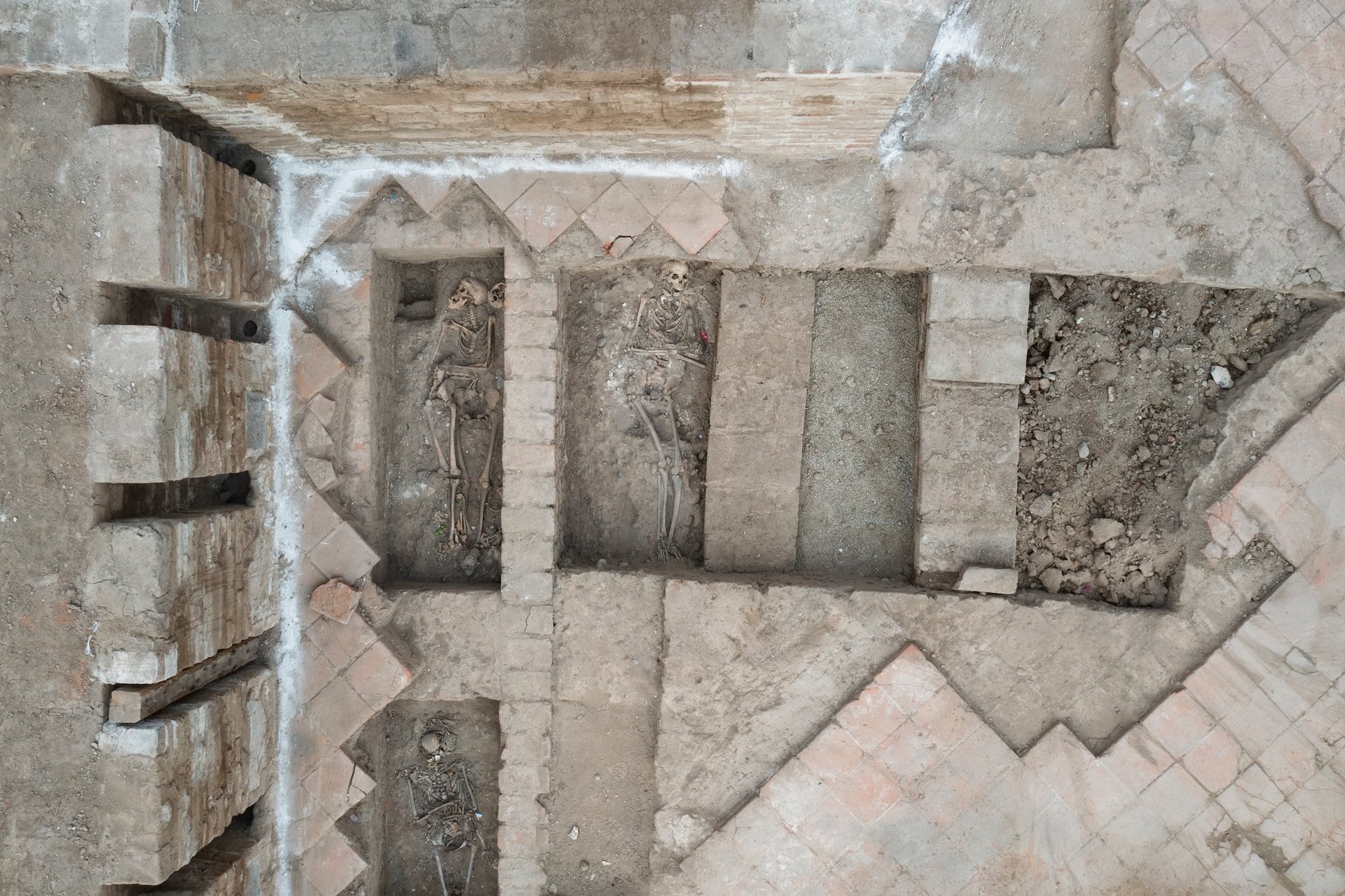
Sailors who had died in the hospital could be buried there without paying funeral service fees Courtesy Prolima
The site, which suffered from earthquakes over the centuries, was linked to the sea through healthcare and education. It was used by different institutions both during the colonial era and after Peru’s independence from Spain in 1821. In 1817, the Royal Nautical Academy of Lima began operating in the hospital building, followed by the Central Naval School. Other institutions, such as the School of Engineers, used the space until the 1940s, when it was demolished.
The hospital was located on Holy Spirit Street, now called Jirón Callao, in Lima’s centre. The city, founded in 1535 by the Spanish conquistador Francisco Pizarro, was once the most important in South America. As the capital of the Viceroyalty of Peru during the colonial era, it was a political, administrative, religious and economic centre known as the City of Kings. In 1991, Unesco declared its historic centre a World Heritage Site.
The public will be able to visit the archaeological findings starting 24 August, the anniversary of the death of Santa Rosa, the city’s patron saint. “Santa Rosa is said to have healed the sick, and the Hospital of the Holy Spirit was next to her house,” Bogdanovich says. Santa Rosa was a member of the Third Order of Saint Dominic in Lima. She died in 1617 at age 31.
The human remains found beneath the church and hospital will not be on view, Bogdanovich says. “Instead, we will exhibit a museum-style display with resin bones so that visitors can get an idea of the burials.”


