

A 1,300-year-old ship of legend, last seen as a ghostly scar in the yellow clay of a Suffolk hillside, is rising again in a long narrow shed on the opposite bank of the River Deben. Giant oak trunks lie outside on the Woodbridge quay, waiting to be split into planks with wedges, hammers and axes. In the Longshed, free to visitors every working day, the whole 90ft length of the ship now fills the space, ringing with the noise of axes and knives shaping the long curving planks of the clinker hull, and the intoxicating smell of pitch, beeswax, linseed oil and green oak. In May 2027, time and tide permitting, the ship should slide down the slip and, powered by 40 volunteer rowers, take to the water again. Meanwhile, the project is raising and spending around £250,000 a year.
Men at work on one of the giant oak trunks being used to reconstruct the 90ft-long ship, which rotted in the ground near the River Deben © Andy Mills; Applied Risk Management Ltd
At some point in the early seventh century, the original Sutton Hoo ship, an old vessel that had been repaired in its working life, was dragged up from the river and laid into a trench in the soil. In the centre of the hull a wooden burial chamber held a body surrounded by some of the most beautiful Anglo-Saxon treasures ever found. It was famously rediscovered just before the Second World War, when the landowner Edith Pretty believed she saw ghostly figures around 18 shallow mounds in her fields. As romanticised in the recent film The Dig, she employed Basil Brown, a local self-educated archaeologist, who excavated the vessel with great care in 1938, finding remains of a cremation and what he recognised as ship rivets. The following year, assisted by a gardener and a game keeper, in the neighbouring mound he found the undisturbed remains of the great ship; Pretty gave sherry parties for guests to watch the work.
The timbers had decayed along with the body, but the entire outline was traced by impressions in the soil studded with the scars of hundreds of iron rivets. Pretty gave all the finds to the British Museum in London, where the marvellous helmet with garnet eyebrows, the massive gold buckle writhing with interlaced decoration, the gold and garnet shoulder clasps and jewelled sword fittings, as well as the silver bowls that came 1,500 miles from Byzantium, remain among its most spectacular and popular displays.
In 1939, three days before war was declared, Brown’s excavation and the careful recording by the Science Museum stopped; the ship was filled with brushwood and reburied. The reconstruction is based on Brown’s own meticulous drawings, the museum’s records, and hundreds of photographs taken by two local women—though one of many conundrums is reconstructing the ship as it originally sailed, not as shown in 1939 after it had slumped and tilted in the soil.
Major research project
The Sutton Hoo Ship’s Company was established in 2016 to create an authentic replica using traditional materials and techniques. It was envisioned not as a tourist attraction but as a giant research project to test theories of Anglo-Saxon ship building, and the status of the Anglo-Saxons as a sea-going power.
Many among the 170 volunteers have been involved with Sutton Hoo for most of their working lives, including the chair Martin Carver, an emeritus professor of archaeology at the University of York, who has excavated and written extensively about the site—which he was instrumental in getting into National Trust ownership in 1999. Angela Care Evans, a trustee, had excavated with the British Museum at Sutton Hoo in 1965-70, and with the Sutton Hoo Research Trust for decades from the 1980s; all the other finds from the burial have been reconstructed, she says, except the greatest, the ship itself.
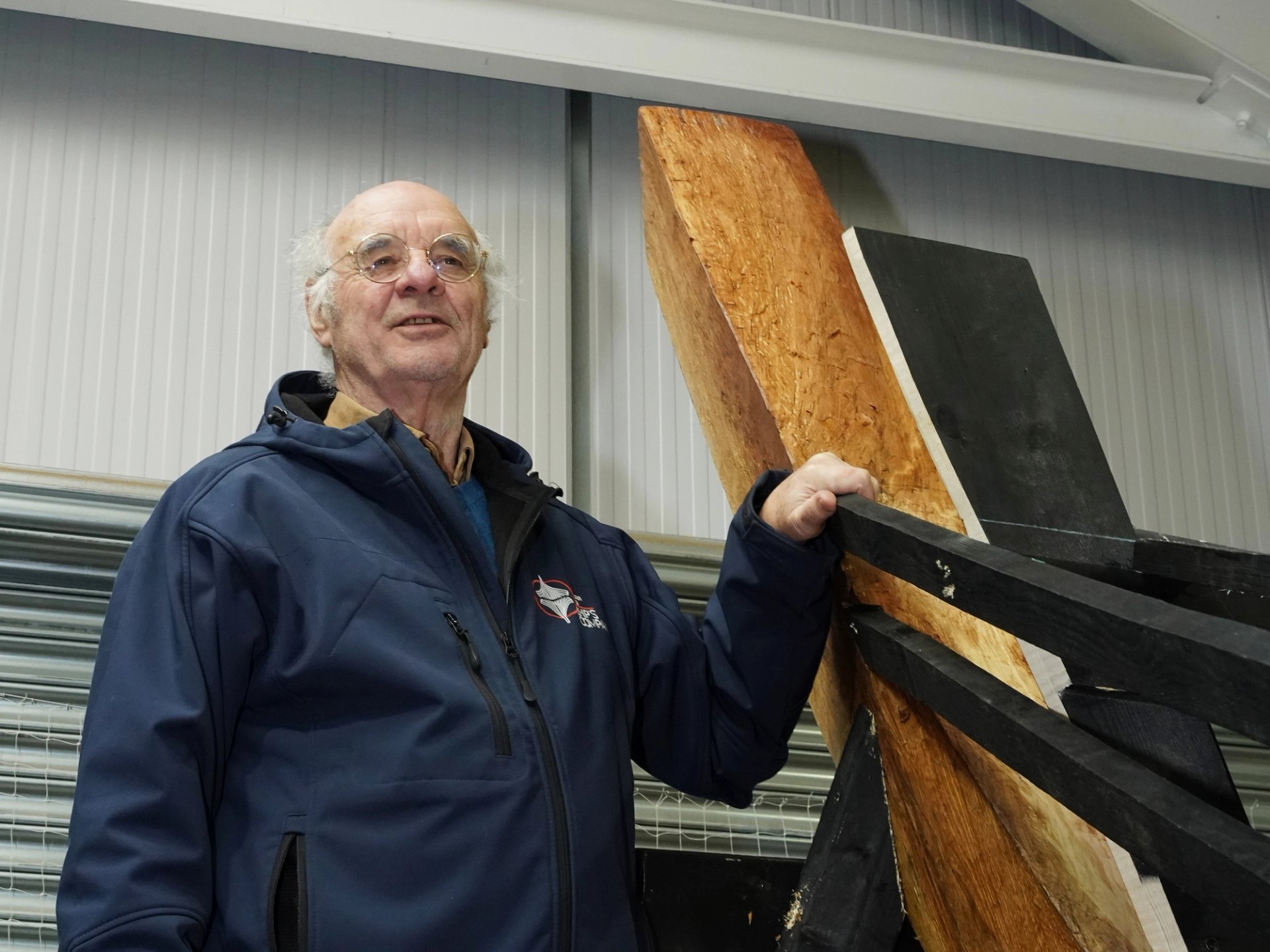
Martin Carver, chair of the Sutton Hoo Ship’s Company, has excavated and written extensively about the site © Andy Mills; Applied Risk Management Ltd
Many questions remain were passionately debated in a long study day in the ship hall in May. Was the steering done by oar or rudder (no trace survived)? How many oars were there and what wood were they made of? Was it decorated with beautiful carvings and brightly painted? Was it really King Raedwald who was buried among such heaped treasures? Most passionately argued of all, and still to be decided in trials, is whether the ship was just rowed, or carried a sail, and so could travel further and faster.
After a permanent home is found for the Sutton Hoo ship—the team has been told to vacate the Longshed in 2028—attention will turn to another contemporary Anglo-Saxon ship under a mound, the Snape Ship discovered in 1827 and excavated in 1862. Nothing remains above ground, though some finds including rivets and a glass beaker are on display at nearby Aldeburgh, while the British Museum has a splendid gold ring. “It would be a fine thing to rebuild the Snape Ship,” Carver says.


