The Argentine artist Lola Mora (1866-1936), one of Latin America’s first female public sculptors, is getting long overdue recognition with the newly opened Lola Mora Cultural Center in San Salvador de Jujuy, in northwest Argentina.
The 15-hectare site, located at the foot of the Andes Mountains, is also the final project designed by the renowned Argentine architect César Pelli (1926–2019). The centre features six monumental sculptures by Mora, relocated from various locations across the province of Jujuy. Through glass-filled spaces, the works interact with the surrounding subtropical Yungas forest and landscaped gardens.
Lola Mora (born Dolores Candelaria Mora Vega) was a pioneering artist, urbanist and mining entrepreneur years ahead of her time. In a rare feat for a woman of her era, she travelled to Rome at age 30 with government funding to further her training. Under the guidance of the Italian sculptor Giulio Monteverde, she shifted from painting to sculpture, then a male-dominated medium, and ran a successful atelier.
Mora received commissions from the Argentine government for monumental sculptures, often depicting civic life and patriotic figures. Mora also achieved international recognition: one of her marble self-portraits won a gold medal at the 1900 Paris Exposition. But Mora’s public works constantly faced scrutiny, and she died in poverty and obscurity.
Inside the Lola Mora Cultural Center Photo: Jason O’Rear for Pelli Clarke & Partners
“Lola created, fought and challenged the conventions of a society that often failed to recognise her talent,” Victoria Martínez Fascio, the director of the Lola Mora Cultural Center, tells The Art Newspaper. Her best-known work, Buenos Aires’s marble Nereids Fountain (1903), was relocated amid controversy over its nude figures.
The six allegorical works on display at Mora’s new museum had a similar fate. Commissioned for Buenos Aires’s Palace of the Argentine National Congress in 1906, they were relocated 15 years later to various locations in Jujuy. Following extensive restoration amid damage and vandalism, Mora’s works—The Lions, Liberty, Progress, Work, Peace and Justice—characterised by an academic portrayal of the human figure, are now displayed together for the first time in more than 100 years.
The Lola Mora Cultural Center was Pelli’s final project. It is the first museum in South America designed by Pelli Clarke & Partners, the US-based firm he founded, which is known for high-rises like the Petronas Towers in Kuala Lumpur, Malaysia. The 3,000 sq. m, single-storey design is inspired by a sculptor’s chisel and adapted to conservation concerns.
“Pelli sought to respect the sculptures’ origins and celebrate the landscape, which led him to initially envision the centre as a largely outdoor space,” says Rafael Pelli, César’s son and a partner at Pelli Clarke & Partners. “As the sculptures’ conservation requirements became apparent, the design evolved into a light-filled structure that treads lightly on its site and celebrates the landscape around it.”
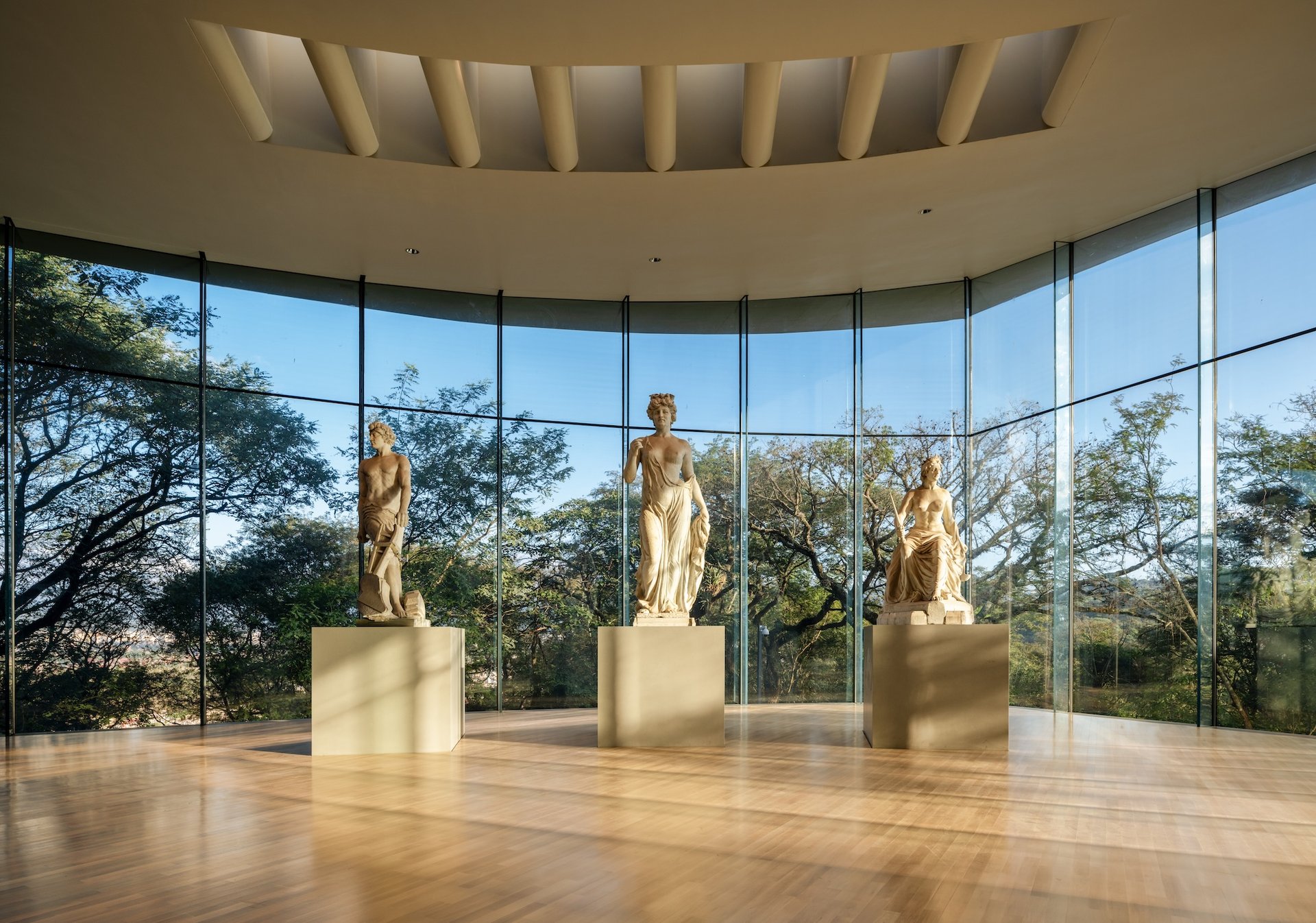
Inside the Lola Mora Cultural Center Photo: Jason O’Rear for Pelli Clarke & Partners
The centre includes a restaurant, library and studio that will host visiting artists as well as temporary exhibitions in dialogue with Mora’s work.
Funded by the provincial government, the centre is intended to become a community hub, adding to Jujuy’s nine existing museums. Public well-being is another priority. “We believe in the transformative power of art and in its capacity to generate well-being, reflection and a deeper connection with the territory,” Martínez says.
The project has achieved LEED Gold certification for its sustainable design, boasting water-management systems and zero-energy consumption. The building’s positioning also minimises disruption to existing vegetation at the site, with trees relocated where necessary. “Sustainability was a priority for the client, and a key design driver,” Rafael Pelli says. “We took great care to make the project sustainable in its sourcing, design and operation.”
At its heart, the Lola Mora Cultural Center aims to bring greater visibility to Mora’s legacy and connection to Jujuy, where she worked on urban projects between 1924 and 1926. “More than remembering an extraordinary artist, our purpose is to help her take the place she deserves in Argentine art history and to project her figure internationally,” Martínez says.