

A fountain by the German sculptor Georg Kolbe, previously held in the collection of the artist’s museum, sold for a record-breaking €4m (with fees) at auction on Thursday night (4 June). The sale follows the work’s deaccession and subsequent restitution to the descendants of its commissioner, 85 years after it was looted by the Nazis.
In 2024, Berlin’s Georg Kolbe Museum initiated a research project into the Tänzerinnen-Brunnen (Dancer’s Fountain) that had been in its collection since the 1970s. Through the project, it contacted the descendants of the work’s first owner Heinrich Stahl, a prominent member of Berlin’s Jewish community who was murdered in the Theresienstadt ghetto.
Commissioned in 1922, the fountain features a bronze of a white female dancer, held up by three crouching Somali men in limestone. The depictions of the classical dancer and Black colonial subjects were well-established within Kolbe’s practice, with the latter revealing the artist’s “reliance on colonial representational conventions and the associated hierarchies”, according to the museum’s website.
Detail of the fountain, showing limestone sculptures of three Somali men at its base
“The museum and the foundation are aware that restitution does not undo the inexcusable injustice suffered, but it is a natural gesture of acknowledging the wrongdoing towards the descendants,” reads a museum statement.
“Collections are not fixed heritage,” Kathleen Reinhardt, the director of the museum, tells The Art Newspaper, “but living matter which are ready to be constantly reinterpreted anew, and shared widely”.
The fountain was the star lot of the first evening of Villa Grisebach’s summer auctions in Berlin, which continues tonight. It smashed the previous record for a Kolbe statue of €1.4m, also achieved at Grisebach last year. Other standout lots included Emil Nolde’s Astern (1919), which reached its upper estimate of €800,000, and two early prints by Edvard Munch, that exceeded their upper estimates at €350,000 and €145,000.
“I’m delighted that we have been entrusted by the descendants of Heinrich Stahl to auction the restituted work here in Berlin, which is of course a great honour for us,” said Villa Grisebach’s managing director Daniel von Schacky before opening the bidding.
Heinrich and Jenny Stahl commissioned the fountain for their villa in Berlin’s exclusive western suburbs. An insurance broker and art collector, Heinrich persisted in Berlin to use his contacts to help others emigrate from the Third Reich. His own attempt to leave Germany was later blocked by the Gestapo. In a common form of cultural looting, he was forced to sell his entire estate under value, including the fountain. The buyer was the Bulgarian consul Theodor Dimanow, who took the bronze dancer with him when he fled to Francoist Spain after the Second World War.
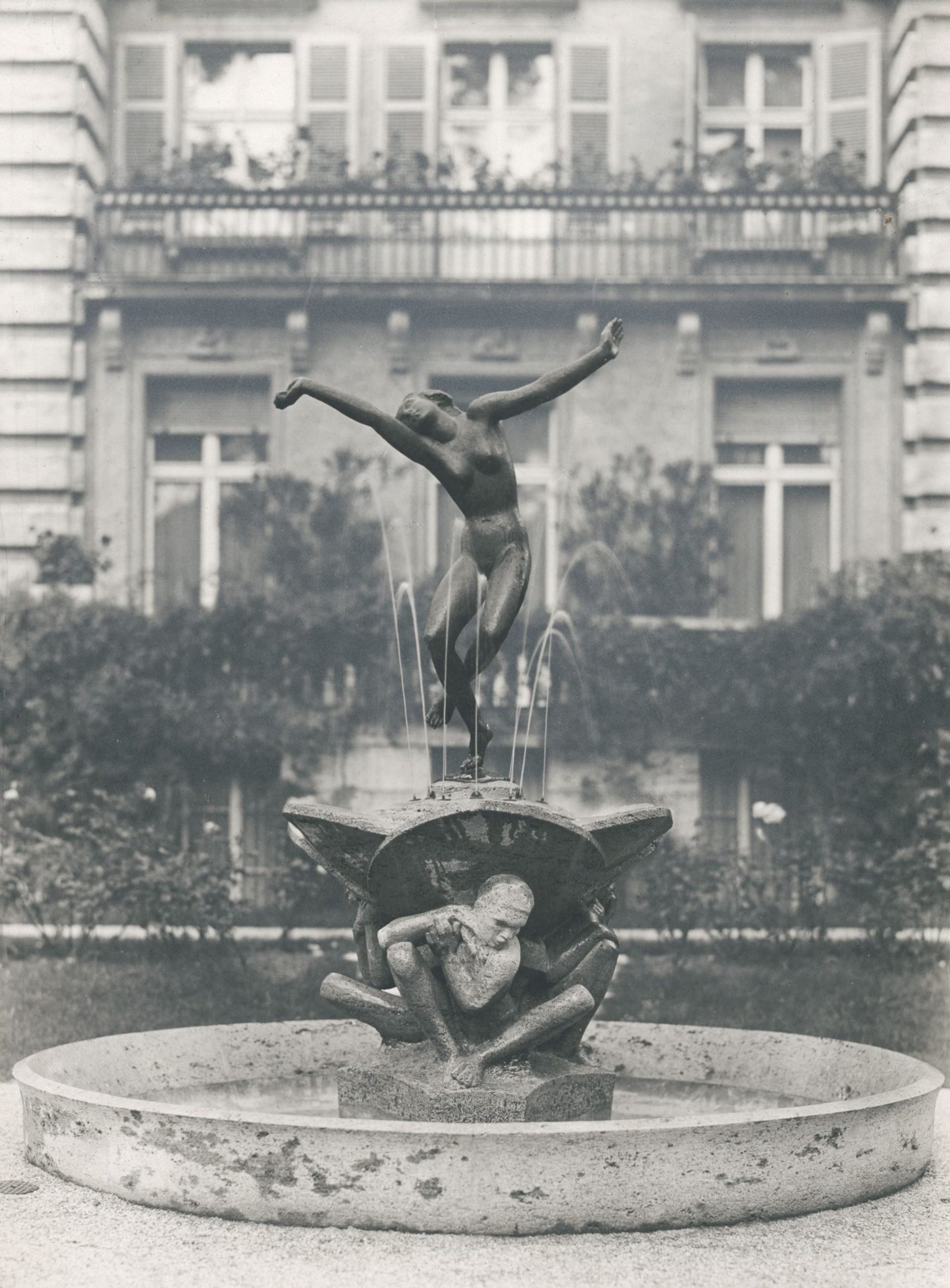
This shows the fountain installed at Heinrich Stahl’s villa
The Stahls were deported to Theresienstadt in 1942, where Heinrich died of pneumonia after only a few months. Jenny survived and made it to the United States, where she was reunited with their son Bruno, who fled Germany in the late 1930s.
In the 1970s, the Georg Kolbe Museum became aware of the fountain’s existence at Dimanow’s former home in Madrid. After placing advertisements in Berlin newspapers, they also found the base in a retirement home. Both parts were purchased with funds from the German Class Lottery Foundation, enabling the full fountain to be installed in the museum’s gardens in October 1979.
In 2001, a legal representative of the Stahl family contacted the museum, waiving their right to restitution and requesting that a commemorative plaque be installed alongside the fountain. “I was startled to not find this plaque,” said Reinhardt at an event about the fountain’s history in July last year. “Under the impression that all legal matters were resolved, we started to think about ways to make present the entangled histories culminating in this hyperobject.”
During the course of the museum’s research project on the fountain, it became clear that the legal representative’s decision did not reflect that of the entire Stahl family. The museum was eventually able to make contact with the rest of the family and came to an amicable agreement on restitution in February, in line with the 1998 Washington Principles for Nazi-confiscated art.
As part of the research project, and to engage with the sculpture’s depictions of racialised Black subjects, the museum has commissioned a video work of a Black dancer by the Afro-Jewish artist David Hartt to play in the garden, where the fountain once stood.


