

The Taiwanese artist Lee Mingwei’s Guernica in Sand (2006-present) installation, which is currently on show at M+ museum in Hong Kong (running until 13 July), feels more timely than ever against the backdrop of ongoing global conflicts in Ukraine and the Middle East.
The vast sand painting evokes Picasso’s searing 1937 masterpiece Guernica, which depicts the horrors of the Spanish Civil War. “In Guernica in Sand, I used Picasso’s Guernica as the departure point for a different view of the damage done when human beings are victimised,” says Mingwei in a statement provided to The Art Newspaper by Galerie Perrotin, his gallerist.
Lee Mingwei with his work Image courtesy of Taipei Fine Arts Museum
“Instead of simply being critical of what happened in the Basque town of Guernica in 1937, I wanted to use the concept of impermanence as a lens for focusing on such violent events in terms of the ongoing phenomena of destruction and creation,” he says. The work, which took almost 1,000 hours to create at M+, was made by a team of ten people at the museum. The piece references the Indigenous and religious traditions of sand paintings found around the world, including mandala designs. “I’m using the Tibetan method of creating a mandala to [build] a great masterpiece of the West, so I’m creating a conversation and an homage from an East Asian point of view [in regards to] a great master of the West [Picasso],” says the artist.
His Guernica piece is running in tandem with The Hong Kong Jockey Club Series: Picasso for Asia—A Conversation, the first major Picasso exhibition in Hong Kong in more than a decade. The show will include more than 60 of Picasso’s works, dating from the late 1890s to the early 1970s, alongside more than 80 pieces by Asian and Asian-diasporic artists drawn from the M+ collection, including Isamu Noguchi and Gu Dexin. “My project is not part of that show, but it’s in conversation,” Mingwei says.
A live performance is scheduled to take place on 28 June in which visitors will be invited to walk on Mingwei’s sand painting. “Four performers [including Mingwei] will then gently sweep the sand in spontaneous movements that simultaneously destroy and recreate the image anew,” says a museum statement.
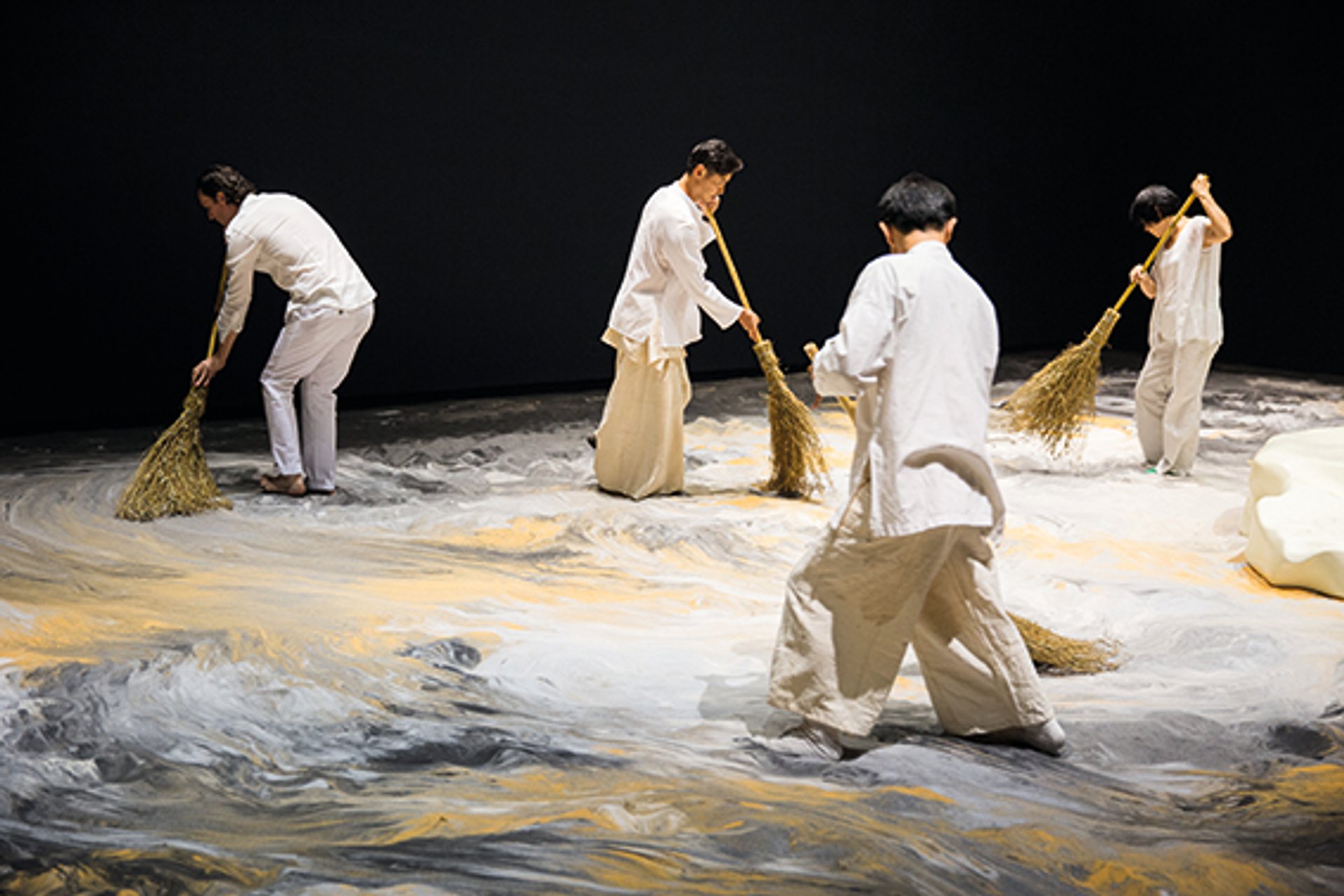
Performers at Lee Mingwei and His Relations: The Art of Participation at Taipei Fine Arts Museum 2015 Image courtesy of Taipei Fine Arts Museum
“Each one of us will have a broom and will brush the sand gesturally to the middle; the sand is actually quite thick, we can only brush the surface,” says Mingwei. After this, the sand is usually given to a local recycling centre. Since its inception in 2006, the artist has created more than ten iterations of the work at venues including Museum Macan in Indonesia.
The installation was made following a trip to a highland desert in Bolivia where Mingwei was caught up in a desert storm. “The sand started piling up against the car window and I thought we were going to die,” he says. “When I crawled out onto the desert surface, there was absolute silence. Then I saw a little mark on the floor made by a snake, which immediately summoned the idea of using sand to express the idea of impermanence.”
Audiences have reacted in different ways to the piece. At the de Young Museum in San Francisco last year, a woman was one of the last two people to walk on the piece. “She got out there and started kicking the sand and jumping, as if she was playing beach volleyball. Afterwards, a lady came over, held her hand and screamed at her, saying, ‘What do you think you were doing up there?’ So it’s clearly quite an emotional piece for most people,” the artist adds.
• Guernica in Sand, M+, until 13 July


