

At a time when arts funding in the United States is dwindling, art triennials have taken a hit. Cleveland’s Front International folded in 2024 after two editions, and Prospect New Orleans is skipping its seventh edition next year.
A new arrival, however, offers an unusual approach and an unlikely origin story. Opening Saturday (6 June) and continuing until 7 September, the Medina Triennial is named after its off-the-beaten-track location, a town of 6,000 in Western New York. It was initiated by the New York State Canal Corporation—a subsidiary of the New York Power Authority—as part of a $300m drive to boost tourism and recreational activity along the Erie Canal, which marked its bicentennial in 2025.
Established as a nonprofit, the triennial appointed Kari Conte and Karin Laansoo as curators and drew up a budget of less than $2m, financed by regional foundations and overseas grantmakers such as Outset in the UK and the Mondriaan Fund in the Netherlands. As a seed funder, the New York Power Authority is a rare example of a public institution investing in culture as it would in infrastructure.
“It’s a crazy idea that I think no one in the field of art would have had,” Conte tells The Art Newspaper. “We hope this can be a model around the country for other agencies that are not necessarily cultural agencies.”
Few today have heard of the village of Medina, which is an hour by car from Buffalo or Rochester, and two hours from Toronto. Fewer know how to say it: unlike its namesake in Saudi Arabia, the middle syllable is pronounced “die”. In the 19th century, though, Medina was a major stop for boats plying the Erie Canal. Slicing across New York State to connect the Midwest with the Atlantic Ocean, the canal fuelled trade with Europe and lifted the fortunes of New York City and Great Lakes cities such as Chicago and Detroit. Medina was also famous for its sandstone, used widely to pave streets and construct buildings.
In shaping the triennial, the curators drew on past experience—Conte has worked with the Helsinki Biennial and the Aichi Triennale, and Laansoo with Performa, the New York City performance art biennial—as well as research into other examples, particularly the Echigo-Tsumari Art Triennale. Launched by Japan’s Niigata prefecture to revitalise its rural regions, that festival similarly emphasises local participation and a strong connection with nature. The biggest difference is that the Medina Triennial is smaller in scale, the entire presentation contained within a walkable half-mile radius.
Mary Mattingly planting her Floating Garden, a work developed during the triennial’s residency programme Photo: Dawson Andrews, courtesy Medina Triennial
Titled All That Sustains Us, the triennial’s first edition is inspired by the work of Mierle Laderman Ukeles, the unsalaried artist-in-residence at the New York City Department of Sanitation since 1977. Ukeles’s 1969 manifesto for “maintenance art” sought to foreground the labour of women and workers that keeps cities and families running. In a similar vein, Conte and Laansoo assembled 39 artists and collectives from around the world and commissioned and selected works that relate to how social, ecological and infrastructural systems are sustained in Medina and the Erie Canal.
“This is not a triennial that has a bunch of abstract paintings on the wall,” Conte says. “There are forms and ideas that the community knows.”
The art is spread across ten sites, including two parks, a YMCA, a church and a former high school for the main exhibition. The triennial hub, housed in a historic building that used to be a hotel, features furniture made of wood reclaimed from the Erie Canal. In addition to hosting its own programmes, the hub provides an art library and a meeting space for locals and visitors.
Many commissioned pieces were created in collaboration with local residents and regional institutions. Two Waters by Tania Candiani, for example, is a video in which the wordless vocalisations of hundreds of locals evoke the flow of Oak Orchard Creek and the Erie Canal through the village. And on the first day of the triennial, Lina Lapelytė will debut Faithfully Recording at the Medina Railroad Museum, a live performance in which singers and construction workers build a sculpture from reclaimed Medina sandstone.
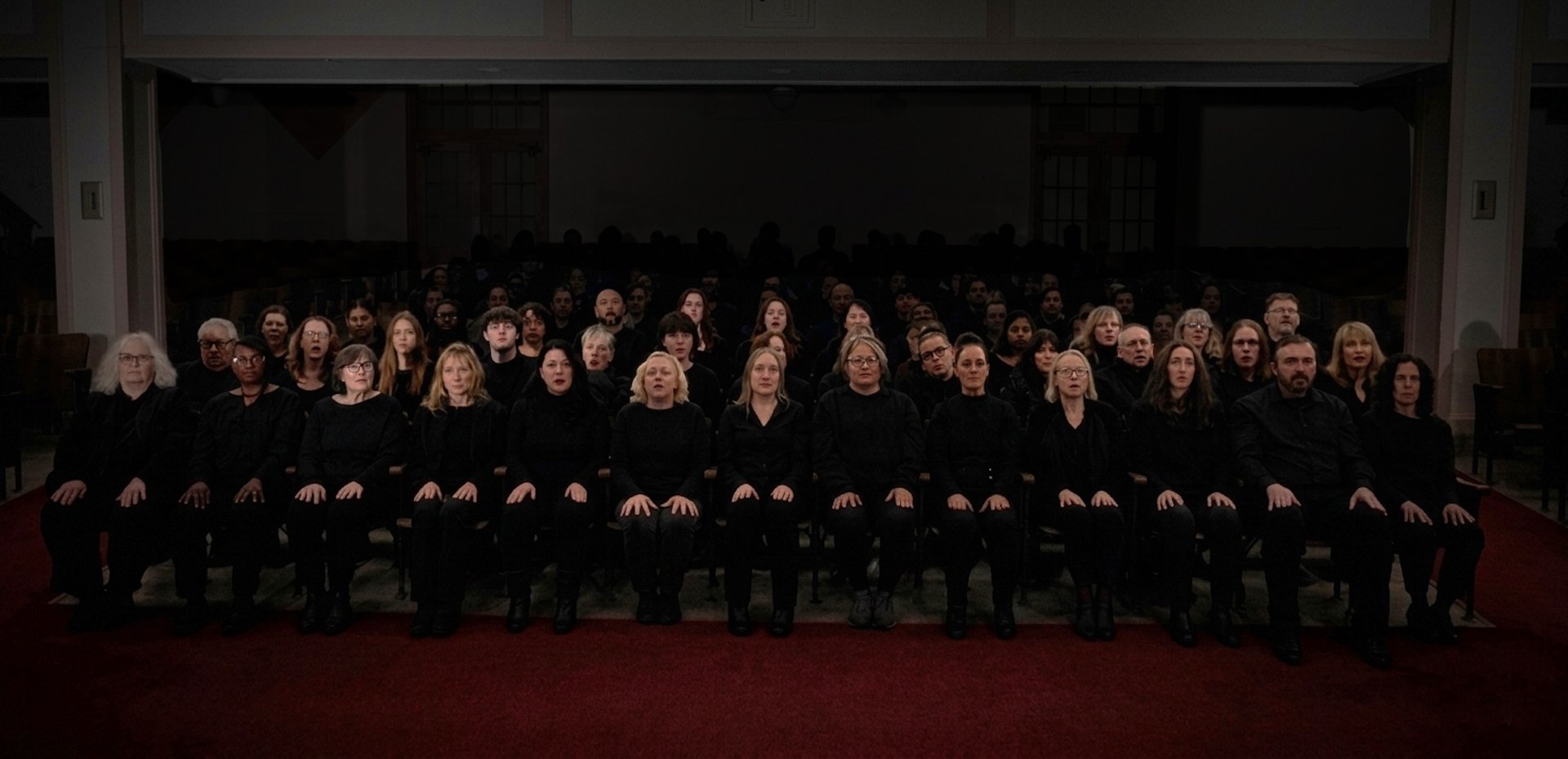
Tania Candiani, production still for Two Waters,2026 Courtesy the artist
Through the triennial’s residency programme, artists have developed works in consultation with Medinan experts and business owners. Last autumn, Mary Mattingly planted a Floating Garden on a barge with students from the Rochester Institute of Technology and residents, who contributed trees from their backyards and personal stories of relationships with plants. This past spring, Michael Wang collaborated with maple farmers to produce Sugarbush Energy, a canned maple-sap drink distributed at Medina shops.
To stage the triennial, Conte’s and Laansoo’s team worked closely with the village, seeking approval for sites, signage and building alterations. They conducted talks at schools, churches and other organisations, enlisted hundreds of volunteers and harnessed the skills of youth from the Iroquois Job Corps, a local trade school—although specialists commuting from Buffalo and Rochester still had to be engaged for the installation of works.
The curators have been pleasantly surprised by the public’s support despite their limited exposure to contemporary art. “The village of Medina is excited for the triennial,” says mayor Deborah Padoleski. “The participants have opened the eyes of the residents of our small village to art forms that we were previously unaccustomed to!”
For Scott Hocking’s sculpture at the Medina Theater, the building owner stepped in to facilitate logistics. For Evelyne Leblanc-Roberge’s installation at the Medina Memorial Hospital, its marketing director volunteered to help with publicity.
“The community shows up when you least expect it,” Laansoo says. “We stand outside the hub, and somebody will walk by and offer something that we exactly need, which would never happen in a big city. Nobody’s asking: ‘Is it art?’ They’re asking: ‘What can we do? How can we get involved? In many ways, we made a triennial together with them.”
- Medina Triennial 2026, 6 June-7 September, Medina, New York


