

The history of ballet is a history of collaboration. Nowhere is this more apparent than in the work of Wayne McGregor. Sit among the audience at any of his performances and you’ll find yourself not just surrounded by dance devotees, but by people from the worlds of art, fashion, music and beyond. As much as they come for McGregor’s choreography, they are there for scores by Max Richter and Thomas Adès; set designs by Tacita Dean and Olafur Eliasson; and for costumes by Gareth Pugh and Grace Wales Bonner. In the case of a brand-new work premiering at the Royal Opera House as part of McGregor’s Alchemies mixed bill (from 18 April to 6 May), the young British fashion designer Saul Nash will be an attraction.
Wayne McGregor’s ballet Untitled, 2023 featured costumes designed by Daniel Lee, Burberry’s creative director Photo: © 2023 Alice Pennefather
Alchemies brings together two previous works by McGregor: Yugen, which first premiered in 2018, and Untitled, 2023. The new piece, which unites McGregor and Nash, is still unnamed at the time of writing.
Nash founded his eponymous label in 2018, having spent many years as a dancer himself. He quickly became known for his sleek spin on sportswear (his aesthetic has been described by Dazed as “tracksuits for the thinking man”), and is now based in Milan, where he presents on the menswear schedule.
I began by modernising what had previously been done for dance—particularly ballet
Saul Nash, fashion designer
“I have been following Saul Nash’s career for quite some time,” McGregor says. “He is a designer–dancer and a dancer’s designer. He works with incredible technical fabrics that are cut for motion and he intimately understands the human form in flow.”
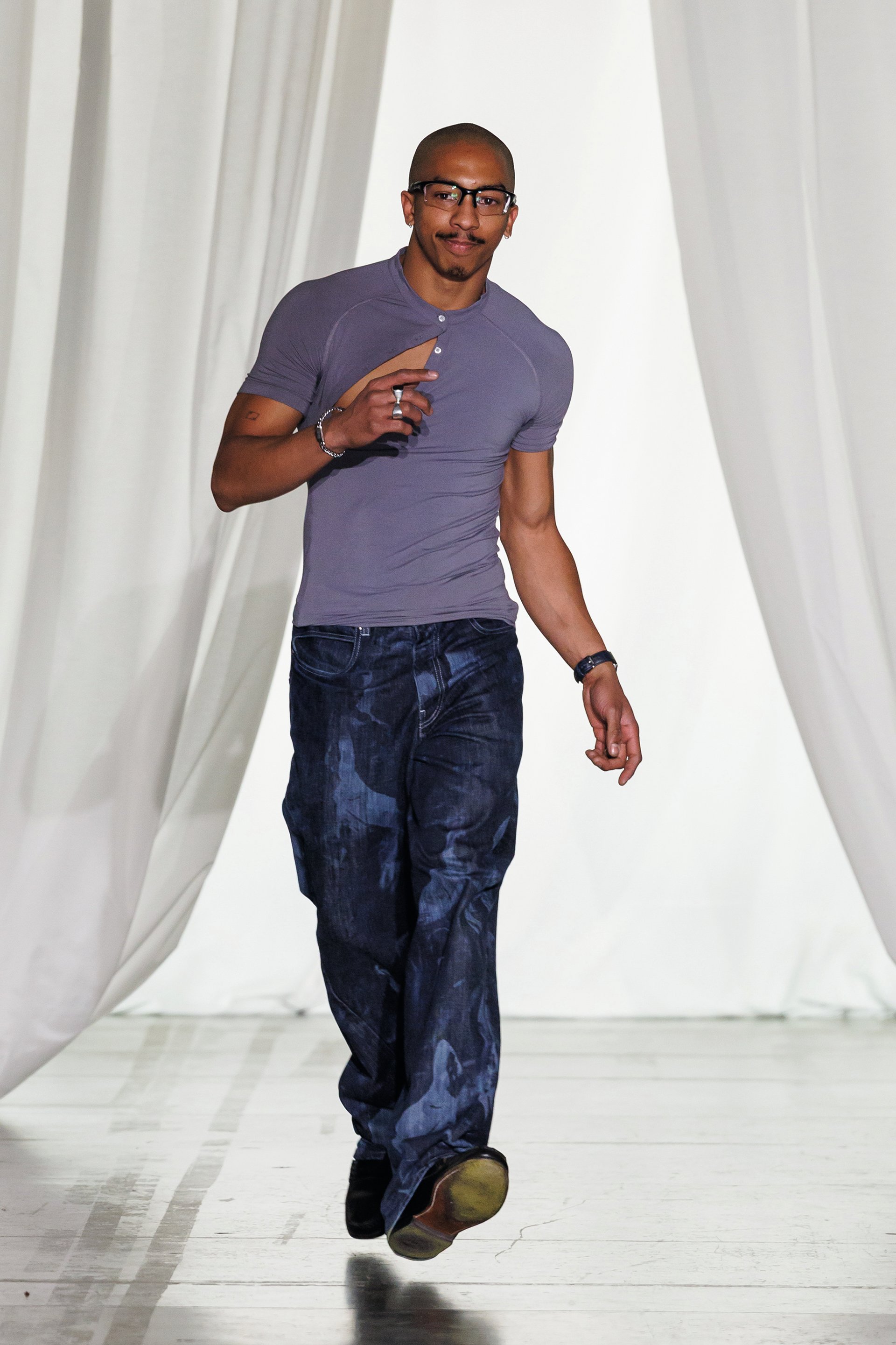
Saul Nash switched from dancing to designing, launching his label in 2018 Photo: © IK ALDAMA
For McGregor, Nash’s designs stuck closely to the history of dance costume. “I began by modernising what had previously been done for dance—particularly ballet,” Nash says. “This approach connects Wayne’s dynamic choreography with the cutting and codes of my own design approach.”
Revealing and revolutionary
When Marie Taglioni donned a tutu for the 1832 premiere of La Sylphide, she did so with the intention of allowing her intricate footwork to be seen in full. Quickly, the short, stiff skirt became the defining garment of ballet’s Romantic era. In the early 20th century Sergei Diaghilev, with his revolutionary company the Ballets Russes, became known for bold, confrontational design, perhaps best exemplified by the riots that greeted the premiere of Stravinsky’s The Rite of Spring, where Nicholas Roerich’s sets and revealing male costumes proved as unsettling as Stravinsky’s searingly modern score.
Pablo Picasso’s collaboration with the Ballets Russes included his largest ever work, a gargantuan backdrop for the 1924 production of Le Train Bleu, now on prominent display at the V&A East Storehouse in East London. Meanwhile, Oskar Schlemmer’s influential Triadic Ballet translated the ethos of the Bauhaus into angular movements and avant-garde costumes. By the mid-century, couturiers including Christian Dior, Pierre Balmain and Yves Saint Laurent had all turned their hands to designing for dance.
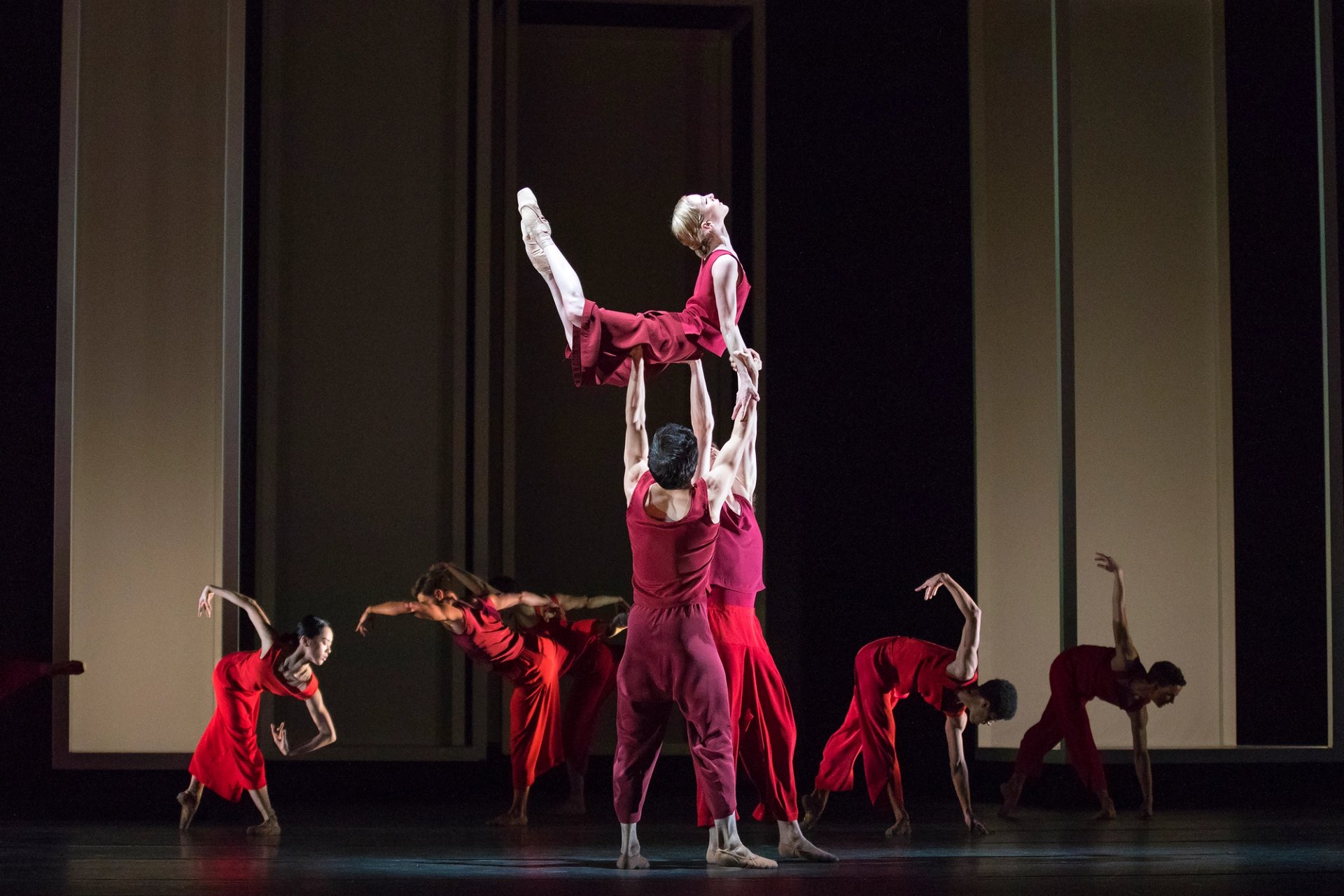
For Yugen, Wayne McGregor worked with the Iranian British designer Shirin Guild, who dressed the company in simple, blood-red costumes Photo: Andrej Uspenski; © 2018 Royal Opera House
For Yugen, McGregor chose to work with Bernstein’s choral masterpiece, Chichester Psalms. The company, dressed in blood-red costumes designed by the Iranian British designer Shirin Guild, performed in a set designed by the British ceramicist and writer Edmund de Waal. McGregor says he was drawn to De Waal for his liturgical upbringing; his father was a priest who served as the dean of Canterbury. If anyone could grasp the resonance of the psalms, and translate them into a visual language, he says, it would be someone who had grown up hearing them every day. For Guild, it was through her longstanding connection to De Waal—they had known one another for over 20 years—that the creative team coalesced. Her costumes are loose and fluid, composed of simple vests and drop-crotch trousers that move easily with the body. In a standout pas de deux, the dancers Sarah Lamb and Calvin Richardson intertwine, as Guild’s garments flow softly around the body.
I wondered if it was possible to create something for the dancer that was a place of refuge and pause
Edmund de Waal, ceramicist
De Waal’s set is spare, punctuated by tall, vitrine-like structures that glow and dim. “I wondered if it was possible to create something for the dancer that was a place of refuge and pause,” De Waal wrote in an essay for The Telegraph about designing the work. Perhaps referencing the shelves that typically house his porcelain vessels, De Waal has talked about days spent working with McGregor in his studio—“picking things up, playing with clay”—while McGregor “pushed and gently tested” his practice beyond territory he had previously explored.
For Untitled, 2023, it was the abstract canvases of the Cuban American artist Carmen Herrera that provided the direct inspiration for Wayne McGregor’s choreography. Herrera also collaborated with McGregor on the ballet’s set—marking one of her final artistic works before her death at 106 in 2022. “There’s something really interesting about how she balances line, shape, colour, symmetry and asymmetry in precarious ways,” McGregor says. “It’s really analogous with dance-making.”
The set for the piece is empty, save for a single object: a right-angled form that cuts into the space, like a Tetris block fallen from the rafters. Lucy Carter’s lighting animates washes over it throughout, conveying an inanimate object with something approaching emotion: solitary, static and yet alive. The Royal Opera House sent a scale replica of the main stage to Herrera in New York, who sent back a scheme in just a week.
Herrera’s distinctive lines and colours are echoed in the costumes designed by Daniel Lee, the creative director of Burberry. Green-and-white planes bisect the skin-tight leotards, as if Herrera’s canvases have leapt from the wall and wrapped themselves around the dancers.
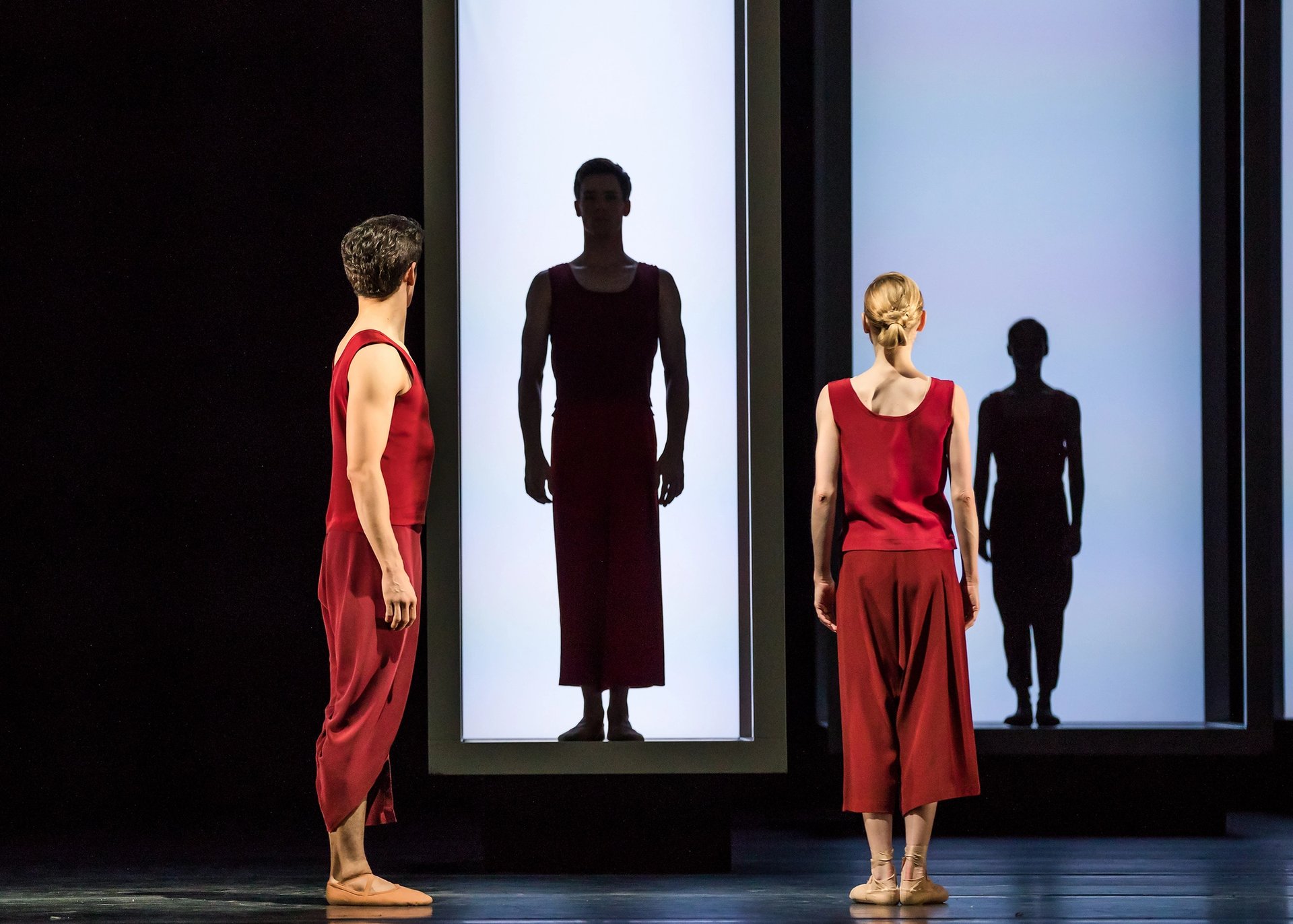
Yugen‘s set was designed by the British ceramicist and writer Edmund de Waal Andrej Uspenski; © 2023 Royal Opera House
McGregor’s connection to Lee goes back to the designer’s time as the creative director at Bottega Veneta. Then, McGregor was often spotted wearing Lee’s designs to take the final bow. When Lee moved to Burberry, it was natural that they should collaborate. “I was thinking about it even when he was at Bottega Veneta and how he took a heritage brand and subverted it, but always using the craft of the brand as the point of departure,” McGregor said in 2023. “That’s kind of how I work in ballet.”
From 18 April, audiences at the Royal Opera House will see these works reprised alongside the new collaboration with Saul Nash in a mixed bill that pays tribute to the art of collaboration and to a process that, when all goes well, feels just like alchemy.
• Wayne McGregor: Alchemies, Royal Opera House, London, 18 April-6 May


