

The future looks an awful lot like the past in Ho Tzu Nyen’s commission for the 110-metre facade of the M+ museum (22 March-29 June). Night Charades, which uses cutting-edge technology to reimagine famous scenes from the Golden Age of Hong Kong cinema from the 1980s and 1990s, is filled with references to works by celebrated filmmakers such as John Woo, Wong Kar-wai and Tsui Hark.
The Singaporean artist has used AI to render and re-render scenes, creating a dizzying multiplicity of different versions of imagery. This latest work continues an approach that Ho has been honing for years, one where he uses the past to explore the future and mines history to reconsider the present. The installation was co-commissioned by M+ and Art Basel and is supported by UBS. Ho, who represented Singapore at the 54th Venice Biennale in 2011, has shown at the Guggenheim Bilbao, the Hammer Museum in Los Angeles and the Sharjah and Gwangju biennials.
The Art Newspaper: Where does your interest in the Golden Age of Hong Kong cinema come from?
Ho Tzu Nyen: I’m not sure if interest is the right word, it’s just something I grew up with. My family watched Hong Kong TV series and films, which were extremely popular in Singapore. One of the biggest distributors of Hong Kong cinema was [film studio] Shaw Brothers and they were from Singapore. One would be surprised how influential it is. You sometimes see it mentioned in Korean dramas or variety shows, as it has its own references to Japanese cinema and samurai films. It’s hard to say I’m interested in it, because that would assume I have some distance, but it’s what I grew up with. It formulated my visual world and imagination as much as Hollywood films. It’s just part of my fabric. At the same time, on my last visit to Hong Kong I was struck by how much the phrase ‘Golden Age’ was used to describe the cinema of the past. It troubles me to think that the Golden Age is in the past.
Are you troubled on a personal level or a cultural level?
It doesn’t trouble me in a particularly heavy way. ‘Golden Age’ is something we usually celebrate, but it’s of the past. I’m curious what that means for the future. My work deals with the past but as a way to think about the future.
A still from Ho Tzu Nyen’s Night Charades (2025), which is showing at M+ museum in Hong Kong until 29 June Courtesy of the artist
Is that why you’re placing the past in a contemporary, futuristic context using AI?
There is a part of me that definitely wishes to connect with some kind of a future, but not in such a literal sense. Rather, what interests me in AI is the possibility of different renders. You can have different versions of the same scene and that interests me. What I resist is the single version, the single timeline. AI is a way for me to work with multiple versions, which is to say that there is no perfect version, it’s always slightly imperfect, like a charade. A charade is a version of something that’s come before, but it’s never as good as the first time.
A charade implies there’s a falseness to it.
Yes, there is, but one could say it’s all in good fun because a charade is usually played in a family setting, with friends in your living room with pizza and beer. I would suggest it has a double meaning. You could look at the charade as a reference to an earlier movie scene, but we could also look at it like it’s a performance, which is to say it’s not real. This duality interests me as a way to resist a single narrative. AI is just part of the process of how we view the past.
You treat it as a tool, not a medium?
I treat it as a tool with all the respect due, because each has its own specificity, its own nature that we have to understand, and each has its limitations and political, technological, economical and sociological implications. It’s a tool in the same sense that computers, cameras and paintbrushes are tools.
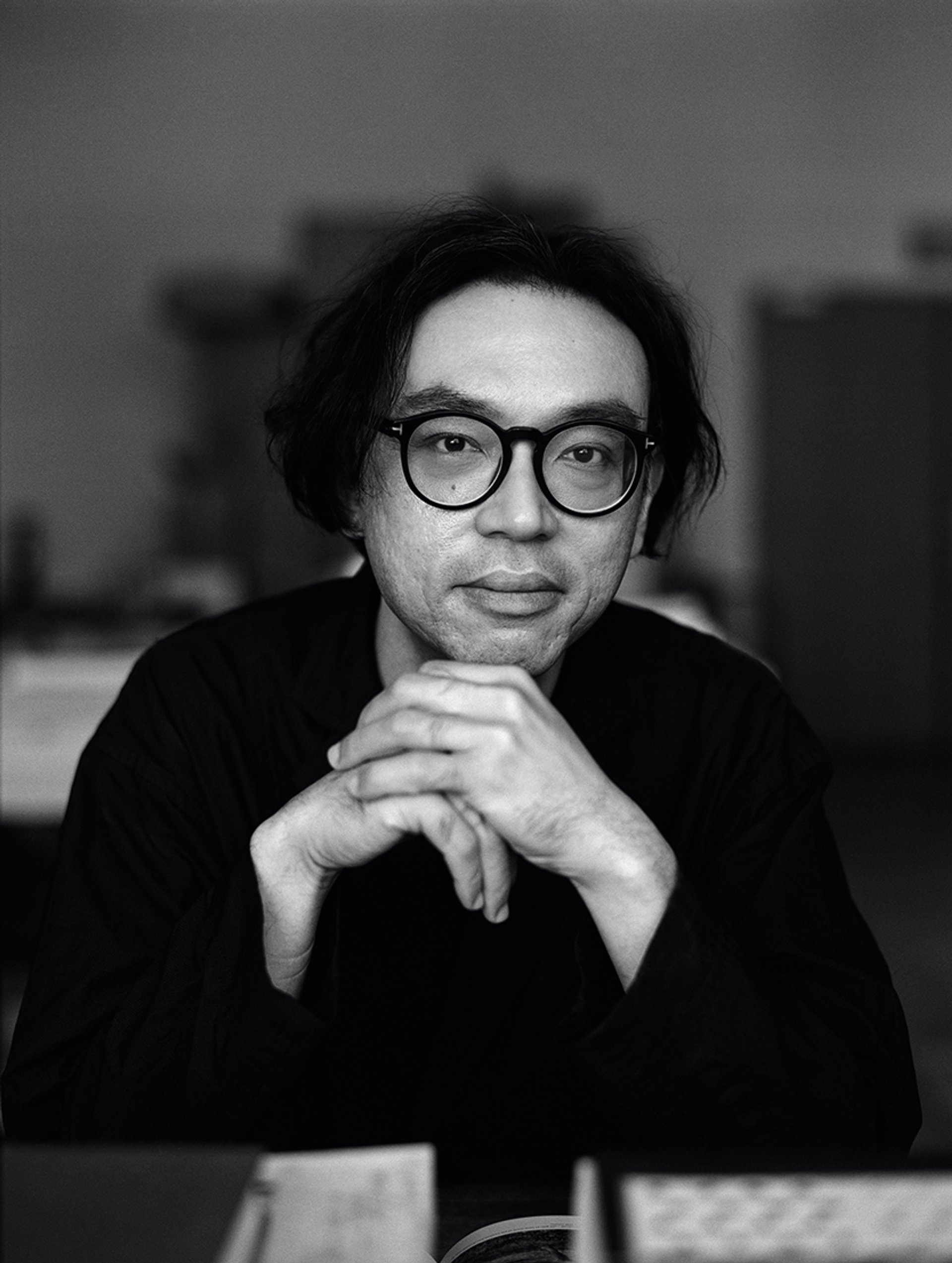
Ho Tzu Nyen, artist Portrait by Stefan Khoos. Courtesy of a+ Singapore
When did you start working with AI?
It was because of this project. I always thought I would engage with it, but the way this work developed jump-started the process and I was plunged into it. It’s been a great learning experience. It gets me thinking about the nature of AI or the future of intelligence. It opens up all these questions I’m not sure I can answer in Night Charades. But that’s where the next project comes in. The next few projects I do will be AI, with the specific aim of going deeper and further right into the process.
Have you thought about how this will always look like AI work from 2025?
Sometimes, being dated is the most perfect thing that can happen to a work. It somehow completes it and gives it a kind of perfection. This work references many different disparate moments across history so it has a strange temporality. The way I think about these images has a lot to do with Caravaggio, his composition with light, dark and cloth, and the folds of drapery, and Caravaggio is dated too.
What are the challenges of making work for the facade of a building?
I’ve always done things in the shelter of a museum. But this is exposed, so it’s extremely intimate in a way. But its size liberates me. It’s so big that everyone sees it, but no one watches it. The light is so bright that it becomes part of the ambience and atmosphere. It’s like a ritual, the return of these [cinematic] moments in this transfigured form through this strange process of AI being beamed back into the city. I chose iconic scenes, but many are weird and beautiful too.
• Ho Tzu Nyen, Night Charades, M+, 22 March-29 June.


