

“An era can be said to end when its basic illusions are exhausted. A retreat began from the old confidence in reason itself; nothing any longer could be what it seemed […] The whole place was becoming inhuman.”
So wrote Arthur Miller in New York Magazine in December 1974, just under two years after the end of the US-Vietnam war. Spooling forward just over 50 years, the playwright’s words seem to describe with even greater accuracy the mood of many after America waged another surreal, irrational war, this time against Iran.
The US’s latest foreign policy adventure, pursued in partnership with Israel, primarily through a relentless bombing campaign, triggered retaliatory Iranian drone and missile strikes across the Gulf and the enforced closure of the Strait of Hormuz. This has caused mayhem in the global economy. At the time of writing, the US, Israel, Iran and Lebanon were trying and failing to cobble together a peace treaty after President Trump backed down from bombing Iran “back to the Stone Ages where they belong” and destroying the country’s “whole civilisation”. The sanity of the President of the United States has been questioned.
The art trade is one of the many industries affected. Iran’s bombardment of the Gulf states, which host American military bases, has damaged the art world’s vision of Qatar, Dubai and Abu Dhabi as the next big growth market for international dealers and auction houses. The inaugural, strangely unreal Art Basel Qatar fair managed to take place three weeks before the Iranian drone and missile strikes, but the 20th edition of Art Dubai, scheduled for April, has been postponed until May. If the fair does go ahead, it will be held in an “adapted format”, according to Art Dubai’s organisers. Doubts also hang over the first edition of Frieze Abu Dhabi, planned for November, although applications for the fair were sent out last month.
Meanwhile, the Gulf’s art scene tries to keep calm and carry on. “Our gallery is open,” says Maliha Tabari, the founder of the Dubai-based contemporary dealership Tabari Artspace, which exhibited at Art Basel Qatar. “Across Dubai, the art scene has remained active, with institutions, galleries and artists continuing to operate and, importantly, to remain in dialogue with one another,” Tabari adds. “While the situation is difficult and uncertain, there is also a determination to maintain continuity, to keep working and to support our artists.” The gallery’s participation in Art Dubai is “moving forward”.
One of the many unintended consequences of this Middle East conflict is that it has shown that Dubai and other Gulf States are not quite the low-tax, high-income luxury paradises that their publicists and influencers would have us believe. More than 20 people were arrested by the Dubai authorities for filming the Iranian missile attacks, according to Detained in Dubai, an organisation that helps foreigners who fall victim to the territory’s Orwellian laws suppressing dissent.
Rashid Rana’s work referencing the Israeli bombing of Gaza appeared at Art Basel Qatar Courtesy the artist and Chemould Prescott Road
In 2020, Amnesty International reported that nearby Qatar had passed a vaguely worded law that authorises the detention of anyone who disseminates material with the intent to “harm national interests, stir up public opinion, or infringe on the social system or the public system of the state”.
If the Gulf is going to be the art world’s next big commercial hub—and recent events make that a very big “if”—the art being made and sold there will not ruffle too many feathers, as was clearly to be seen at Art Basel Qatar. Moreover, art will surely drop down the Gulf States’ list of sovereign spending priorities. Faced with the long-term threat of Iranian aggression, missile defence systems will be a more urgent investment than museums.
India is booming
How will all this affect the wider so-called “ecosystem” of the global art market? Seemingly very little, according to knowledgeable insiders. Take the case of India, which imports around 85% of its liquified gas from the Middle East. Fuel shortages have caused a crisis in its huge gas-dependent restaurant industry, forcing menus to be reduced and eateries to close. But India’s art market is booming and the country has 229 billionaires, in third place behind America and China, according to Forbes.
“The art market in India is completely incomprehensible. I thought the auction market would be affected, but it’s never been better,” says Shireen Gandhy, the director of the Mumbai-based contemporary gallery Chemould Prescott Road. She, like many, is still trying to make sense of the staggering $18m winning bid (with fees) in April at Saffronart in Mumbai for Yashoda and Krishna (1890s), a work by the late 19th-century Indian religious and portrait painter Raja Ravi Varma. Executed in a stiff academic Western style, this image of the Hindu deity Krishna’s foster mother milking a cow was bought by the Indian biotech billionaire Cyrus Poonawalla.
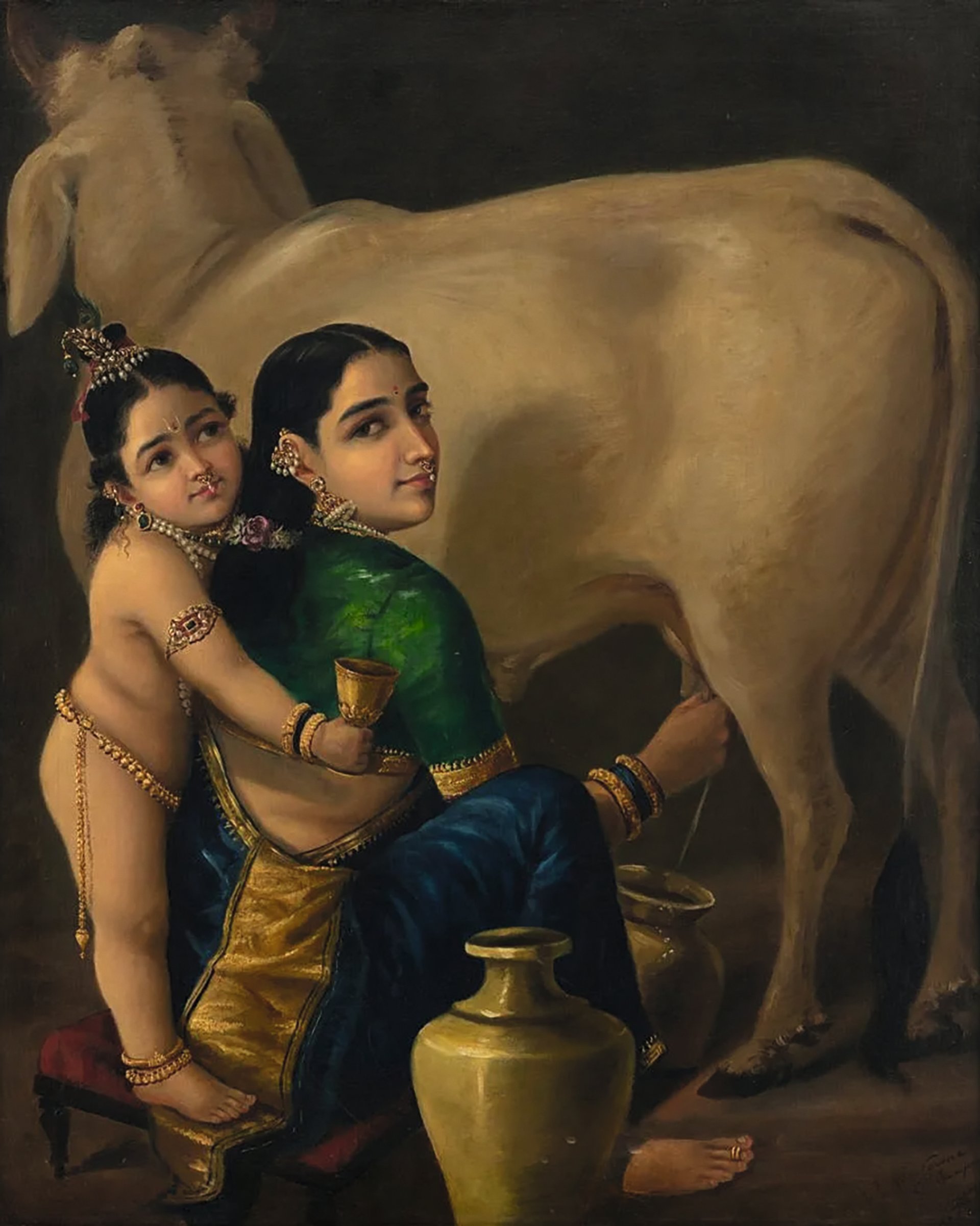
Raja Ravi Varma’s painting Yashoda and Krishna (1890s) sold for $18m (with fees) in Mumbai in April, reflecting the conservative tastes of India’s wealthy collectors Saffronart
“Rich collectors are generally conservative people,” says Gandhy, who adds that freedom of expression in India has been subject to a “huge clampdown” under Narendra Modi’s Hindu nationalist government. The commercial success of Varma’s traditionalist religious paintings—which had previously fetched a dozen $1m-plus prices at auction—reflects the new political mood.
“Everything that has been happening in America when Trump took over in January [2025] has happened here,” says Gandhy. “There is a certain amount of self-censorship among artists. There’s never a direct response,” according to Gandhy, who was one of the few exhibitors at Art Basel Qatar who did bring a work of contemporary art that responded to the current political situation. The Pakistani artist Rashid Rana’s 2025 installation, Beneath the Black Square, consisting of walls papered with repetitive images of Israeli night-bombing raids in Gaza—one of the few external political issues that Qatar seems to care about—did not find a buyer at the fair. However, a large Diasec wall piece associated with the project did sell for $30,000 to a Qatari collector.
In October 2023, the surprise Hamas attack on Israel proved a serious shock to the international art market system and business was subdued during the two following years. The ongoing conflict in the Middle East is still claiming plenty of lives, but this no longer seems to diminish wealthy individuals’ appetites for buying and selling art.
“The first quarter of 2026 marked a significant rebound in the global auction market, pointing to renewed confidence,” ArtTactic’s latest quarterly auction review states, noting “stronger demand for higher-quality works and greater depth at the top end of the market”. Sales at Christie’s, Sotheby’s and Phillips increased 64% to $1.7bn, the strongest first quarter since 2016, according to ArtTactic.
The search for normalcy
The New York-based art adviser Wendy Cromwell is optimistic about the forthcoming May marquee week of Modern and contemporary auctions in Manhattan. A $35m Gerhard Richter “Candle” painting from the collection of the artist’s dealer Marian Goodman, on offer at Christie’s, is one of the latest additions to the pile of blue-chip trophies by prestige names.
“I don’t believe the conflict in the Gulf will have a short-term impact on the May auctions,” Cromwell says. “Most contemporary art collectors that I know are deeply troubled by what is going on geopolitically. Maybe in reaction to that, buying art is their way of maintaining a sense of normalcy?”
With the S&P 500 stock index climbing back to and beyond the record levels it had achieved in February, a Raja Ravi Varma making $18m and rich art collectors doing their bit for normalcy, who knows where the prices for Rothko, Richter and Basquiat could go?
Wars rage, but human civilisation endures. President Trump has announced that he plans to build a magnificent 50-storey-tall presidential library in Miami, less than 10km away from the venue of the Art Basel Miami Beach fair. The library will not have any books in it, but it will feature the $400m jumbo jet Qatar gifted President Trump, as well as an auditorium with a colossal Ozymandias-style gold statue of Trump giving what appears to be a Nazi salute.
And the art world’s curatorial establishment, struggling to keep pace with political events, continues to cherish ideas that increasingly feel like old illusions. The official theme of this year’s Venice Biennale is a tribute to the event’s late curator Koyo Kouoh. It proposes an exhibition “attuned to quieter tonalities and lower frequencies, privileging practices that unfold through intimacy, improvisation and poetic persistence”.
Hopefully it will include works by some contemporary artists who, like Goya, like Arthur Miller, can make sense—or nonsense—of all this madness.


