

The Kremlin is moving to eliminate the theme of Soviet repression under Joseph Stalin from the country’s museums as part of its latest crackdown on the remnants of free speech.
Verstka, an independent investigative publication, reported on 13 April that the exhibitions of the Gulag Museum in Moscow were being packed up and moved away.
Meanwhile, on 9 April, Russia’s supreme court ruled that Memorial, a human rights movement founded to document Stalin-era crimes, is an extremist organisation and banned it—the culmination of a decade of unrelenting pressure since it was designated as a “foreign agent” in 2016.
‘Anti-Russian’
In its decision, the court characterised Memorial as “anti-Russian,” devoted to destroying “historical, cultural, spiritual and moral values”. Within days, the Yeltsin Presidential Center in Yekaterinburg, an exhibition and conference centre known for its liberal interpretation of Russian history, removed mention of Memorial from its walls. Memorial’s central office in Moscow was at one time known for its carefully curated shows.
The ruling came on the heels of the rebranding of Moscow’s Gulag Museum, which exhibited and archived evidence of Stalin-era crimes, to highlight Nazi crimes against the Soviet Union.
Focus on Nazi war crimes
The museum’s entire website content was removed in February and replaced with three sentences: “A Museum of Memory is set to open in Moscow. It will be dedicated to the memory of the victims of the genocide against the Soviet people. The exhibition will cover all stages of Nazi war crimes during the Great Patriotic War.” A report on the website of Moscow’s city government, which oversaw the Gulag Museum, said the new institution would inform visitors about “manifestations of Nazism, the biological experiments conducted by the Japanese on Soviet citizens, and the liberation mission of the Red Army”. When Russian President Vladimir Putin launched Russia’s full-scale invasion of Ukraine in February 2022, he claimed the need to “de-Nazify” Ukrainian President Volodymyr Zelensky’s government as one of the main reasons.
Although the Gulag Museum’s shutdown in 2024 due to purported fire-safety violations was presented as temporary, changes that year in official Russian policy about memorialisation of victims of political repression indicated the move would be permanent.
The Gulag Museum opened in 2001
Yuri Palmin
The museum, which opened in 2001 just blocks from the Kremlin, moved into an expensively redesigned pre-revolutionary space in 2015. Roman Romanov, who was removed as its director in 2024, served until last December on Putin’s presidential Human Rights Council. A Moscow city museum director served as a placeholder until the appointment on 20 February of Natalia Kalashnikova, who previously ran the Smolensk Fortress Museum and, according to the Moscow city government website, received a medal for participating in the “Special Military Operation”, the official term for the war against Ukraine.
Romanov helped fundraise for a government-sponsored memorial to victims of political oppression called “Wall of Sorrow”, unveiled not far from the museum in October 2017, with Putin in attendance. At the ceremony, Putin said: “We and our descendants must remember the tragedy of repression and what caused it.” Officially, the Gulag Museum had Putin’s backing at the time.
Authorities had already taken over the Perm-36 gulag museum in the Urals in 2015 and in 2018 forced the closure of a museum of Gulag history in Yoshkar-Ola. And last month an organisation led by Vladimir Medinsky, a former culture minister, opened an exhibition at the memorial complex at the site of the Katyn massacre in Smolensk called 10 centuries of Polish Russophobia.
Nationalist vandalism
The Sakharov Center in Moscow, founded by Elena Bonner, the fellow dissident and widow of Andrei Sakharov, the Soviet physicist who was banished for speaking out against human rights abuses, was disbanded and kicked out of its facilities by a Moscow court ruling in 2023. Contemporary art exhibitions held at the centre in the 2000s were vandalised by nationalists and led to landmark trials that codified religious intolerance in Russia.
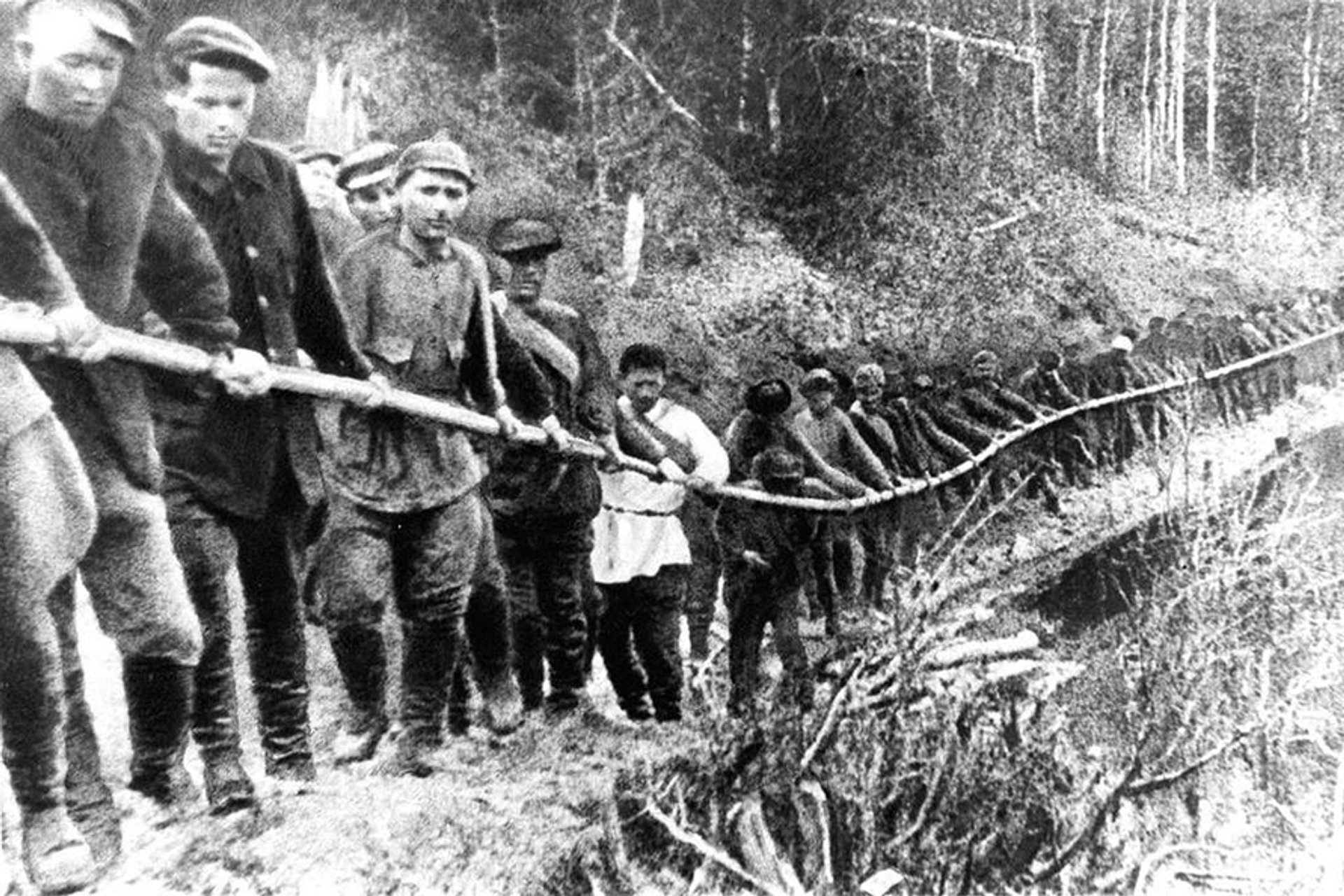
Photographs of the Gulag have been taken down
Sergey Lukashevsky, the centre’s director, who is now based in Berlin, told The Art Newspaper by email: “The recent rebranding—effectively equivalent to shutting down of the Gulag Museum—sends a clear signal that the Russian authorities are prepared to do anything to remove the history of political repression from public view. The parallels with today’s situation in Russia are simply too obvious.”
In 2024, Lukashevsky was sentenced in absentia to eight years in prison for “spreading fakes” about the Russian military via Facebook posts against Russian atrocities in Ukraine.
On 13 March, Nina Khrushcheva, the great-granddaughter of Nikita Khrushchev, the Soviet leader whose revelation in 1956 of Stalin’s crimes led to a period of cultural and social flourishing known as The Thaw, was labelled a “foreign agent” by Russia’s justice ministry. Khrushcheva is a New York-based academic who travels often to Russia.


