

In a recent viral segment from Drew Barrymore’s talk show, she and producer Ross Mathews brought on renowned floral designer Kristen Griffith-VanderYacht as a guest. At one moment, they asked him for tips on how to make flowers last as long as possible. Griffith-VanderYacht responded by taking each of their hands. “Flowers are not supposed to last,” he said. “Their job is to help us to stay in the present. They grow, they blossom, they thrive, and then they’re gone. You have to stay in the present … you have to be in the moment.”
Flowers have been fixtures throughout art history for centuries, as in our everyday lives: tucked under arms, behind ears or adorning our houses. Despite existing in countless varieties, they all possess similar sets of contradictory meanings and symbolism: beauty and decay, fragility and resilience, fertility and death. Over the years, artists have abstractly, conceptually and physically used them, not just for ornamentation or aesthetics, but as a medium and method. They are tools for thinking through and visualising ideas of colonialism, gender, mortality, politics, even the act of perception itself – all grouped together by the larger concept of time.
In the 17th century, a specialised genre of Dutch still lifes called vanitas paintings depicted vases and bouquets in a state between lush and wilting, to reflect on the ephemerality of pleasure and life. Frequently rooted in biblical themes, these works by artists like Rachel Ruysch, Jan Davidsz. de Heem and Jan Brueghel the Elder made wider comments on mortality and the imminence of death. By the 19th century, with Romanticism and Symbolism, the subject matter had become more associated with emotional and figurative expression than moral allegory, In the 1900s, the Impressionist movement – typified by the world-renowned Water Lilies series by Claude Monet or Vincent van Gogh’s Sunflowers – asserted them as fields of changing colours, atmospheres, places and light. They simultaneously became associated more with gardens, leisure time and bourgeois domestic life.
During Modernism, flowers were sites of evolving abstractions and sensuality, such as in the enlarged works of Georgia O’Keeffe. Elsewhere, Henri Matisse revelled primarily in vibrant colours, patterns and aesthetics. Then came Pop Art, where Andy Warhol severed blooms from nature and morphed them into emotionally flat, reproducible, commercial icons, serving as illustrations of consumer culture and the commodification of beauty and artifice. In contemporary installation, artists like teamLab, and Yayoi Kusama, among many others, treat flowers as a material with which they can immersive viewers in the wide-ranging, pressing concerns unique to our century. Right now, Anya Gallaccio, Kapwani Kiwanga, Steve McQueen, Takashi Murakami, Taryn Simon, Yto Barrada and more are harnessing them to address climate change, colonial legacies, ecological crises, the Anthropocene, mourning, labour, extraction, gender and care work.
At this year’s edition of Rencontres d’Arles, the annual photography festival held each summer in France, an exhibition in the Jardin d’Été, curated by Beata Nowak and Michel Poivert, focuses on the floral motif. Titled Flower Power and included in the Forms of Life section of the festival (its other chapters are Independence, Journeys, Revisits and The Uncertain Archive), this show includes work by five international image-makers: Alice Pallot, Anaïs Tondeur, Jiang Zhi, Matei Bejenaru and Suzanne Lafont. “Contemporary photography offers a stimulating reinterpretation of the floral theme,” the curators, Nowak and Poivert, expound. “Framed by ecological, political and historical concerns, images of flowers take on a different tone. What may at first appear as an exploration of form and colour often carries an activist undercurrent.”
Pallot and Tondeur’s works, for example, document “environments that seem inhospitable to growth … landscapes shaped by extractivism, pollution and radioactive damage.” Here, the exhibition invokes American anthropologist Anna Lowenhaupt Tsing’s concept of “third Nature” – referring to life forms that persist and adapt within the ruins of capitalist wreckage – where the images become “ground from which unexpected forms of life emerge.” Bejenaru, meanwhile, photographs hyperrealistic plant models, purchased by a Romanian university from Germany in the 1980s. The results blur the lines between truth and fiction. Elsewhere, Lafont shifts attention to plants we are wont to forget or ignore, like overlooked foliage growing between concrete blocks and paths.
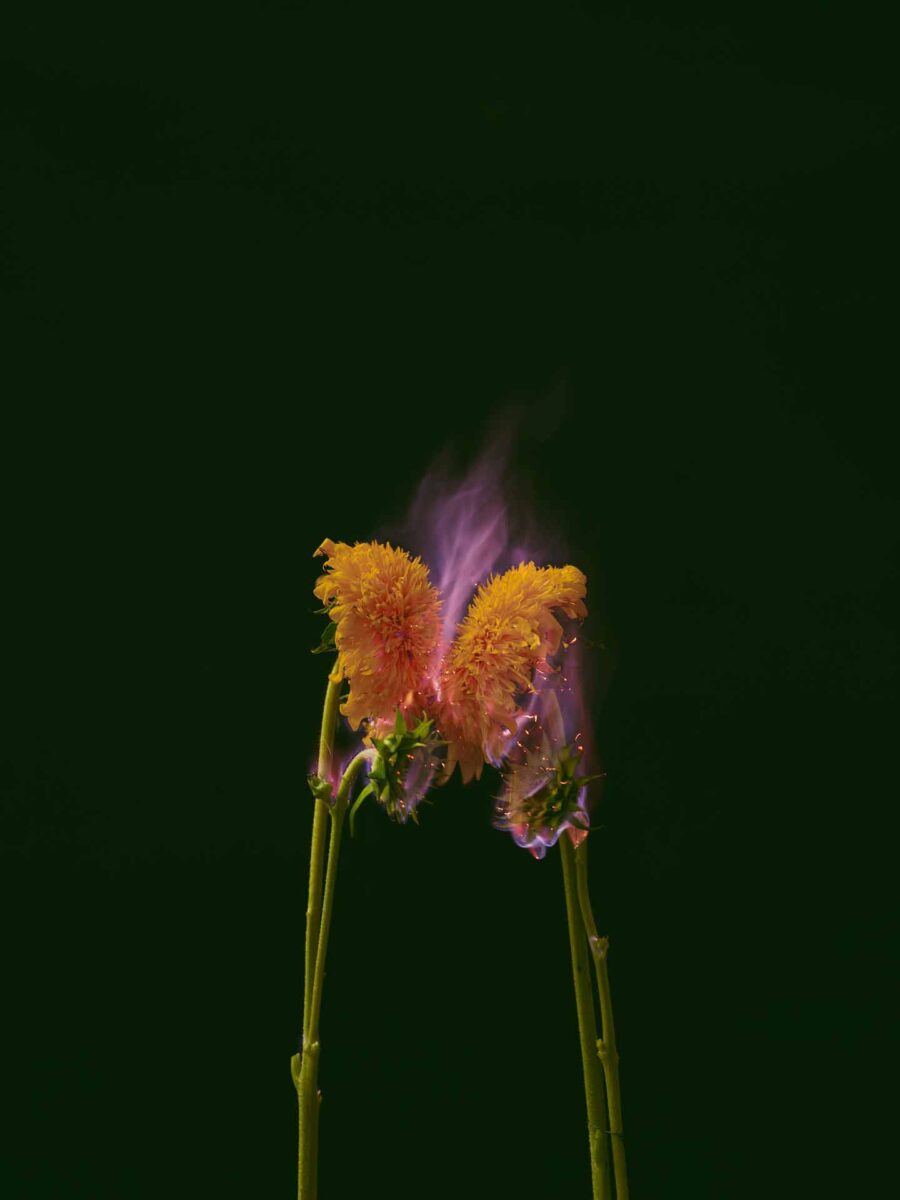
The Beijing-based Chinese photographer Jiang Zhi is presenting his series Love Letters (2011-2014), which he produced following the passing of his wife in 2010. Zhi, born in 1971, is part of the post-1990s generation of Chinese artists making work in the wake of the rapid economic and social changes that characterised the country’s reform era. His work spans photography, video, installation and writing, moving between documentary realism and poetic metaphor. Zhi’s Love Letters collection, in dedication to his late wife, is an absolutely stunning selection of individual flowers that have been set aflame. Here, the beauty of shared companionship, which lends life its deepest shades of meaning, and the suffering and pain of being a human coexist within a single frame. We can almost feel the impossible sting of hot blue fire entrapping the vivid petals. This series is simultaneously an act of mourning and a literal snapshot of the ephemerality that flowers have symbolised throughout the history of art.
“Flowers are among nature’s greatest masterpieces of form and colour. From the Renaissance worship of natural order to the nineteenth-century Impressionists’ fascination with light, shadow and colour, flowers have offered an exceptional subject for artistic creation,” Zhi shares. “They are both the embodiment of beauty and a perfect vessel for reflecting on life. Perhaps this is where [their] deepest power … lies. Their blooming is so splendid, and yet their withering is so swift.”
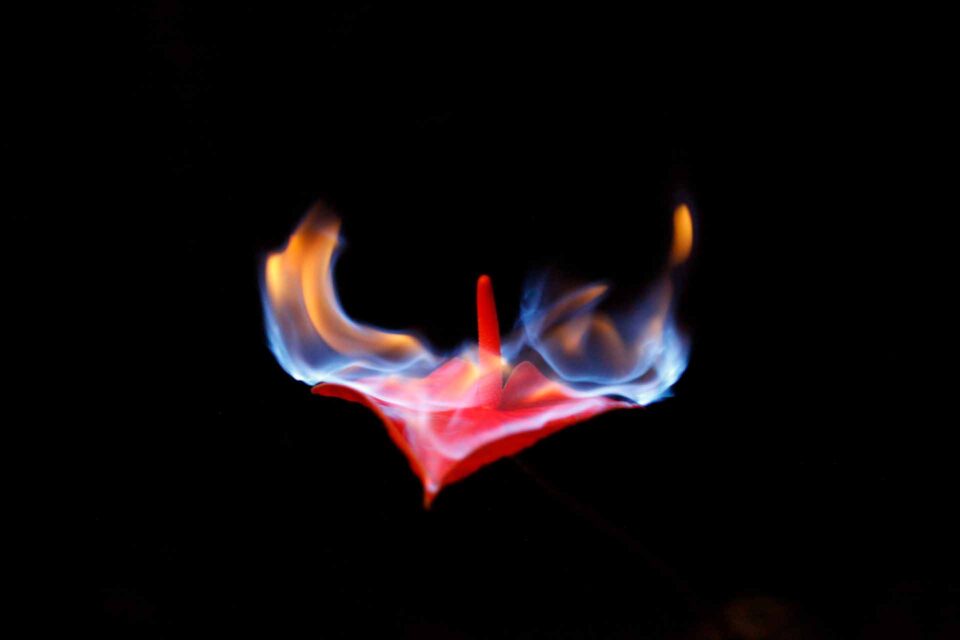
In March 2010, Zhi’s wife had organised a birthday party for him. “It was a gathering I will never forget. We lit a small tower made of many glasses filled with alcohol, and I watched the blue flames flow down from the glass at the top. I don’t know why, but at that moment an image of flowers and fire together appeared in my mind. After returning home, I made an experiment and set fire to a small bunch of flowers. In a way, that was the beginning of this series,” he recollects.
Zhi’s wife loved flowers. On her birthday in May 2011, he left a bouquet for her as an offering. He remembered his own birthday party from the previous year, and the photographic experiment he had conducted after coming home. Zhi began to shoot the Love Letters series and worked on it until 2013. It was a way of transmitting his longing and loss through a physical medium. Zhi’s blazing photographs are so striking and brilliant, that they can sometimes even appear slightly abstract. “At that stage, the process was quite simple and direct. I did not deliberately plan the images in advance. I photographed them whenever I felt like doing so, and everything was very spontaneous.” This was an intutitive process.
By 2014, Zhi had started to incorporate vessels as containers for the flowers, drawing on the Japanese ikebana tradition. “I collected a number of ancient ceramic jars. I was thinking that people from several thousand years ago, just like us today, also experienced love and being loved,” Zhi says. “The art of Japanese flower arrangement originated from Buddhist floral offerings in China during the Sui dynasty, and later developed into thousands of different schools. I have long been interested in Buddhism and Zen, so during this stage I paid more attention to the posture and arrangement.”
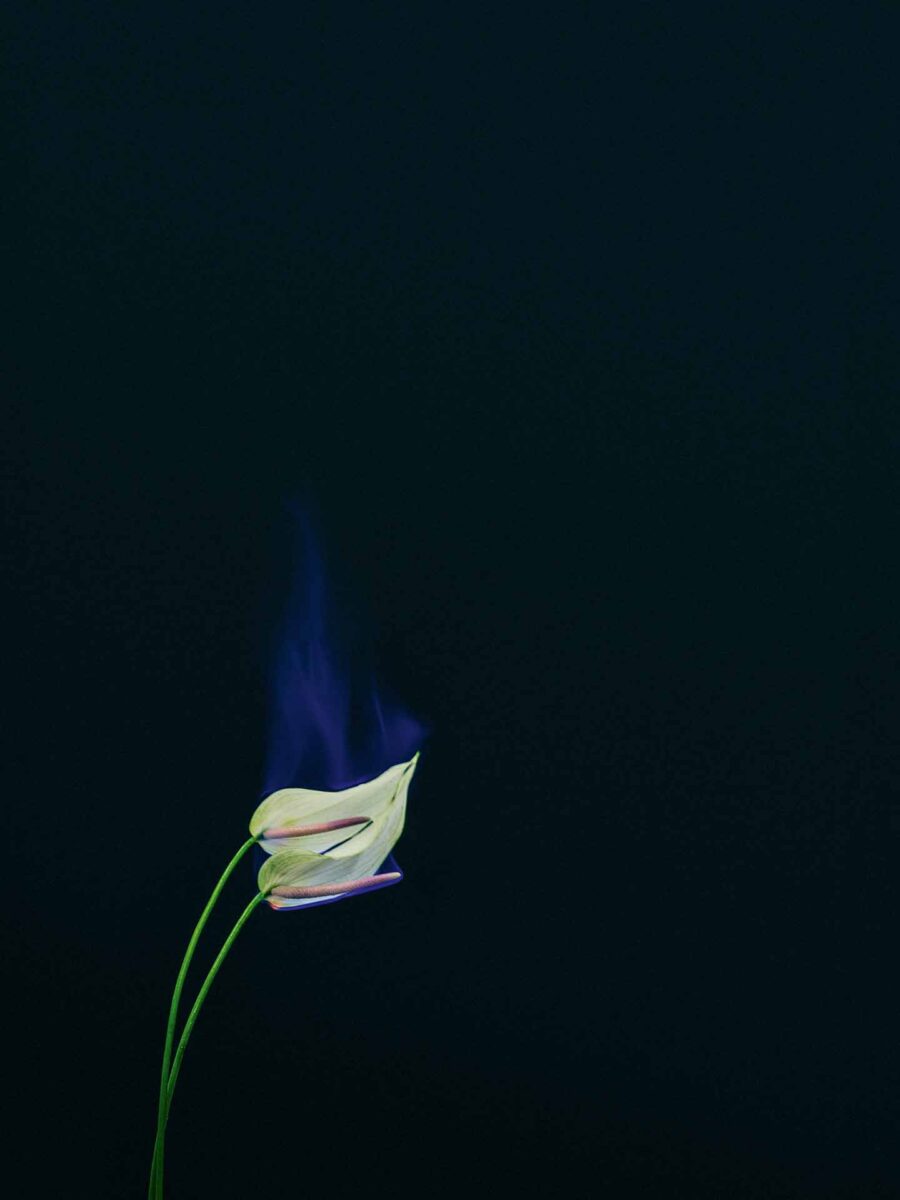
At the time of making this body of work, Zhi wanted to convey to his wife feelings of “love” and “apology.” But that intention inevitably expanded to take a more wide-reaching outlook. “Humanity is divided, differentiated and set against itself because of desires, beliefs, cultures, geographies and many other differences. I increasingly felt that love is the most powerful spiritual force we have to resolve endless conflict and mutual harm. I wanted these works not to be love letters addressed only to one person, or to one category of people, but toward all those who have loved and been loved.”
At a time when relentless assaults of images that are frequently hateful, violent or manipulated pervade our everyday lives, Zhi’s view of photographic images as love letters that help bind and maintain our humanity – our capacity to care – feels like a balm. “Love is an emotion that exists in everyone’s heart. How wonderful it would be if it could transcend separation,” Zhi says. The director of Rencontres d’Arles, Christoph Wiesner, seems to share this sentiment; his introductory statement explains how photography does not only “artificially soften the violence of reality” but also “bring[s] out its depth … to face a sometimes unsettling world while continuing to find beauty, connection and freedom within it.”
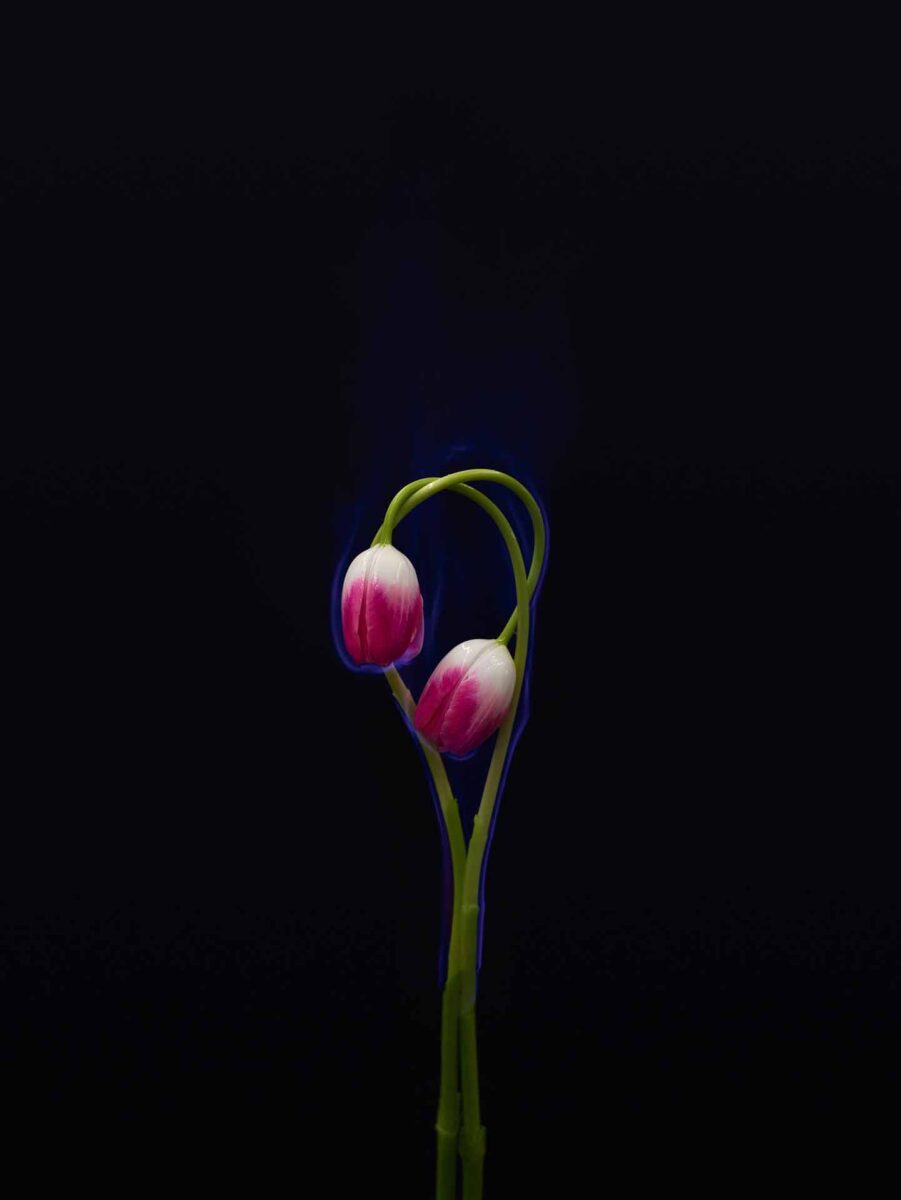
This year marks the bicentennial of the invention of photography. For its 57th edition, Rencontres d’Arles is thus commemorating and celebrating 200 years of the evolving medium as an art form and communication tool. Running from 6 July to 4 October 2026, its overarching theme is Worlds in View, offering narratives rooted in various locations across the globe. There is an exhibition dedicated to Ghana’s independence from British rule, showing how photography played a crucial role in shaping the image of the young nation. Lee Shulman and Omar Victor Diop’s Being There asks questions about who is seen and remembered, whilst We Are Not Alone turns attention to unexplained phenomena.
Solo shows shine a spotlight on names like Edward Steichen and William Klein, who are part of established canons. But there’s also a focus on contemporary image-makers who are mobilising some of the biggest issues of our era – like Meghann Riepenhoff, Ming Smith and Sammy Baloji, to list a few. There is, as always, a robust Emerging Voices section, including work by exciting younger photographers from around the world: Amira Lamti, Charlotte Yonga, Phan Quang, Souleymane Bachir Diaw and more. The festival is invested in youth engagement – “because ways of seeing are shaped from an early age.” L is for Look brings together children’s photobooks to nurture engagement with images and observation as a site for play and discovery. This year’s Arles programme is as wide-reaching as the history of photography itself – a fitting tribute to two centuries of creation.
Words: Vamika Sinha
Image Credits:
- Jiang Zhi, Love letters, No. 2, (2023). Image courtesy PARIS-B.
- Jiang Zhi, Love letters, No. 5, (2023). Image courtesy PARIS-B.
- Jiang Zhi, Love letters, No. 5, (2023). Image courtesy PARIS-B.
- Jiang Zhi, Love letters, No. 11, (2023). Image courtesy PARIS-B.
- Jiang Zhi, Love letters, No. 8, (2023). Image courtesy PARIS-B.
The post Enduring Symbolism appeared first on Aesthetica Magazine.


