

Well-known historical works by artists like George Stubbs and Thomas Gainsborough, as well as famous and sometimes tragic events of the past, get a new twist in the work of the British artist Dexter Dalwood. His fascination with past events and with the development of art history are combined in his most recent paintings. These works, such as Bloody Sunday (2023) and The Blitz (2024), combine images and numbers on canvas to recall famous historical events in new ways.
Dalwood’s first artistic enterprise was as the bass player in a punk rock band, The Cortinas. His breakthrough moment as a visual artist came in the late 1990s when he was shown at the Saatchi Gallery, and he is still best known for works from that period, especially his fictional interiors such as Kurt Cobain’s Greenhouse (2000), Wittgenstein’s Bathroom (2001) and Jackie’s Cabin on the Christina O (2000).
In 2017 he undertook a residency in Mexico and moved there five years later. This, and his long association with the National Gallery in London, where he was an artist trustee for eight years, is the backdrop to his latest, and perhaps unexpected, role as co-curator of José María Velasco: A View of Mexico. The show runs until 17 August and includes sweeping, detailed paintings of a then-rural landscape that today is the setting for the world’s fifth biggest urban conurbation, Mexico City.
Dalwood first gained recognition through a series of paintings of famous people’s imagined private spaces, including Kurt Cobain’s Greenhouse (2000) © Dexter Dalwood; courtesy of Lisson Gallery
The Art Newspaper: In your show at London’s Lisson Gallery last year you explored the work of artists from Stubbs and Gainsborough to Ben Nicholson. The exhibition you are currently involved in centres on an obscure 19th-century Mexican artist, José María Velasco. That is quite a pivot—how did it come about?
Dexter Dalwood: Velasco is hardly known outside Mexico—even some eminent art historians in Europe have never heard of him—but when I saw his work for the first time, I could see he’s got a very different idea of what painting is about, and he’s an artist with a great deal to say in 2025. Velasco was painting in Mexico around the same time as Paul Cézanne was painting in Europe: like him, he painted in plein air and then worked his canvases up in the studio.
Unlike most 19th-century European artists, Velasco wanted to record the advent of industrialisation. He wasn’t interested in people sitting in their gardens or eating lunch, as so many of the Impressionists were; he was interested in recording the beginning of industrialisation, the arrival of train lines and factories, in Mexico City. He captured it at the moment of change, and he wants the viewer to think about what this place was like before it was like this—and what it might be like in the future?
What makes him an artist for today?
In the 19th century there was a new way of thinking philosophically: a new way of thinking about nature, which before then had been all about categorising everything. By Velasco’s time there was a realisation that the world is much older than people had thought, and that evolution was a real thing. And that made clear how everything connected with everything else. Now, at a time when there’s an acute awareness of ecology and climate change, we’re again very aware that we need to include knowledge of, and research from, science in art.
Velasco understood all that. He was an artist, but he was also a scientist: he studied geology, palaeontology and zoology as well as botany. He also did a lot of work on the evolution of the Mexican amphibian axolotl, writing scientific papers on it.
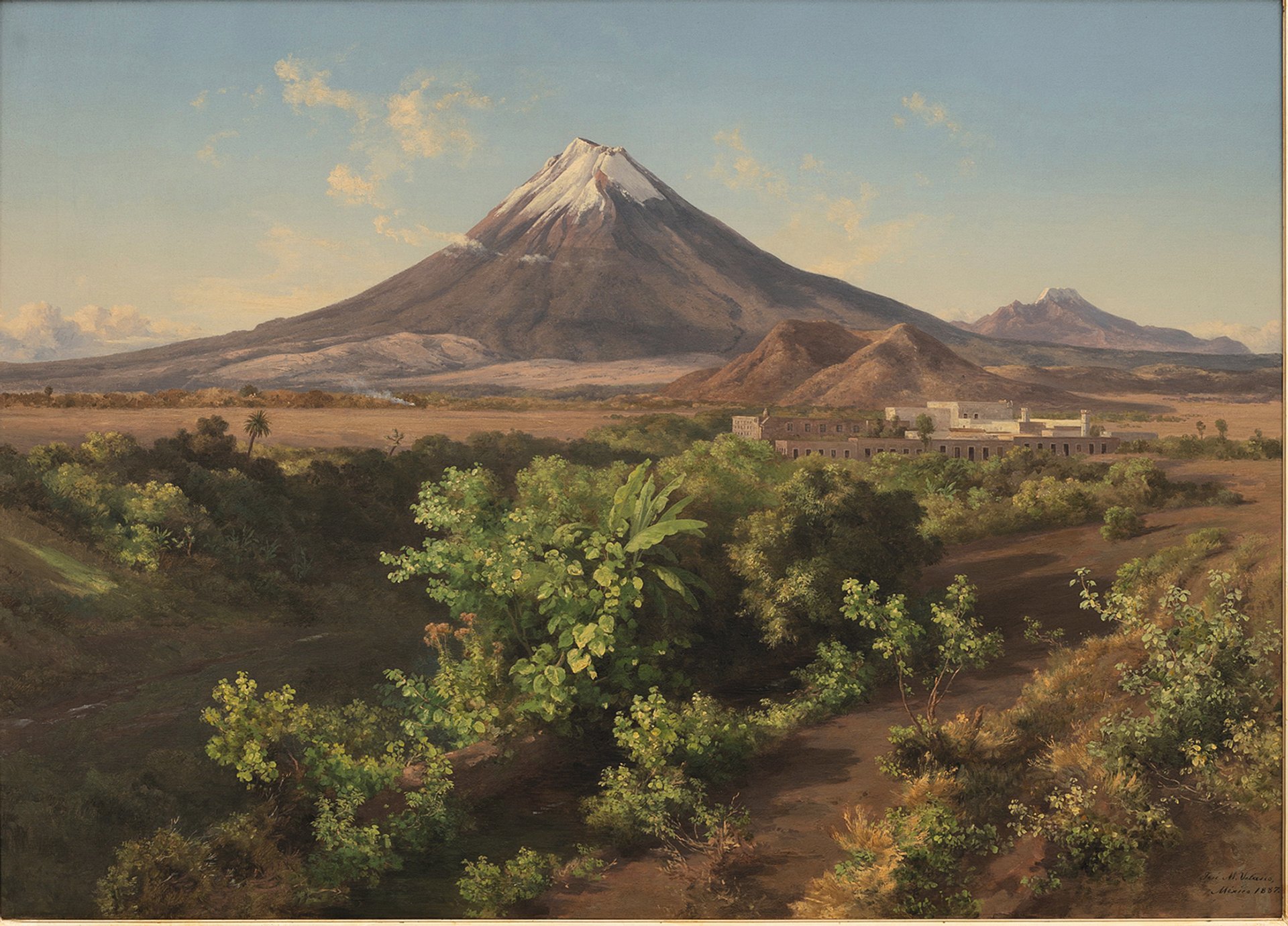
Velasco’s The Textile Mill of La Carolina, Puebla (1887), depicting the impact of industrial development on landscape Photo: Denisa Dimitrovova; © The National Museum of the Czech Republic, Prague
There are lots of well-known Mexican artists—Frida Kahlo, Diego Rivera, Rufino Tamayo, to name but three—but how come we have not heard of Velasco?
He’s always been well known in Mexico, but he dropped out of favour; and his work was never inserted into the European-centric canon of art history. He wasn’t in the right place at the right time. But now we’re at a time of revisionism, and we’re looking at artists whose work was marginalised.
Velasco was all about observation, observation of a changing world. And if we want art history to change, we need to include artists in creating shows because practising painters can find marginalised painters who they think are important because of painting itself, who should be looked at again.
Why the National Gallery for this exhibition?
The National Gallery has a huge 19th-century collection, but the only painting which references Mexico is Manet’s The Execution of Maximilian (around 1867-68), an event that happened during Velasco’s lifetime. This show of Velasco’s work will be the first time the National Gallery has had an exhibition of the work of an historic Latin American artist.
How has Mexico influenced your work?
When I went back to England after my first visit, I did a series of paintings about Mexico, and that became an exhibition in 2021 in Mexico City. It was called This Doesn’t Belong to Me, and it was about dates and making images that relate to the idea of markers in time as dates in history.
And then you decided to up sticks and move to live there?
After Saint Martin’s [School of Art, London] I lived in India for a while, and I used to go back there sometimes. But coming to Mexico was a shock because I realised the phenomenal impact of history on this country, its ancientness threaded with its present.
History painting has long been the core of your work. So your fascination with Mexico was to do with that?
What I’ve been most interested in since the early 2000s is how to do a contemporary version of a history painting. Because alongside talking about artists who’ve been marginalised historically, there are also questions about how genres of painting have been marginalised. For example, history painting in the 18th century was the top of the hierarchy and then that completely changed. I’m interested in artists who kept going with the idea of history and rethinking it, and I’m also interested in how times change, and how some work no longer has the same impact it had when it was made.
I’ve been looking at how to make paintings that don’t look like landscapes, but have that intent
Dexter Dalwood
Presumably your next work will bounce off Velasco?
I don’t want to pre-empt it too much. But I’ve been looking at landscape as genre and how to make paintings that don’t look like landscapes, but have that intent. What I’m interested in with Velasco is a painting that’s more of a state of mind—a figment of the imagination.
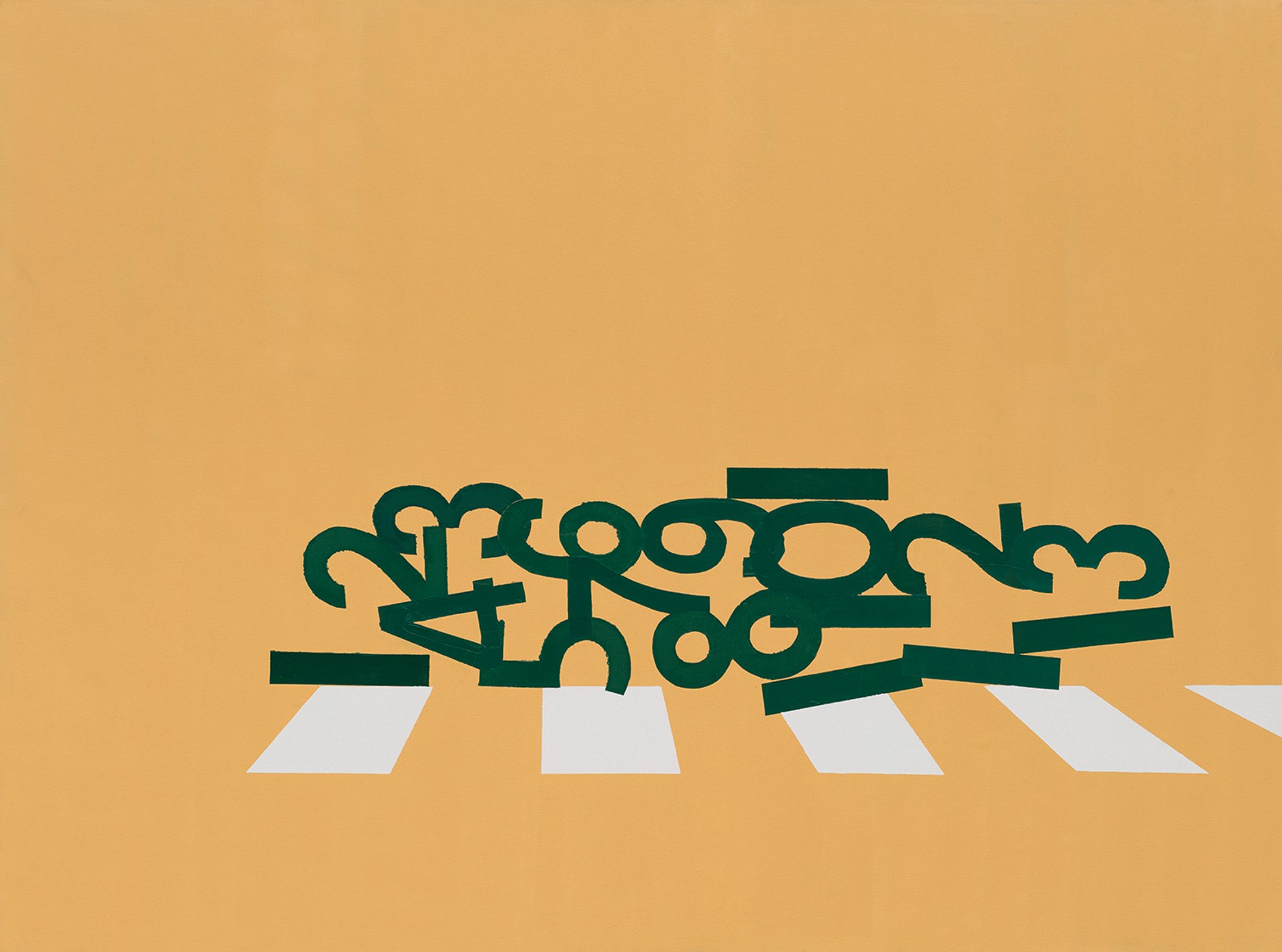
Dalwood painted Bloody Sunday in 2023, a year after the 50th anniversary of a civil rights march in Northern Ireland in which British soldiers killed 14 people. Much of his work includes numbers and letters © Dexter Dalwood; Courtesy of Lisson Gallery.
You have always used numbers and words—will you use those in your new work?
I’m interested in text because it becomes like a strange punctuation, a full stop thing, stating the obvious. And I’ve become interested in numbers that represent something and become something else, physical elements in the painting.
The new work won’t be about time in the same way. But in a painting like Bloody Sunday I used the numbers to become figures falling—I have 1973 cascading from the sky. Dates won’t be as prevalent in the new work but I’m playing with different ideas. I want to include numbers and text in some way. It’s part of a lexicon. Putting a number in something creates a real scale, [while] a word creates its own real scale.
Do you always work from an existing painting?
I often start from something I’ve already seen but the image I end up with is often very different. For a decade I made a collage for every painting, so it was almost a template.I don’t do that anymore, but I still use fragments of different things to build up an image. A big part of my art is music: with the Lisson show, though it was about the idea of English painting as a genre, I thought about how growing up I was more influenced by music than by art. And I wanted my work to reflect that. So one piece was called Rise Up, and it’s a set of speakers. I wanted people to think about the relationship of David Bowie to Ben Nicholson and Gainsborough and punk.
Biography
Born: 1960 Bristol
Lives and works: Mexico City
Education: 1985 Saint Martin’s School of Art, London; 1990 Royal College of Art, London
Key shows: 2021-22 Centro de las Artes de San Agustín, Oaxaca; Museo Nacional de Arte (MUNAL), Mexico City; 2013 Kunsthaus Centre PasquArt, Biel, Switzerland; 2010 Centro de Arte Contemporáneo Málaga; FRAC Champagne-Ardennes, Reims; Tate St Ives
Represented by: Lisson Gallery
• José María Velasco: A View of Mexico, National Gallery, London, until 17 August


