

Paintings by Diego Velázquez are a rarity. Numbering around 120, with some 50 of those concentrated in the permanent collection of Madrid’s Museo del Prado, they can typically be found in the world’s other great museums in the low single digits, if that, with less than ten thought to be in the hands of private collectors.
This month it was revealed that those numbers may need some tweaking, according to Salvador Salort-Pons, the director of the Detroit Institute of Arts (DIA) and a noted Velázquez scholar. He made his case in ARS Magazine, the Madrid-based art quarterly, that he has located a 1626 Velázquez portrait of the Spanish statesman Gaspar de Guzmán, Count-Duke of Olivares, in a private collection.
A favourite of the Spanish king Philip IV, Olivares was instrumental in installing the young Velázquez as court painter in 1623 and became a frequent subject for the artist. The newly discovered work, which may help shed light on Velázquez’s early years in Madrid, shows Olivares dressed in gold-trimmed armour set off by a glistening red sash.
The discovery of The Count-Duke of Olivares in Armour was marked by a dramatic coincidence, Salort-Pons tells The Art Newspaper.
Commissioned as a gift from Olivares to the cardinal Francesco Barberini, the powerful nephew of Pope Urban VIII, the work appeared in Barberini’s Roman inventory but was then forgotten for centuries. Its potential existence only re-emerged in 1970, in published diary extracts of a 17th-century papal diplomat.
Note the sash and armour in Velázquez’s Philip IV (1626-28) Courtesy Museo Nacional del Prado, Madrid
Salort-Pons, long interested in connections between Spain and Italy, looked for traces of the work in the early 2000s. Coming to the conclusion that the painting was either lost or in an unknown location, and long intrigued by the topic, he began to plan a small DIA exhibition in 2024 that would bring together other noted examples of Velazquez’s 1620s depictions of Olivares. Then, in 2025, he says, “someone emailed me”.
The Olivares portrait was being cleaned in a Madrid restoration studio. Previously, it was believed to be “from the workshop of Velazquez”, says Salort-Pons. Asked to have a look, he made his way to Madrid at the end of 2025. “When I saw it,” he recalls. “I recommended doing technical analysis.”
The results were astounding. X-rays, ultraviolet imaging and infrared analysis placed the painting firmly in the artist’s works of the 1620s, Salort-Pons says. There was “a perfect match of the pigments” that Velázquez used at the time, he notes, and the thread count of the canvas matched the thread count of three other Velazquez works, including a portrait of the young king, Philip IV (1626–28), also in armour and sash. In addition, x-rays revealed important alterations in composition—another key aspect of Velázquez’s early Madrid works.
Initially, Salort-Pons says, Velázquez depicted Olivares in a black outfit with what appears to be fur lining, changing his mind to portray him instead in military garb. Similarly, analysis of the Prado portrait of the king revealed black garb that was later replaced with armour and sash.
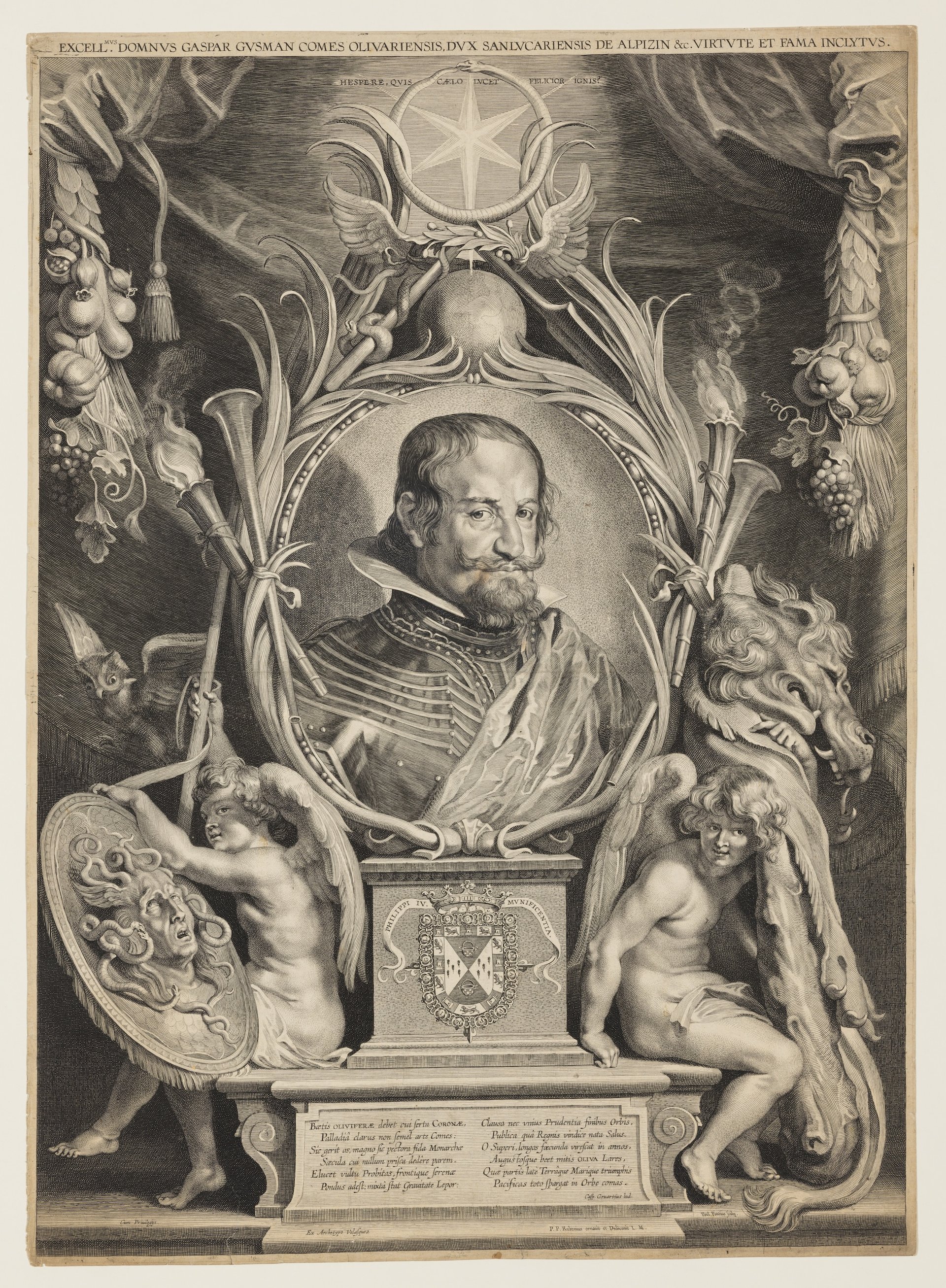
Paulus Pontius’s Gaspar de Gusman, Count of Olivarez (around 1626) Courtesy the Metropolitan Museum of Art, New York
Before his article came out earlier this month, Salort-Pons kept quiet. “I told my wife,” he says, and he notified the Prado of the discovery. He is currently finalising the loan of the armour portrait of the king to the DIA show.
Velázquez and Olivares: Early Years at Court will open in Detroit in January 2027, featuring Velázquez’s well-known 1620s portraits of the statesman from New York City’s Hispanic Society and Brazil’s São Paulo Museum of Art. Additionally, the show will include a 1626 print by the Flemish artist Paulus Pontius that combines allegorical elements from an Olivares portrait by Peter Paul Rubens, who himself was a visitor to the Spanish court in the 1620s, with what seems to be a bust based on the newly resurfaced Velázquez portrait.
The discovery is “a big deal”, says the Velázquez scholar Giles Knox, a professor of art history at Indiana University Bloomington. These early works are important in charting the artist’s progress, he says, which took place at a time of great suspicion and hostility. “The old-guard painters hated him,” Knox says, forcing the young artist to “prove that he was worthy of his position as painter to the king”.
The resurfaced Olivares portrait attests to the young painter’s concerns. On Olivares’s shoulder, at right, there is space for two rivets in the armor but one is missing, creating a subtle but compelling trompe l’oeil effect in the form of a tiny hole. This detail—missing from the otherwise similar Pontius print—was added “to show Velazquez’s great skill as a painter,” Salort-Pons says.
The logical place for a work of this caliber and importance is the auction block, and a fitting permanent home for it would be the Prado itself. The Madrid museum, in spite of its vast Velázquez holdings, does not possess any of the artist’s early Olivares painted portraits. But Salort-Pons is careful not to reveal any details about the painting’s fate beyond its place in the upcoming DIA show. “I will tell you one thing,” he adds. “If I owned it, I would keep it.”


