

A leading archaeologist has warned of destruction faced by a 50,000-year-old rock art site on the remote Western Australian coast after a controversial Australian government decision this week to extend the life of an adjacent gas mega-project.
Environment Minister Murray Watt approved Woodside Energy’s bid to extend its liquified natural gas operations on the Burrup Peninsula (also called Murujuga) by 40 years until 2070.
Pollutants resulting from this decision will put at grave risk the estimated one million individual petroglyphs on the Burrup, including the world’s first depictions of human faces, according to Benjamin Smith, an archaeology professor at the University of Western Australia.
Smith tells The Art Newspaper the petroglyphs could still be preserved if Woodside Energy committed to “simple” innovations such as electrifying the plant’s entire process.
As for damage already done to the petroglyphs by air-borne pollutants from the Woodside plant, Smith says special micro bacteria, which continue to flourish naturally on the islands near Murujuga, can be used to stabilise the petroglyphs and prevent further erosion.
“If we clean up their act, actually those (rock) surfaces can become strong again, and even the holes could get filled in by these little micro bacteria,” Smith says. “But they only live and operate if those rocks are at the right conditions, and they can’t live and operate when there’s pollution.”
The North West Shelf project © Save our Songlines
Woodside has been given ten days to respond to confidential conditions placed by Watt on his decision to give Woodside its requested extension. Until those conditions are known, Smith is determined to “keep up the pressure” on the newly re-elected Labor government of Anthony Albanese.
“As a scientist, I’d like to see those conditions be strict; we need to ensure that the operations don’t continue to damage the rock art,” Smith says. “The first time we’ll see those conditions is when they’re made public and by that point it’s too late (to change them).”
He says it was unusual that Woodside was given the right to negotiate with the government on the conditions. “That’s not the way it would work in most parts of the world,” he says. Murray Watt this week told the media the conditions relating to air quality were “strict”.
Smith says Murujula was unique in encompassing over a million items of rock art in one site. It was also some of the oldest rock art in the world. “Just to put it in context, the oldest rock art in Europe is some 34,000 years old,” he says.
The “ghostly faces” that look out from the rocks are the oldest known depictions of the human face. Other images depict extinct animal species, and food varieties hunted by Indigenous people of the area.
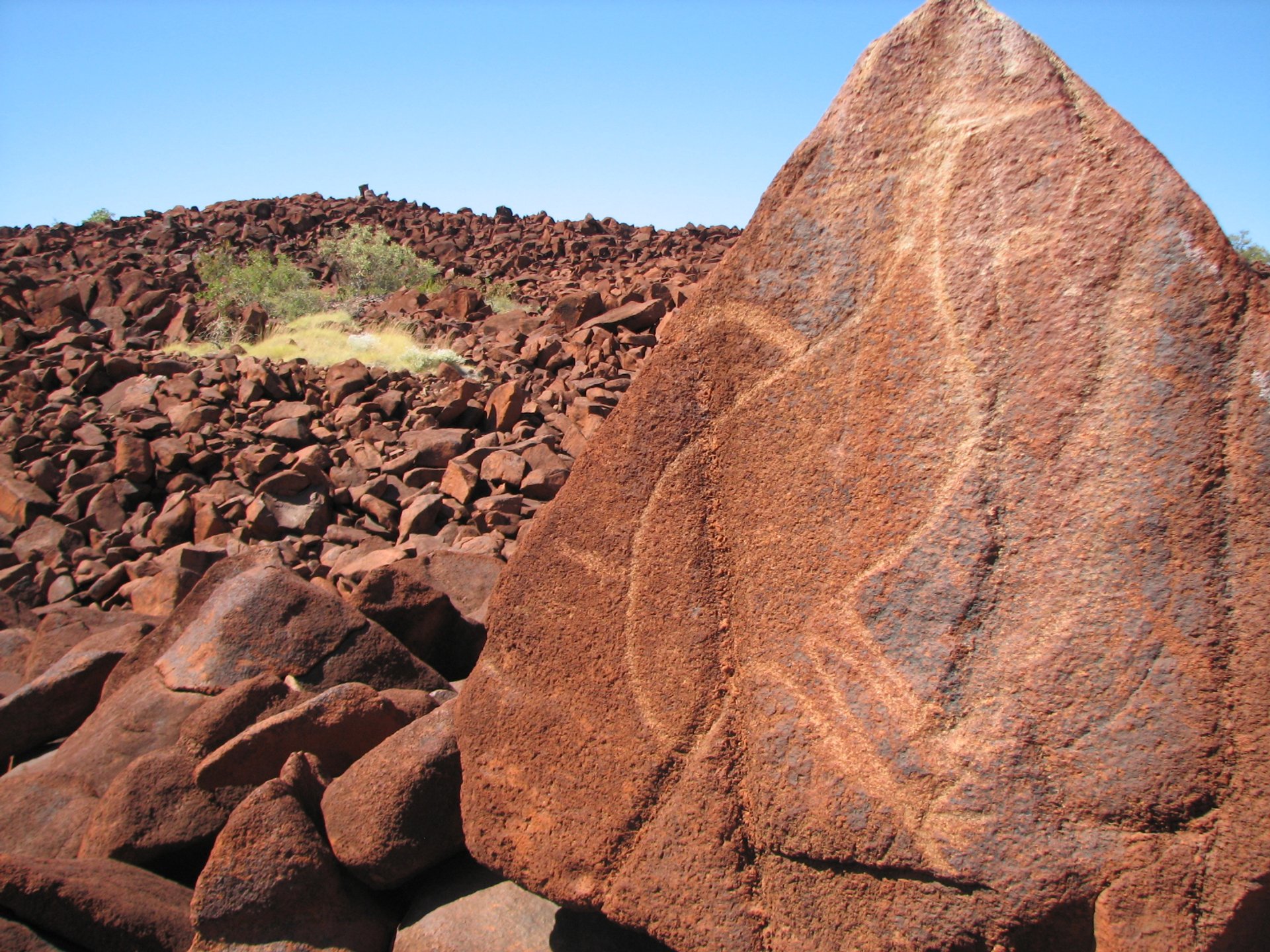
A petroglyph of an emu © Save our Songlines
Another unique feature of the Murujula petroglyphs is that Indigenous Australians were still adding to them until the time of European settlement. “With the European cave art, it cuts off, and we’ve lost the memory and the connection,” Smith says. “Aboriginal people still have that memory, they have the connection.”
Woodside Energy’s gas plant at Murujuga is one of the world’s largest liquified natural gas projects.
According to a statement on the Australian Conservation Foundation website, Woodside’s plans to expand the so-called Burrup Hub “would make it the largest new carbon bomb in the South Hemisphere and in the top ten most polluting fossil fuel developments in the world”.
“A carbon bomb is a fossil fuel project that will produce over one billion tonnes of carbon pollution,” the ACF statement said. “This proposed expansion is a climate disaster in the making, and a complete contradiction to Woodside’s net-zero pledge.”


