

Contemporary art has increasingly turned towards the edges of perception, where science, philosophy and lived experience begin to blur. Across installation, moving-image and immersive sculpture, artists are no longer content to represent the world as it appears; instead, they construct environments in which alternative ways of knowing can be felt, sensed and momentarily inhabited. In this expanded field, Laure Prouvost has become a defining figure, developing a practice that transforms language into sensation and thought into atmosphere. Her work resists fixed interpretation, instead unfolding through humour, fragmentation and poetic association. With We Felt A Star Dying opening at the Grand Palais, she extends this inquiry into the elusive terrain of quantum physics. The exhibition positions perception itself as unstable, shaped less by certainty than by relation, probability and entanglement.
Born in France in 1978, Prouvost trained in experimental video and emerged internationally following a career that included working as an assistant to the conceptual artist John Latham. Her recognition was cemented with the Turner Prize in 2013, yet her practice has consistently resisted the formal boundaries that prize implies. Across film, installation and sculptural environments, she constructs narrative systems that behave more like ecosystems than linear stories. Meaning is generated through drift, mishearing and sensory overload, rather than direct statement. Words become unstable objects, slipping between languages and registers. Images behave similarly, shifting between documentary clarity and dreamlike distortion. This instability is structural, forming the basis of how her work engages the viewer.
At the core of Prouvost’s practice is the idea of translation – not simply between languages, but between registers of experience. She has described her work as “an act of translation, a sensory elaboration of emotions, perceptions, and suspended moments”. In this sense, translation becomes a way of thinking through art rather than a means of clarifying it. Her installations invite audiences to abandon the expectation of resolution and instead enter states of partial understanding. In doing so, she aligns with a broader tendency in contemporary art that treats ambiguity as productive. This approach becomes especially significant in We Felt A Star Dying, where scientific language is metabolised into effect.
Her approach can be understood in conversation with wider contemporary practices that dismantle fixed systems of perception. The work of Tomás Saraceno, for instance, constructs airborne architectures and speculative ecologies that reposition humans within interdependent networks. Like Prouvost, Saraceno uses immersive installation to shift perception away from individual perspective towards systemic entanglement. Where Saraceno often draws on environmental science, however, Prouvost turns inward towards the subjective textures of language and sensation. Both practices converge in their refusal of stable viewpoint, suggesting that reality is experienced as a field of relations rather than isolated objects.
Similarly, the work of Hito Steyerl offers another point of resonance, particularly in her exploration of technological infrastructures and the circulation of images. Steyerl’s essays and installations dissect the political and perceptual conditions of digital life, revealing the ways in which visibility is constructed. While Prouvost’s language is more poetic, both artists are concerned with the instability of representation and the collapse of distance between observer and system. In Steyerl’s case, this often manifests as critical analysis; in Prouvost’s, it becomes immersive experience. However, both can be read as interrogations of how perception is shaped by invisible forces – whether technological, linguistic or conceptual.
A further parallel can be drawn with Pierre Huyghe, whose installations construct autonomous or semi-autonomous environments in which human and non-human agencies coexist. Huyghe’s works often unfold over time, generating conditions rather than fixed outcomes. In this sense, they echo Prouvost’s interest in works that behave as living systems rather than static objects. However, where Huyghe often emphasises ecological indifference and post-human detachment, Prouvost foregrounds intimacy, humour and affect. Her environments are not cold systems but sensorially saturated spaces, inviting touch, smell and emotional response. Taken together, these artists articulate a shared concern with rethinking agency, perception and materiality beyond anthropocentric frameworks.
Within this wider field, We Felt A Star Dying extends Prouvost’s exploration into quantum physics as both concept and metaphor. Developed following two years of research with philosopher Tobias Rees and scientist Hartmut Neven, the project engages with quantum computing and the philosophical implications of probabilistic reality. Quantum physics, which replaces certainty with probability and fixed states with relational conditions, becomes a way of reimagining perception itself. Prouvost asks what it might mean to feel reality from within such a framework, where outcomes are continuously negotiated. The result is not a didactic translation of science into art, but an attempt to render scientific uncertainty emotionally legible.
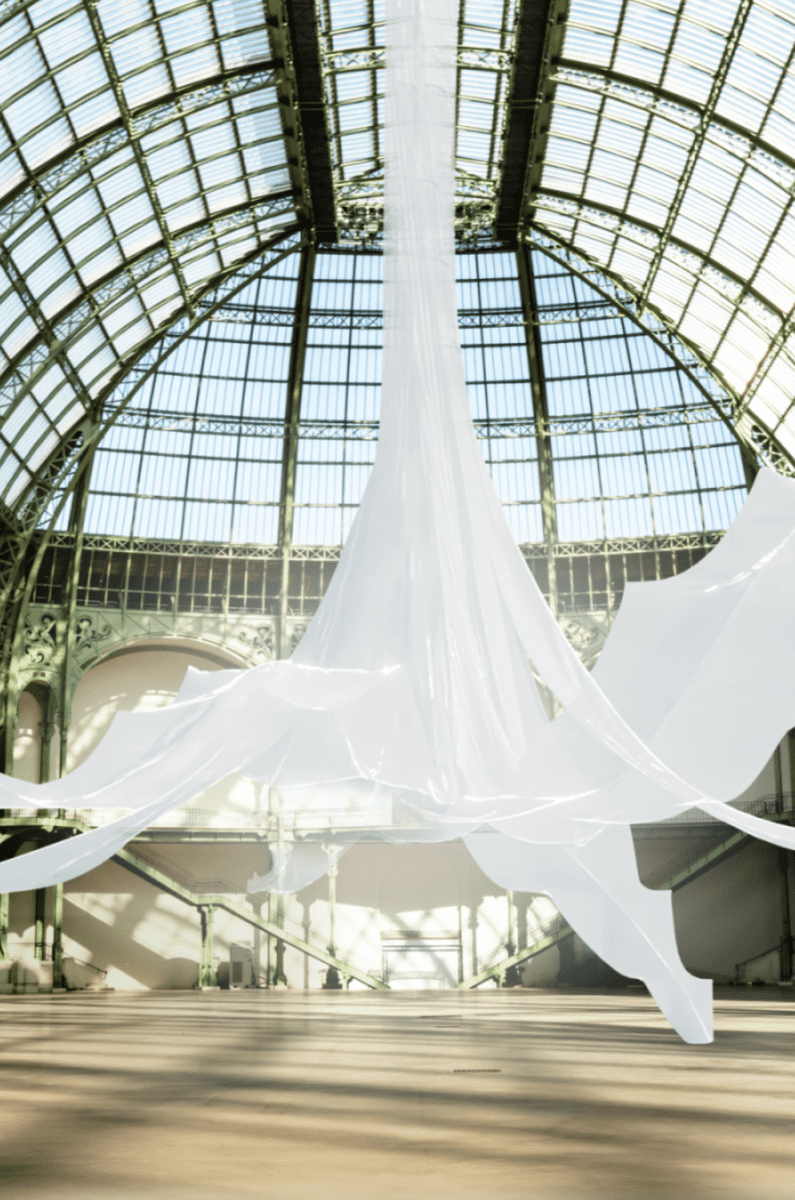
Originally commissioned by LAS Art Foundation and first presented at Kraftwerk Berlin in 2025, the work has been reconfigured for the Grand Palais, where its architectural context fundamentally alters its meaning. In Berlin, the installation unfolded in darkness; in Paris, it is exposed to daylight beneath the vast glass vault of the North Nave. This inversion is not merely aesthetic but conceptual, producing a shift in the work’s perceptual logic. The exhibition becomes less about immersion in darkness and more about exposure within transparency. In this way, the environment itself behaves almost like a scientific variable.
The visitor’s journey begins with a tunnel, a recurring structural motif in Prouvost’s practice that functions as both threshold and transformation. Moving through it marks a transition from the everyday into a space governed by different rules of attention and perception. It is not simply an entrance but an initiation, preparing the body for a recalibration of sensory expectation. Emerging from this passage, viewers enter a field where orientation is no longer stable. Scale, direction and distance begin to fluctuate, echoing the conceptual instability of the quantum frameworks underpinning the work.
At the centre of the installation stands The Beginning, a monumental kinetic sculpture with six limbs, animated through light and sound. It appears at once mechanical and organic, cosmic and terrestrial, stable and continuously shifting. Its presence dominates the space while refusing fixity, operating as a kind of perceptual anchor that simultaneously dissolves. Around it, movement and sound circulate in shifting intensities, creating a field in which perception is constantly reconfigured. The sculpture does not represent a system so much as enact one, embodying the instability that structures the show as a whole.
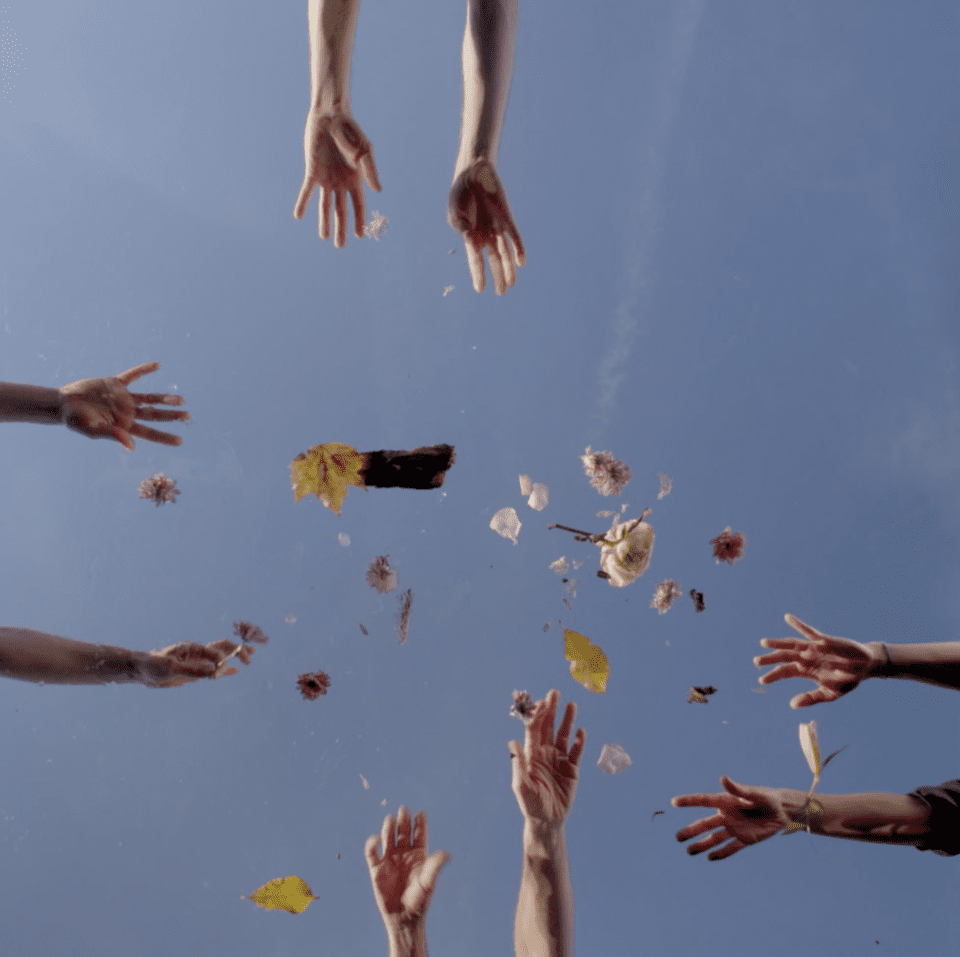
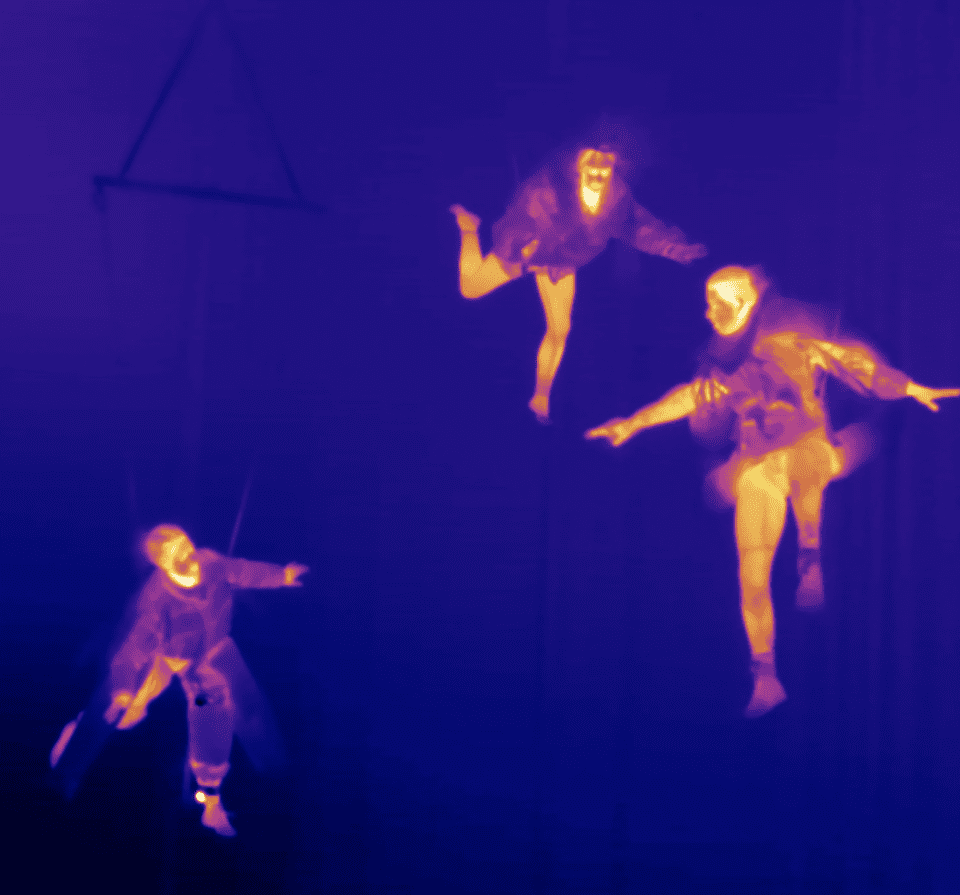
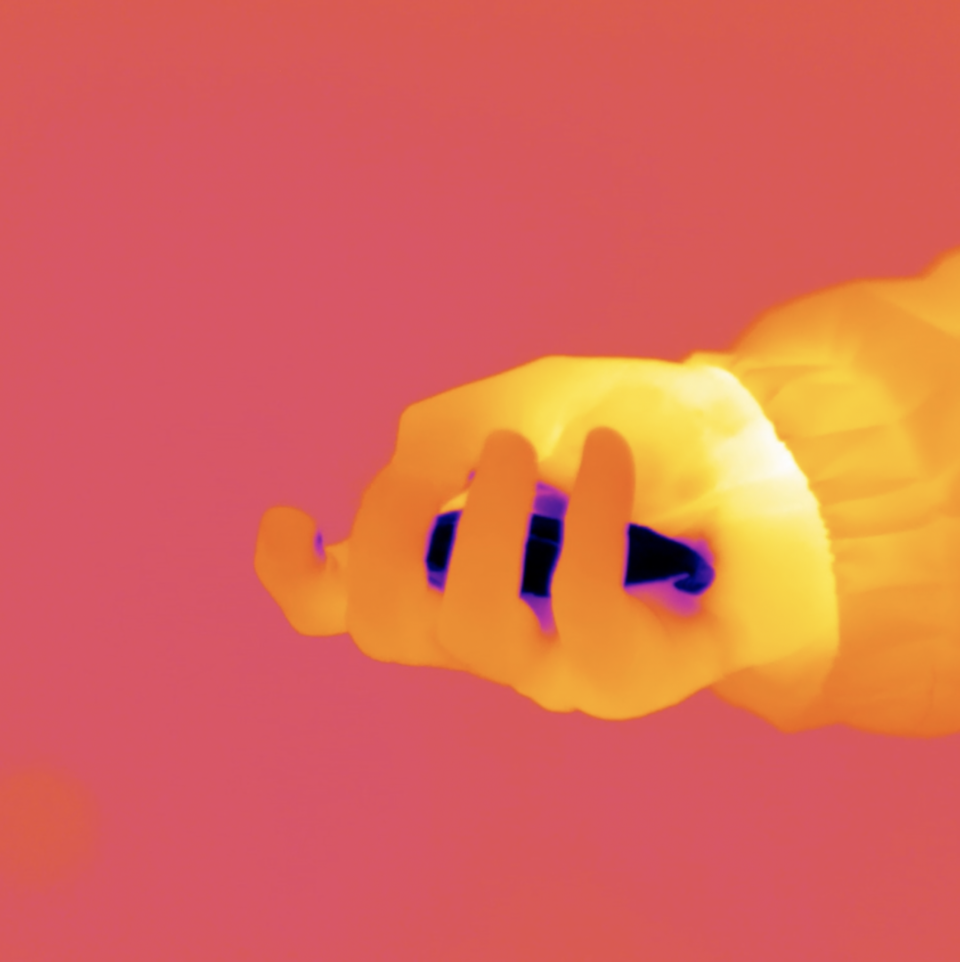
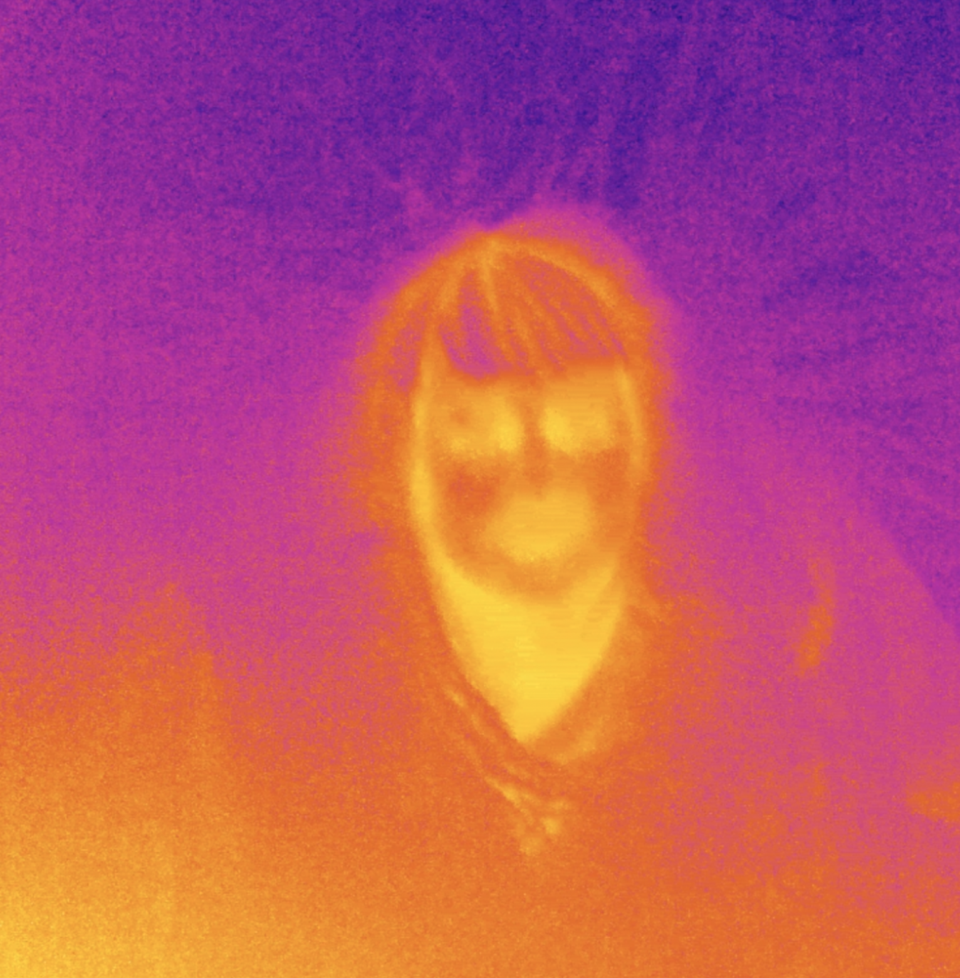
Within this environment, the film We Felt A Star Dying extends the work’s conceptual reach into cosmological and molecular scales. Rather than presenting a linear narrative, it constructs a sequence of visual and sonic fragments that move between registers of scale and materiality. Living and non-living systems, organic and technological forms, microscopic and astronomical perspectives are interwoven into a fluid visual field. The effect is less interpretative than experiential, encouraging viewers to sense interconnectedness rather than understand it intellectually. The film becomes a meditation on relation itself, echoing the entangled logic of the quantum systems it references.
Suspended throughout the nave are the Cute Bits, sculptural forms derived from “qubits”, the fundamental units of quantum computation. These objects appear as meteorite-like bodies, paired and suspended in delicate relational configurations. Their arrangement evokes the quantum phenomenon of entanglement, in which the state of one particle is linked to another regardless of distance. In translating this principle into sculptural form, Prouvost renders abstract scientific theory as choreography and spatial tension. The works do not explain entanglement; they stage it as a visual and bodily experience within space.
Some of the Cute Bits also function as sensory devices, incorporating sound and scent within helmet-like forms. Metallic and mineral aromas accompany disembodied voices, extending the installation into olfactory and auditory dimensions. Elsewhere, visitors encounter soft platforms and enveloping cushions that encourage reclining and prolonged looking. Filaments from The Beginning brush against the body as people move through the space, collapsing distance between artwork and viewer. Light shifts continuously across the nave, producing moments of intensity and dissolution. These elements combine to create an environment in which perception is never stable but always in formation.
We Felt A Star Dying proposes a reorientation of how knowledge itself might be felt. Rather than treating quantum physics as a subject to be explained, Prouvost transforms it into an experiential condition – something encountered through atmosphere, texture and duration. In doing so, she aligns with wider contemporary practices that challenge the dominance of rational clarity in favour of embodied uncertainty. Yet her contribution remains distinct in its insistence on humour, tenderness and sensory excess. The exhibition suggests that to understand the world differently, one must also feel it differently. Beneath the vast light of the Grand Palais, Prouvost offers not an answer, but a state of attention attuned to instability – where meaning flickers, dissolves, and briefly, luminously, comes into being.
Laure Prouvost: We Felt a Star Dying is at Grand Palais, Paris until 26 July: grandpalais.fr
Words: Shirley Stevenson
Image Credits:
1. Laure Prouvost, film still We Felt A Star Dying, 2025 © Laure Prouvost © ADAGP, Paris, 2026.
2. Laure Prouvost, Nous, frissons d’étoiles, 2026. Image made in collaboration with Diogo Passarinho Studio © ADAGP Paris 2026 Photograph © Simon Lerat for Grand Palais.
3. Laure Prouvost, film still We Felt A Star Dying, 2025 © Laure Prouvost © ADAGP, Paris, 2026.
4. Laure Prouvost, film still We Felt A Star Dying, 2025 © Laure Prouvost © ADAGP, Paris, 2026.
5. Laure Prouvost, Nous, frissons d’étoiles, 2026. Image made in collaboration with Diogo Passarinho Studio © ADAGP Paris 2026 Photograph © Simon Lerat for Grand Palais.
6. Laure Prouvost, film still We Felt A Star Dying, 2025 © Laure Prouvost © ADAGP, Paris, 2026.
7. Laure Prouvost, film still We Felt A Star Dying, 2025 © Laure Prouvost © ADAGP, Paris, 2026.


