

The opening of V&A East Storehouse signals a recalibration in how institutions might live with their collections, not as static reservoirs of heritage but as permeable, operational spaces of encounter. Set within the wider emergence of V&A East, the Storehouse reframes access as a continuous condition rather than an occasional event, dissolving the distance between storage, study and display. It arrives at a moment when museums are increasingly asked to perform not authority but to open their infrastructures to forms of public legibility that were once hidden. Its arrival also invites comparison with the Depot Boijmans Van Beuningen in Rotterdam, where transparency and verticality have already recast the museum store as a civic spectacle of preservation. Yet, where Rotterdam foregrounds architectural visibility, V&A East leans into choreography – a lived circulation between objects, bodies and interpretation. In both cases, the logic of the back-of-house is inverted, and the museum becomes a system of unfolding relations. What emerges is a new grammar of engagement, in which proximity rather than reverence structures experience.
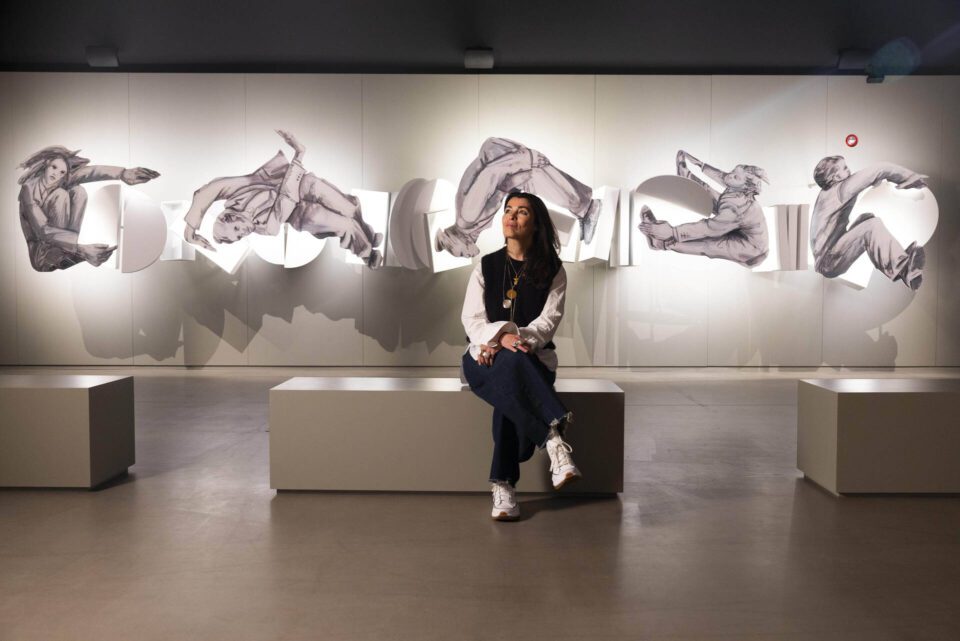
Within this shifting institutional terrain arrives a new commission that fully exploits its possibilities: Es Devlin’s The Everythingists (2026). Installed at V&A East Storehouse, the work sits in direct dialogue with Natalia Goncharova’s monumental Firebird (1926) backcloth, itself a theatrical relic of extraordinary scale and imagination. Their co-presence until 18 October forms a conceptual hinge between modernist stagecraft and contemporary spatial thinking. Curated by V&A East Senior Curator Madeleine Haddon, the commission is part of a rotating programme that invites artists to respond to east London’s layered histories. It positions Devlin within a broader ecology of practitioners including Tania Bruguera, Lawrence Lek, Rene Matić, Shahed Saleem, Justinien Tribillon, Carrie Mae Weems and Laura Wilson. Together, they frame east London as an evolving narrative surface, shaped by migration, industry, and cultural reinvention.
Es Devlin occupies a distinctive position in contemporary visual culture, operating at the intersection of sculpture, performance, architecture and collective authorship. Her practice consistently treats audiences as temporary societies, activated through light, sound and textual assembly, where meaning emerges through shared attention rather than passive viewing. From monumental stage environments for global music tours to operatic installations such as Tristan und Isolde (2026) at the Metropolitan Opera, she has redefined what scenography can mean in the expanded field, collapsing distinctions between set design, exhibition-making and civic sculpture. Works like Library of Light (2025) in Milan and Library of Us (2025) in Miami extend her interest in reading as spatial encounter. She has repeatedly transformed civic and commercial spaces into sites of collective authorship, whether through Olympic ceremonies, mirrored installations, or immersive public sculptures that invite participation. Her practice has been recognised through awards including the Tony Award, multiple Olivier Awards, and a CBE.
The sonic and choreographic dimensions of The Everythingists are shaped in collaboration with a network of artists whose practices extend its conceptual reach. Sound designers and composers Jade Pybus and Andy Theakstone, working as Polyphonia, construct layered vocal environments that treat polyphony as both musical technique and social model. Their practice understands sound not as accompaniment but as spatial architecture, where voice operates as material capable of shaping perception and atmosphere. The work of Polyphonia frequently emerges from site-responsive conditions, engaging architecture as a score that informs rhythm, density and emotional register. Choreography is led by Botis Seva, whose hip hop theatre practice with Far From The Norm has consistently challenged the formal boundaries of contemporary dance through emotionally charged movement vocabularies. Performer Joshua Shanny-Wynter extends this language into the installation through a physical grammar shaped by krump, popping and narrative improvisation. Together, these collaborators unify sound, body and object as inseparable systems.
At the centre of the commission is Devlin’s engagement with Goncharova’s Firebird, a work originally conceived for the Ballets Russes revival of Stravinsky’s 1910 score. With its layered cityscape of towers and imagined Kremlin walls Backcloth was once described as a “richly decorative pattern” that collapsed architectural fantasy into stage illusion. Yet its density also produces a form of visual overload, where ornament and structure merge into a dense, rhythmic visual field. In Devlin’s reading, it becomes a historical engine rather than a static image – a precursor to contemporary debates around system, network and infrastructure. Goncharova’s affiliation with Rayonism and the broader Everythingism movement situates her practice across painting, theatre and design, breaking down disciplinary boundaries before hybridity became institutionalised. Her view of décor as an autonomous art form resonates with Devlin’s approach, where scenography acts as a proposition rather than support.
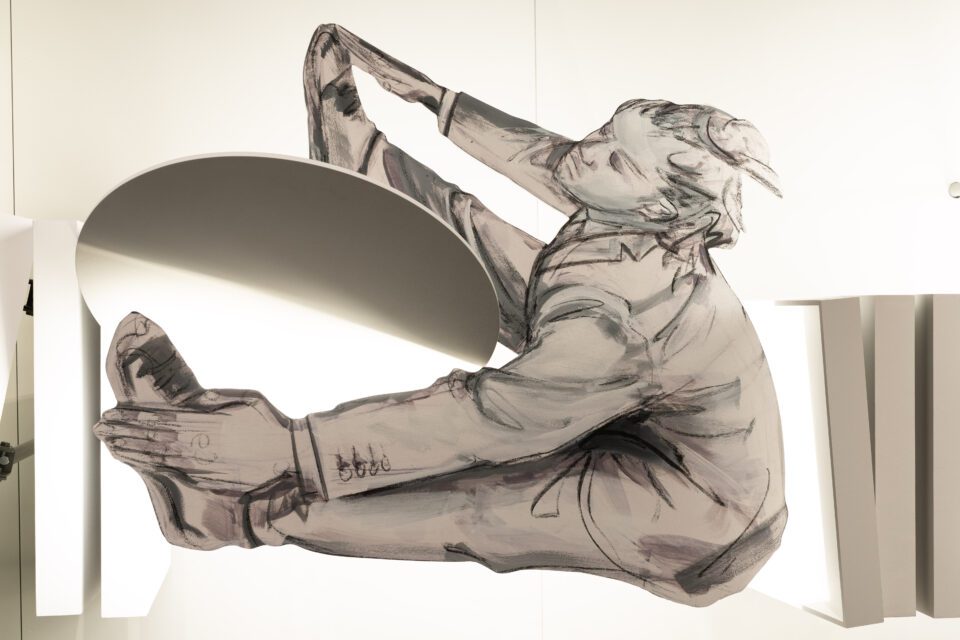
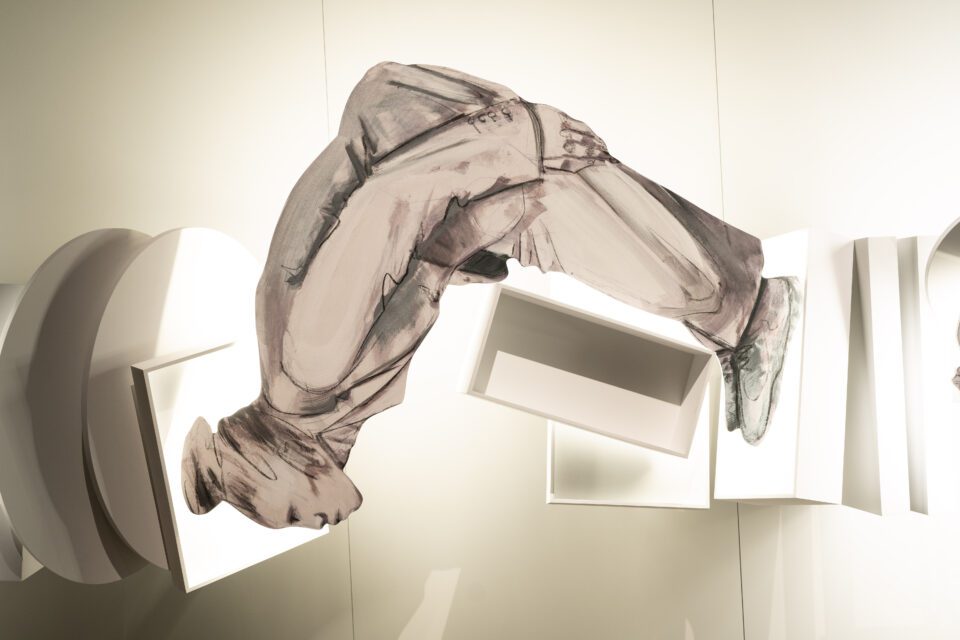
The Everythingists extends this lineage into the present through a set of conceptual provocations drawn from early modernist manifestos and speculative technological futures. Devlin engages with Goncharova and Mikhail Larionov’s 1913 Rayonist Manifesto, replacing stable representation with light, energy and fragmentation. This is placed in dialogue with contemporary reflections on machine–human entanglement, including Cory Doctorow’s centaur and reverse-centaur frameworks, which reconsider agency in technologically mediated systems. These ideas are embedded within an environment of illuminated plywood forms that echo both storage crates and digital packaging systems, suggesting that infrastructure itself has become aesthetic language. The dancer’s body moves through these rectilinear structures as though navigating between classification systems and overflow. What emerges is a space where historical abstraction and computational logic coincide as a frictional encounter.
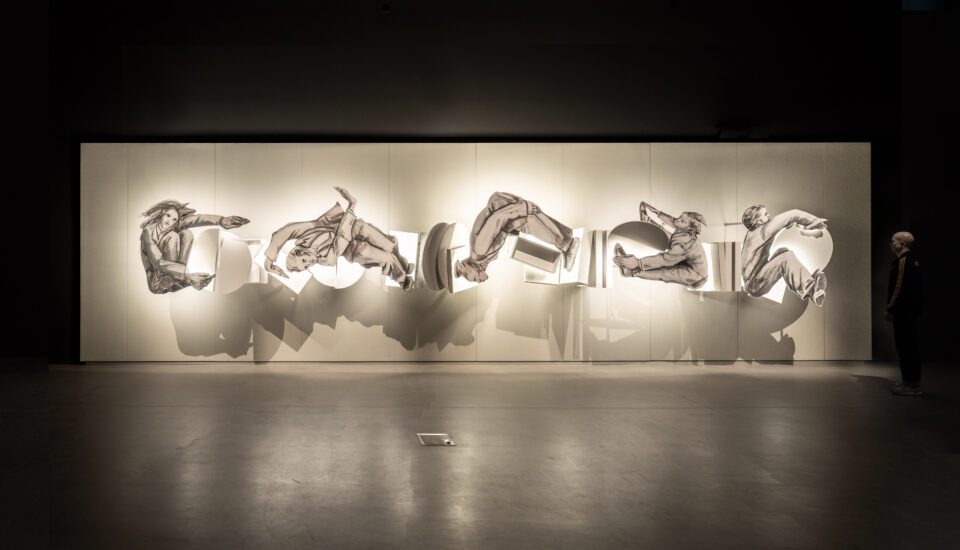
This collision is intensified through a cyclical dramaturgy in which the installation is periodically animated by light, voice and sound. Every ninety seconds, illumination shifts across the structure while Devlin’s recorded narration activates a layered textual score. The soundtrack, composed by Polyphonia, draws on the horn motif from Stravinsky’s Firebird Suite, historically associated with transformation, awakening and release after chaos. Within this sonic architecture, fragments of text are spoken from Goncharova’s writings, early 20th century manifestos, and speculative literary works including Adrienne Rich’s Centaur’s Requiem (2003) and Clark Ashton Smith’s The Centaur (1958). The result is a layered accumulation rather than a narrative, where sound acts as both archive and generator, carrying memory while reshaping space.
The presence of Firebird within the Storehouse context complicates the relationship between preservation and performance. Originally created for Diaghilev’s Ballets Russes in 1926, the set was designed by Goncharova to embody a mythic vision of Holy Russia at the moment of its perceived disappearance into political transformation. Its revival history across London, Monte Carlo and Paris underscores its mobility as both artefact and idea. In dialogue with Devlin’s commission, it reads not only as historical document but as proposition – a way of understanding how images persist through repetition, displacement and reinterpretation. The Storehouse, with its pronounced emphasis on visibility and access, becomes the stage upon which this endurance is reactivated, reframing storage as performative condition. What is stored is not only material but interpretive potential, reactivated through encounter.
The Everythingists positions V&A East Storehouse as more than an architectural innovation – it is a testing ground for new forms of attention. Devlin’s installation refracts the logic of storage into something closer to choreography, where objects, bodies and texts circulate within shared temporal conditions that resist fixed hierarchies. The work suggests that collections are not endpoints but active systems of relation, constantly rewritten through encounter, context and proximity. In bringing together Goncharova’s modernist expansiveness, Devlin’s interactive spatial dramaturgy and the embodied, responsive practices of her collaborators, the commission holds multiple historical and speculative registers in uneasy proximity. Nothing resolves into closure here – instead, the Storehouse reads as a dynamic site where interpretation remains in motion, continuously reassembled in light, sound and movement, and where the act of looking itself becomes part of the work’s ongoing construction.
The Everythingists is at V&A Storehouse, London until 18 October: vam.ac.uk
Words: Shirley Stevenson
Image Credit:
1&5. Es Devlin, The Everythingists, 2026. V&A East Storehouse.
2. Es Devlin The Everythingists, 2026. V&A East Storehouse, Detail 1.
3. Es Devlin with ‘The Everythingists’, V&A East New Work commission on display at V&A East Storehouse © David Parry for the V&A.
4. Es Devlin The Everythingists, 2026. V&A East Storehouse, Detail 2.
6. Es Devlin The Everythingists, 2026. V&A East Storehouse, Detail 3.


