

Street photography has long occupied a paradoxical space within the history of image making – at once documentary and deeply subjective, anchored in the real yet charged with the fleeting architecture of perception. Its most enduring practitioners operate in the charged interval between chance and intent, where composition is not merely arranged but discovered in motion. The genre thrives on attentiveness to the ordinary – the flick of a glance, the choreography of bodies in public space, the accidental poetry of urban life. Within this field, the question is never simply what is seen, but how seeing itself is structured: through proximity, timing, and an instinctual responsiveness to the world unfolding in front of the lens.
It is precisely this dynamic tension that animates the major retrospective of Ed van der Elsken at the Rijksmuseum. Spanning nine galleries, the exhibition unfolds as an immersive psychological map of a photographer who continually reinvented his relationship to image making. Titled Ed van der Elsken. Up Close, the presentation reframes Van der Elsken not only as a chronicler of postwar Dutch life, but as a force whose work oscillated between intimacy and performance, observation and participation.
The scale of the exhibition is significant – nine interconnected galleries allow for a rare depth of exploration, not only of finished images but of the fragile processes behind them. What emerges is a portrait of an artist who was as invested in doubt as in declaration. Early photojournalistic works from the 1950s sit alongside later, more reflective projects from the 1980s, while contact sheets, annotated notebooks, darkroom tests, and unpublished book maquettes reveal a mind testing the boundaries of photographic form. Film excerpts extend this inquiry into moving image, reinforcing the sense that Van der Elsken never worked within a single medium so much as across a continuum of visual expression.
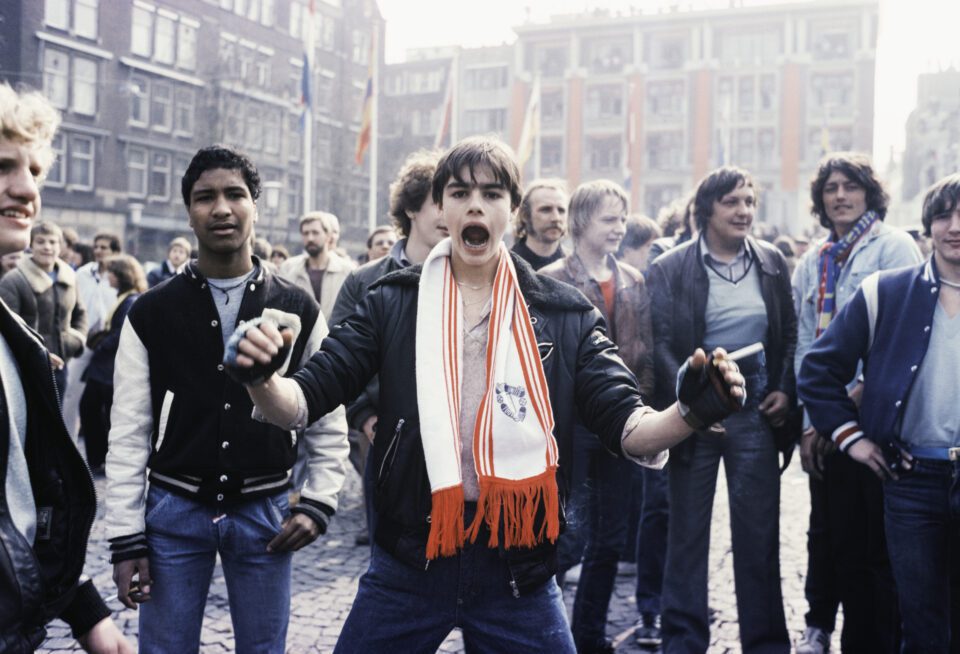
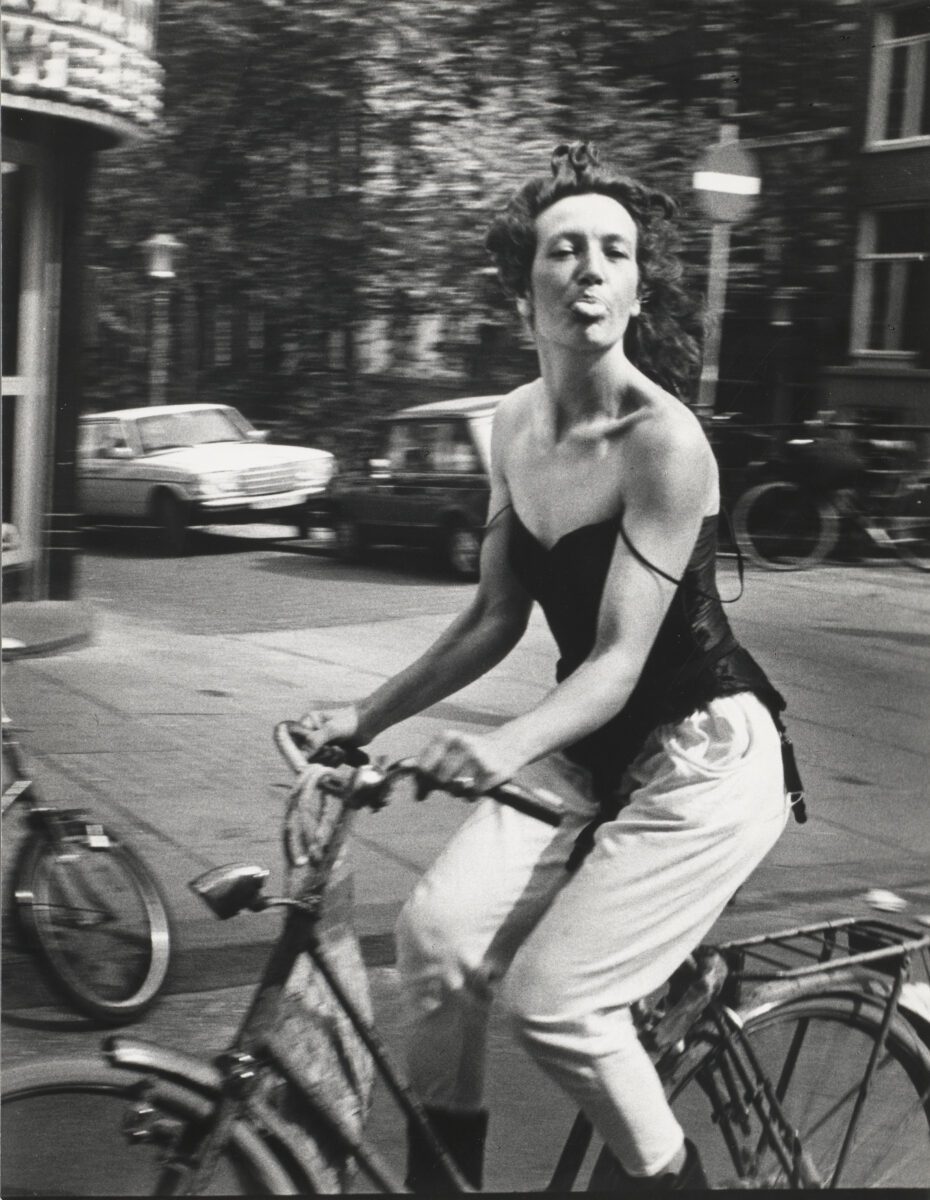
A defining strength of the exhibition lies in its access to his private archive, acquired in 2019 by the Rijksmuseum and the Nederlands Fotomuseum. This material opens an unusually candid window into his practice – not as a fixed canon of iconic images, but as a restless field of revision. It becomes clear that Van der Elsken was less interested in photographic perfection than in emotional charge, often privileging immediacy over formal control. A woman cycling through Amsterdam with a defiant expression, or a group of youths gathered on Nieuwendijk, are not simply urban observations but fragments of lived intensity.
Across the exhibition, his work is positioned within a broader dialogue of twentieth century street photography, and it is here that the affinities and divergences with other key figures become illuminating. The structured poetics of Henri Cartier-Bresson offer one clear counterpoint. Cartier-Bresson’s concept of the “decisive moment” privileges geometric harmony and temporal precision, where form and event collapse into a single, perfectly timed image. Van der Elsken, by contrast, resists such resolution. His photographs often feel looser, more corporeal. Where Cartier-Bresson seeks the distilled instant, Van der Elsken leans into duration – into the messy emotional residue of encounter.
The work of Garry Winogrand introduces another axis of comparison. Winogrand’s mid twentieth century images of American street life are saturated with kinetic energy, often framed by tilted horizons and dense social layering. Like Van der Elsken, he embraces disorder as a structuring principle. Yet where Winogrand’s gaze can feel observationally detached, almost anthropological in its accumulation of moments, Van der Elsken remains conspicuously embedded within his scenes. His presence is felt not only behind the camera but within the social fabric of his subjects – a participant as much as a witness.
A further resonance appears in the work of Daido Moriyama, whose grainy, high contrast explorations of postwar Japan similarly reject photographic clarity in favour of affective intensity. Moriyama’s aesthetic of blur, fragmentation, and visual overload finds a distant echo in Van der Elsken’s willingness to embrace imperfection. Yet Moriyama’s urban vision often veers toward existential abstraction, dissolving the city into a kind of visual noise. Van der Elsken, by contrast, retains a strong sense of narrative anchoring – his Amsterdam is not dissolved but inhabited, its social textures still legible even at their most chaotic.
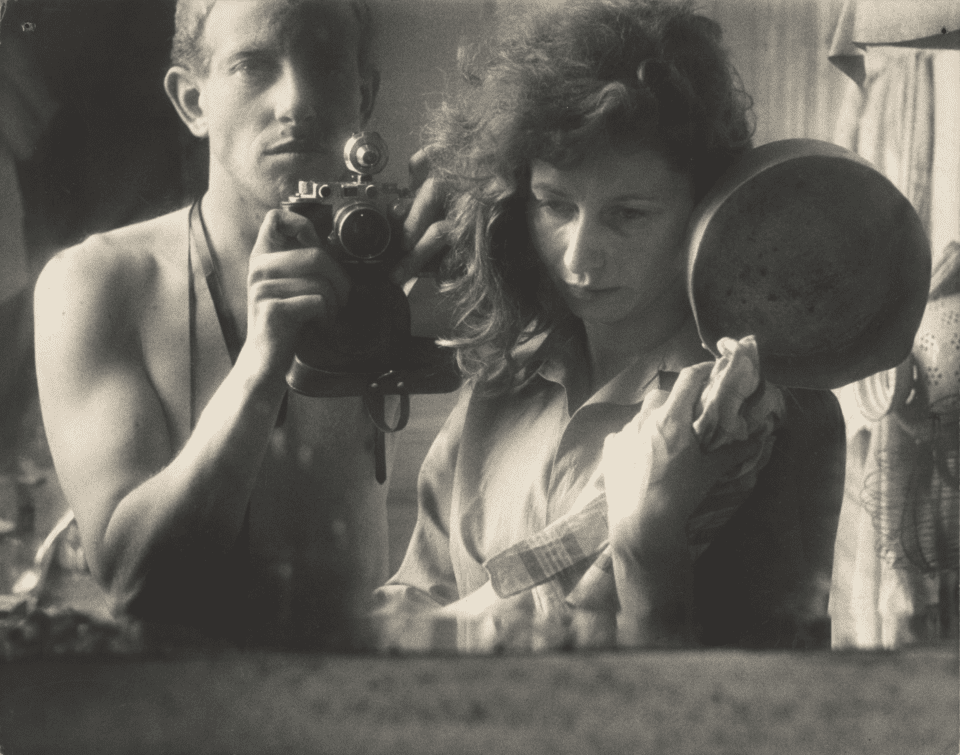
What distinguishes Van der Elsken within this constellation is his sustained attention to biography – not only his own, but those of his subjects. The exhibition foregrounds his tendency to blur the boundaries between personal life and photographic practice. Self portraits sit alongside intimate domestic scenes, including his relationship with Ata Kandó and Juliette Kandó in Sèvres during the early 1950s. These images suggest that for Van der Elsken, photography was inseparable from lived experience. Taco Dibbits, Director of the Rijksmuseum, notes that the exhibition reveals “a surprising and comprehensive picture of his thoughts, intentions and working methods,” underscoring the sense that this is an artist who operated through continual negotiation with his own visual language.
The inclusion of unpublished materials further complicates the mythology of the street photographer as a figure of instant mastery. Instead, what emerges is a practice defined by accumulation and revision. Book dummies that were never published sit alongside decades old negatives that Van der Elsken preserved with careful persistence. These fragments suggest an artist who understood photography as an ongoing process of thinking through images. The international dimension of his work – including travels to Cuba and Japan – expands this framework. Here, Van der Elsken adapts his approach to unfamiliar environments while retaining his focus on human immediacy. Rather than imposing a fixed stylistic identity, he allows context to reshape his visual language. This adaptability reinforces his position as an artist whose practice resists containment within national or stylistic boundaries.
Ultimately, Ed van der Elsken. Up Close is less a retrospective in the conventional sense than a reconsideration of photographic authorship itself. Across nine galleries, the exhibition constructs a layered meditation on how images are made, unmade, and remade over time. It situates Van der Elsken within a broader genealogy of street photography while also insisting on his singularity – his willingness to inhabit contradiction, to oscillate between clarity and confusion, control and surrender.
What lingers is not a definitive image of the city, but a sensibility attuned to its constant instability. In this sense, the exhibition returns to the foundational concerns of street photography: the negotiation between observer and observed, the ethics of proximity, and the fragile boundary between chance and intention. Yet it also extends these concerns, suggesting that the street is not merely a site of capture but a space of continual becoming. Van der Elsken’s work, as revealed here, does not freeze the world – it moves with it, uncertain, alert, and always in search of the next unguarded moment.
Ed van der Elsken. Up Close is at Rijksmuseum, Amsterdam from 19 June – 13 September
Words: Simon Cartwright
Image Credits:
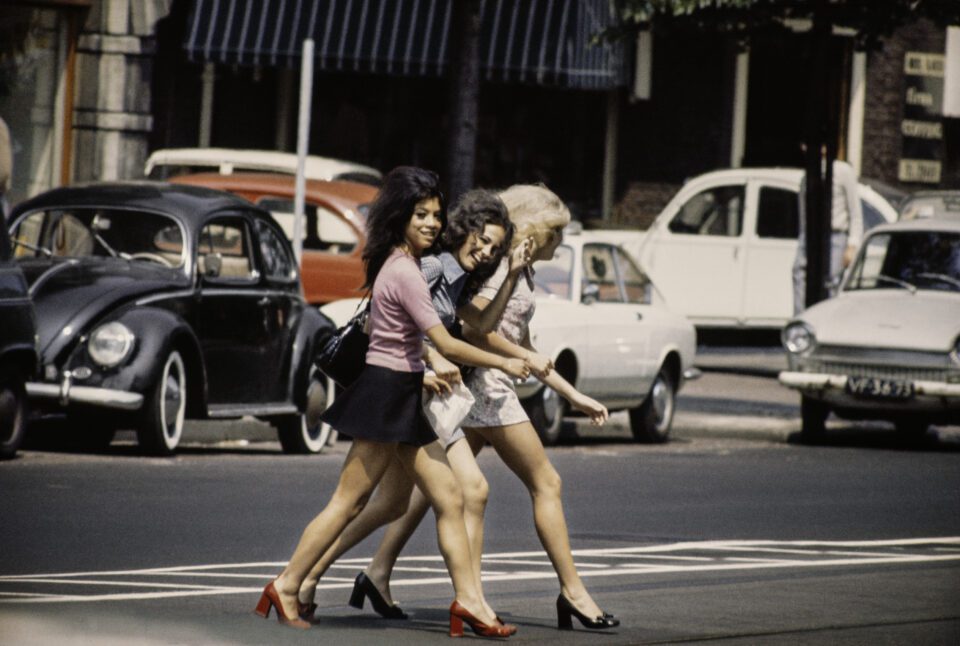
1&5. Ed van der Elsken, Beethovenstraat, Amsterdam,1967. Nederlands Fotomuseum, Rotterdam. © Ed van der Elsken estate/Nederlands Fotomuseum.
2. Ed van der Elsken, Street artist in Paris c. 1951 (printed before 1959). Rijksmuseum, Amsterdam. Long term loan from Anneke Hilhorst, Warder, 2019. © Ed van der Elskenestate/Nederlands Fotomuseum.
3. Ed van der Elsken, Queens Day, Dam, Amsterdam, 1980. Nederlands Fotomuseum, Rotterdam. © Ed van der Elsken estate/Nederlands Fotomuseum.
4. Ed van der Elsken, Woman cycling, Amsterdam, 1983. Rijksmuseum, Amsterdam. Gift by Anneke Hilhorst, Warder, 2019. © Ed van der Elsken estate/Nederlands Fotomuseum.
6. Ed van der Elsken, Self-portrait with Ata Kandó in the mirror of their apartment, Sèvres 1952. Gelatin silver print on cardboard, printed before 1955. Rijksmuseum, Amsterdam. Acquisition with the support of Jan and Trish de Bont and the Paul HufFonds/Rijksmuseum Fonds, 2017. © Ed van der Elsken estate/Nederlands Fotomuseum.


