

In Diana Markosian’s latest body of work, intimacy is framed as an unstable condition, continually reconstructed through absence, repetition and emotional residue, where love persists beyond its apparent ending in altered, shifting forms. Relationships appear less as fixed narratives than as structures in motion, shaped as much by what has disappeared as by what remains visible. Replaced, now on at Gallerie d’Italia, organises emotional experience through cycles of return in which memory functions less as retrieval than ongoing re-authorship. Photography and film work together to stage this instability, allowing scenes to reappear in subtly altered emotional registers, as if slightly out of alignment with themselves. Each return unsettles recognition, shifting tone, weight and proximity before certainty can form. Intimacy emerges here as process rather than outcome, held in continuous revision.
Born in Moscow in 1989, Markosian works across photography, film and installation, focusing on how images construct meaning through fragmentation and emotional discontinuity. Her practice is shaped by migration, familial rupture and a life lived between Russia and the United States, where identity forms through movement rather than fixity. The camera functions less as a recording device than a mechanism for reconstruction, reshaping how personal histories are understood and reassembled. Memory is treated not as retrieval but as an active, ongoing production shaped through repeated looking. Narrative coherence is consistently displaced in favour of provisional and emotionally contingent structures. Time, in her work, is never stable; it is continually rewritten through the image.
International attention first arrived with Santa Barbara (2020), a project tracing her family’s migration from post-Soviet Moscow to California. Archival photographs sit alongside staged re-enactments, dissolving any clear boundary between document and construction. Domestic interiors, family records and fragmented recollections are arranged into sequences that resist linear progression. Rather than forming a cohesive biography, the work reveals how memory operates through omission, distortion and projection. Absence becomes structural rather than incidental, shaping rhythm and sequence from within. Fragmentation emerges as method rather than lack, holding experience together without resolving it.
That approach deepened in Father (2024), which revisits a long-separated relationship through staged encounters and performative reconstruction. The work is less concerned with reconciliation than with the instability of attempting connection after prolonged absence. Moments that can no longer be accessed directly are restaged through performers, producing a quiet tension between lived memory and constructed gesture. Intimacy becomes something both enacted and questioned within the same frame. Repetition replaces resolution, as reconnection unfolds through re-staging rather than recovery.

Those concerns extend into Replaced, which turns towards romantic intimacy and the emotional residue left after rupture. Across photography and immersive film, scenes of affection, tension and separation recur in shifting configurations, as if remembered through slightly misaligned versions of the same moment. Each iteration adjusts framing, duration and emotional register, preventing closure from settling. Recognition is continually displaced by return, so meaning emerges through variation rather than sequence. The accompanying photobook, co-published by Allemandi and Atelier EXB, extends this rhythm into a sequential form where narrative gradually dissolves into echo and recurrence.
Time in Replaced refuses linear progression, unfolding instead through loops that fracture narrative continuity. Images circulate across multiple screens and surfaces, returning in near-echoes rather than repetition. A gesture may reappear later reframed by distance, rupture or altered context, shifting emotional meaning while remaining visually intact. Progression gives way to recursion, and understanding emerges through difference rather than sequence. Performers move through these reconstructed moments with a restrained, almost suspended presence, inhabiting roles that blur memory, enactment and return. Emotional states remain unsettled, held in motion without stabilising.

The film component intensifies this instability, extending photographic logic into a layered, immersive environment that feels physically disorienting in places. Split screens divide attention across competing temporalities, while overlapping sequences resist synchronisation, allowing multiple emotional versions of the same moment to coexist without hierarchy. Sound drifts independently of image – breath, speech and silence slipping slightly out of sync – creating a subtle sense of distance even in moments of proximity. Rather than guiding narrative flow, the installation produces a rhythm of interruption, where each return feels slightly displaced from the last. Familiar gestures reappear as if recalled through interference, their emotional charge quietly altered. The effect is less narrative coherence than perceptual drift.
This fragmentation operates structurally across the installation, embedded in how scenes are constructed and reconstructed. Encounters between figures are staged under shifting emotional conditions, moving between intimacy and distance without clear transition. A single exchange may recur with altered pacing or reframing, changing emotional tone while leaving action intact. These variations accumulate into a system where narrative cannot stabilise because every return produces a revised version of the same emotional event. Memory functions as interference rather than record, reshaping itself through recurrence. Coherence is repeatedly undone at the moment it begins to form.
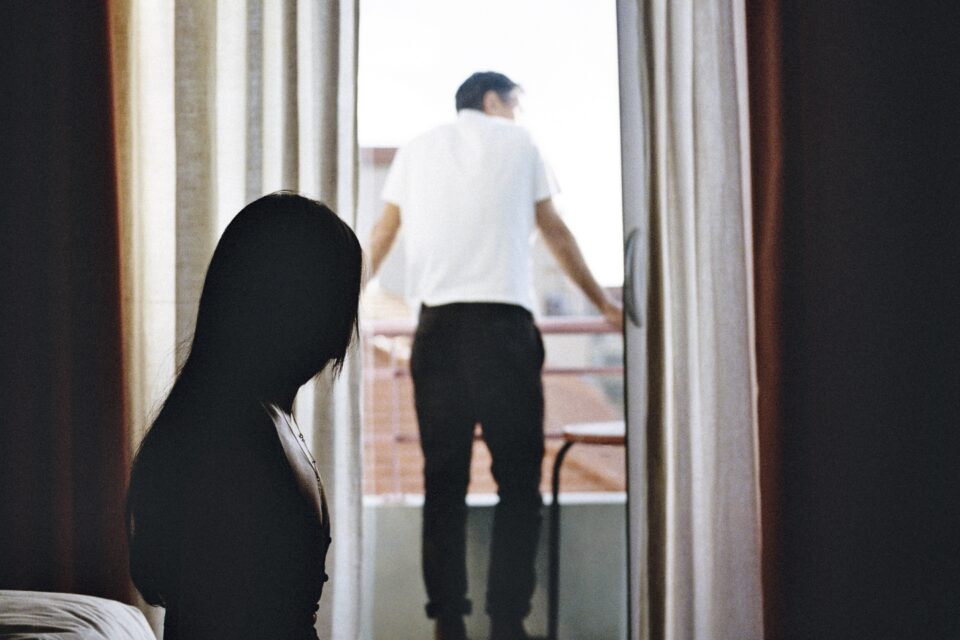
Performance becomes the mechanism through which this instability is both enacted and exposed. Actors inhabit fluctuating emotional states that resist fixation, introducing a controlled artificiality that paradoxically heightens psychological immediacy. Intimacy in Replaced is distributed across multiple iterations of the same encounter, each slightly displaced from the last. Recognition and estrangement coexist within the same frame, leaving familiarity unresolved rather than clarified. The cinematic structure becomes a space for testing how emotion can shift without resolving into certainty.
Repetition is held in suspension rather than resolved, allowing scenes to accumulate without closure. The viewer moves inside this looped structure, where moments return before fully forming and dissolve before they can settle into meaning. Time becomes elastic, shaped by recurrence rather than sequence. Emotional logic emerges through return, resisting narrative absorption at every turn. Even the most intimate exchanges remain provisional, open to reinterpretation by what follows.

Placed in a broader context, Markosian’s work resonates with artists who reconfigure memory through performance and constructed narrative. Nan Goldin’s The Ballad of Sexual Dependency frames intimacy through diaristic fragmentation, where emotional life unfolds in ruptures rather than continuity. Sophie Calle’s Exquisite Pain turns repetition into a method for processing loss, exposing how storytelling structures emotional endurance. Laia Abril’s archival investigations assemble trauma through incomplete evidence, resisting synthesis in favour of distributed meaning. Markosian extends these strategies into a cinematic field where performance becomes central to how memory is formed and unsettled. Staging does not illustrate recollection – it generates it, while simultaneously destabilising its authority.
The spatial design reinforces this logic through a deliberate refusal of linear viewing. Works are distributed across walls and screens, encouraging interruption, return and re-encounter rather than sequential reading. No single pathway produces coherence; meaning emerges only through accumulation and revisitation. Motifs recur across surfaces, shifting in weight and resonance depending on context and proximity. The gallery itself becomes a field of temporal dislocation rather than a container for images. Experience is structured through repetition, not progression. The photobook extends this system into a tactile sequence where meaning forms through adjacency, pacing and rhythm. Each page turn subtly alters temporal flow, producing shifts in interpretation that resist stabilisation. Sequences unfold without resolution, echoing the instability of recollection across time and emotional return. Reading becomes part of the work’s recursive logic. Memory is encountered as something continuously rewritten through engagement. The book functions less as documentation than as another site of recurrence.

Gallerie d’Italia provides a framework that amplifies these concerns across its network in Milan, Naples, Turin and Vicenza, where contemporary practice is placed in dialogue with historical architecture. Within this setting, Replaced operates as an unfolding system rather than a fixed installation. Images circulate across architectural and temporal boundaries, refusing containment within any single interpretive frame. The museum becomes part of the work’s logic of return rather than its endpoint. Memory is activated through encounter rather than preserved as narrative. What remains is an environment shaped by recurrence, where intimacy persists through continual rewriting, and meaning stays open.
Diana Markosian: Replaced is at Gallerie d’Italia, Turin until 6 September: gallerieditalia.com
Words: Simon Cartwright
Image Credits:
All images Diana Markosian, Replaced.


