

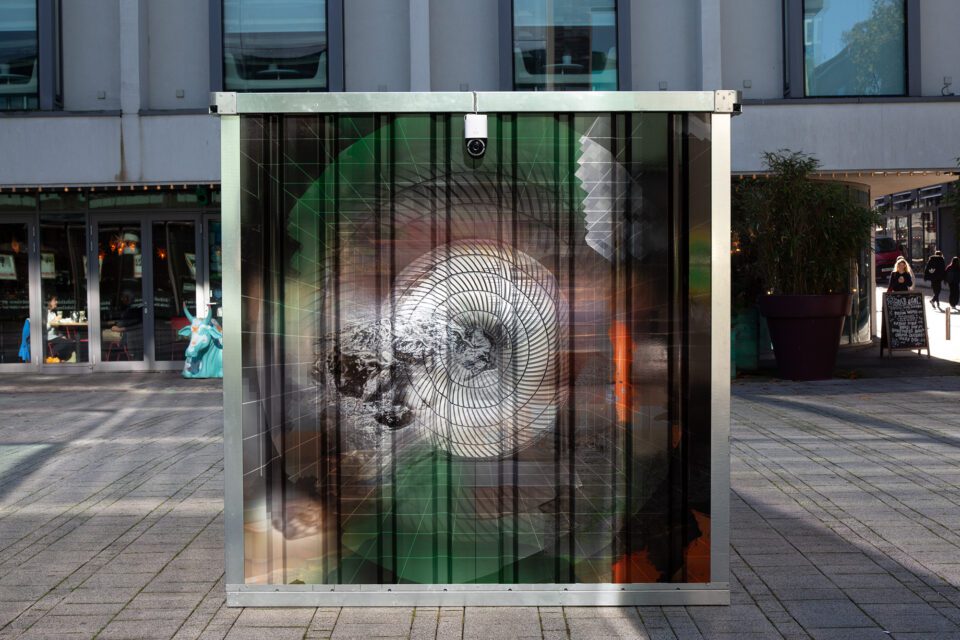
In March 2025, Forbes reported that ChatGPT had 500 million weekly users – a figure that is only getting bigger. The platform, and others like it, has become a part of many people’s daily lives, but how much do we really know about what goes on behind the scenes? Machine learning software relies on a vast ecosystem that extends far beyond the user-friendly interfaces we see on-screen. In fact, it is wrapped up in a whole host of issues: from the politics of surveillance and data extraction to the exploitation of land, resources and labour. This is something artist and educator Felicity Hammond (b. 1988) is keen to bring to the surface. She is doing so via Variations, an ambitious four-part project staged in venues across the UK. Right now, V2: Rigged, the second instalment, is on view at Derby QUAD, as part of FORMAT Festival. It follows on from V1: Content Aware, which was presented at the Photoworks Weekender in Brighton last year. The first iteration was about shipping containers, which carry the raw materials that fuel our digital economy. Now, V2: Rigged exposes how machine learning tools rely on a combination of mineral and data extraction.
The idea behind V2: Rigged is to “unveil the machine” – to reveal the aggressive processes that enable AI tools to operate at scale. At the centre of the installation is a huge circular structure – “part camera, part drill head, part processing plant” – that takes photographs once per minute. It’s set up in front of a giant mirror, so it captures everything: itself, the audience viewing the work, and visitors looking at themselves. This information will soon inform V3: Model Collapse, the next exhibition, opening at The Photographers’ Gallery, London, in late June. Its intimidating, large-scale design is intentional; it reflects the various violent “acts of taking” that lie at the centre of computational image-making – from brutal processes used to extract rare earth minerals, to aggressive surveillance systems and the scraping of personal data.
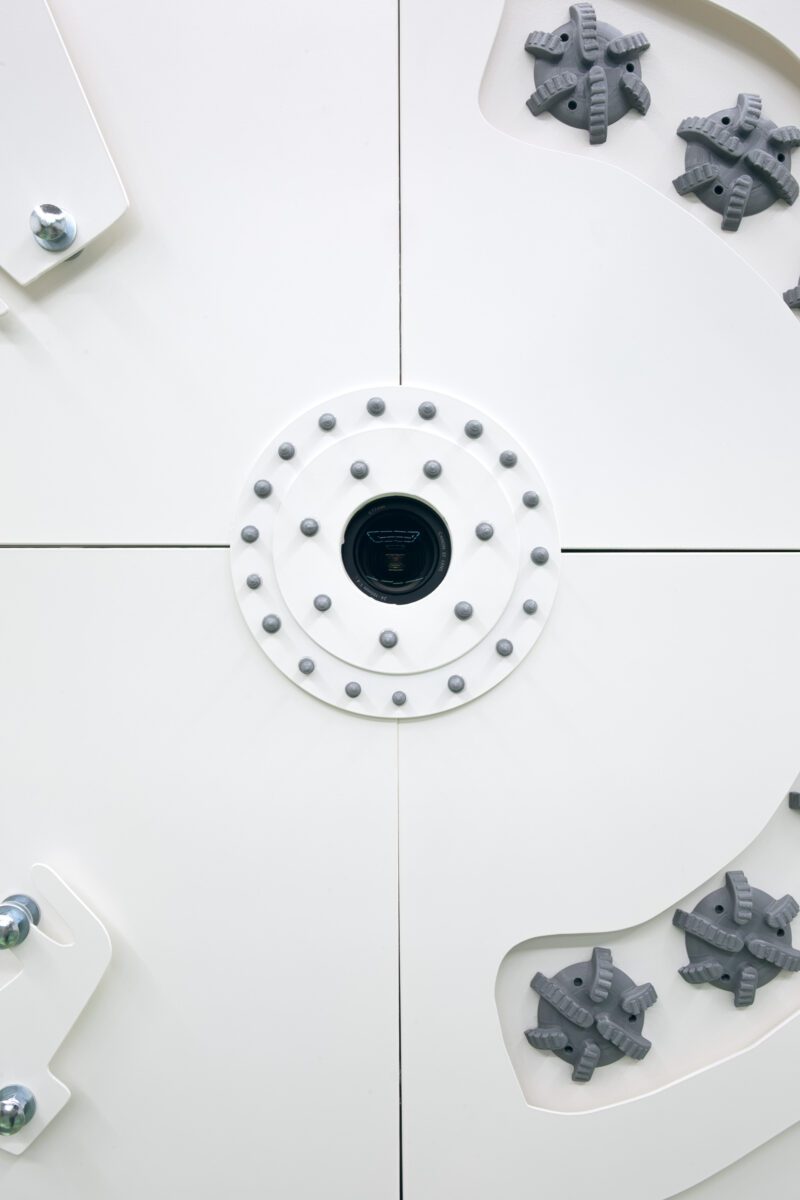
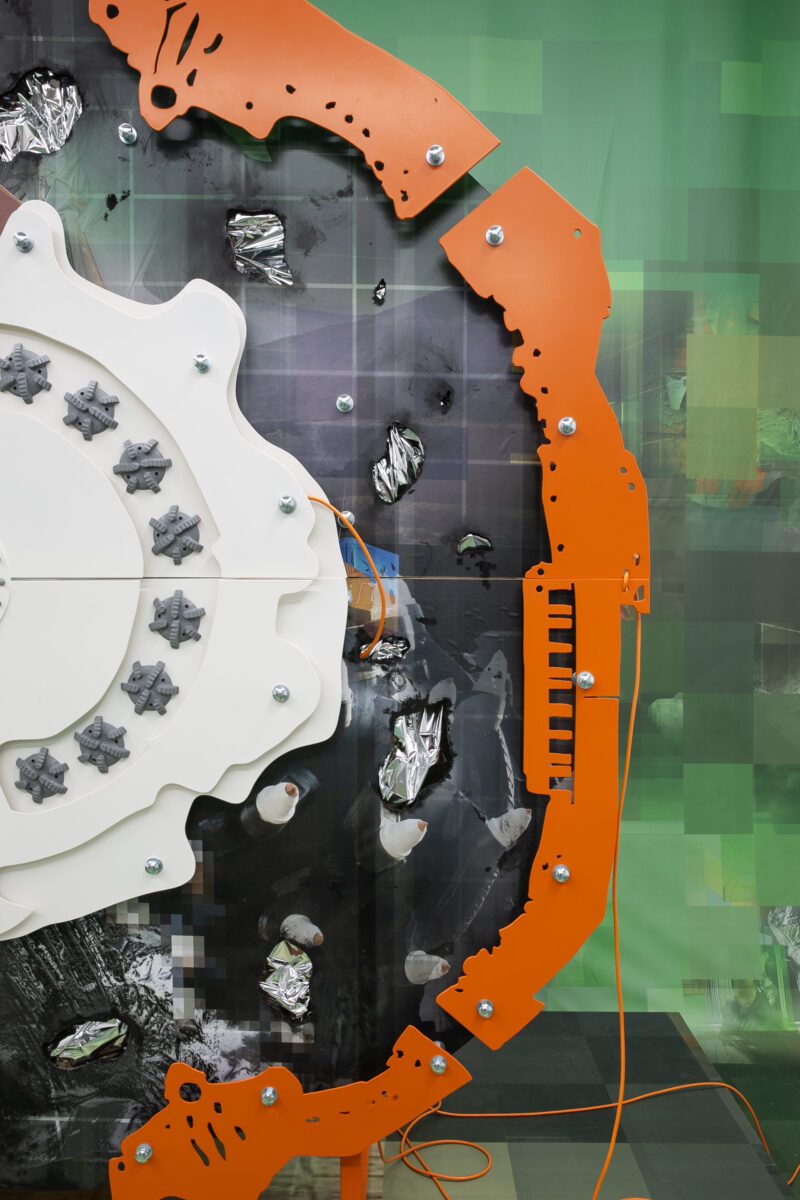
Each version of Variations informs the next one, in clever mimicry of the constantly evolving datasets that grow and develop in the back end of machine learning platforms. So, how does V2 respond to V1? Look closely, and you’ll see that V2’s pixilated backdrop contains AI generated images – these are approximations of the “average” picture taken during the first installation at Photoworks Weekender. People were documented holding smartphones up to the shipping container’s in-built security camera; the resulting AI images therefore depict men holding hybrid machines – cameras as weapons. In 1977, the seminal writer and critic Susan Sontag explored the connection between camera and gun – we shoot, we aim, we load – and the images generated by Hammond’s project offer an eerie echo of this metaphor. Moreover, and perhaps even more worryingly, as German filmmaker Hito Steyerl suggests, these images are not random hallucinations, they are “documentary expressions of society’s views of itself.”
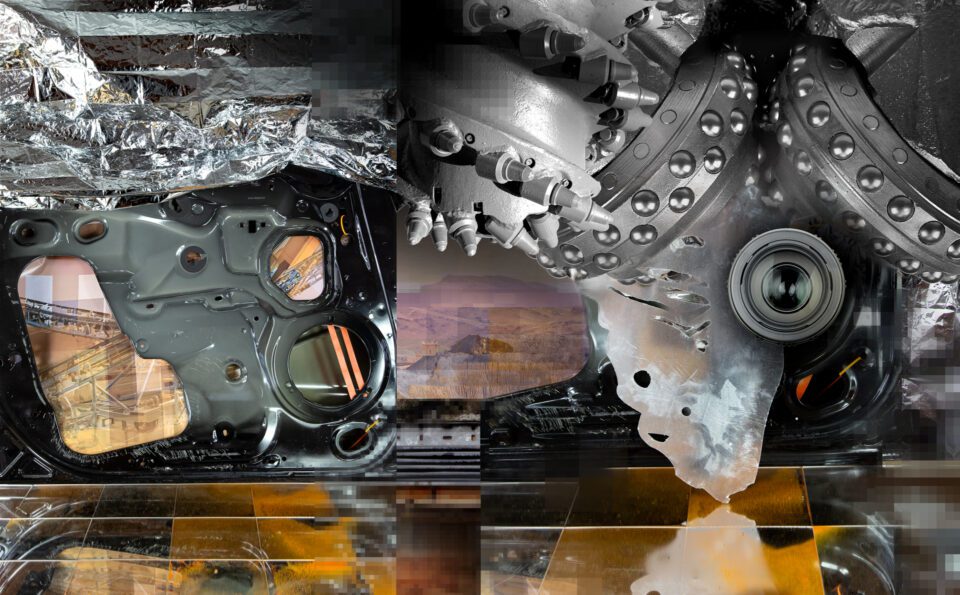
At the end of June, the project will travel to London, where V3: Model Collapse will ask us to consider what happens when the data produced by generative AI is inevitably fed back into its own system. Hammond’s answer: “it gives us an image that starts to fall apart”, full of impossibilities and inaccuracies. Finally, in November, V4: Repository will open at Stills in Edinburgh. This final part will highlight data storage centres, and the massive amounts of energy they consume. At a time when conversations around generative AI are everywhere, yet its inner machinations are left deliberately opaque, Hammond’s project makes for essential viewing. This is an artist who is unafraid to tear down the black box, and demand we peer inside.
V2: Rigged runs until 15 June at Derby QUAD, as part of FORMAT Festival.
formatfestival.com
V3: Model Collapse runs 27 June – 28 September at The Photographers’ Gallery, London.
thephotographersgallery.org.uk
V4: Repository runs 7 November – 7 February at Stills: Centre for Photography, Edinburgh.
stills.org
Read more about Variations in the June / July issue of Aesthetica Magazine.
Image Credits:
1. Felicity Hammond, from Variations.
2. Felicity Hammond, V2: Rigged. Exhibited at QUAD, Derby as part of Format Festival, 2025.
3. Felicity Hammond, V2: Rigged. Exhibited at QUAD, Derby as part of Format Festival, 2025.
4. Felicity Hammond, V2: Rigged. Exhibited at QUAD, Derby as part of Format Festival, 2025.
5. Felicity Hammond, from Variations.
6. Felicity Hammond, V1: Content Aware. Exhibited as part of Photoworks Weekender, Brighton 2024.


