

Between the rhythms of global capital and the architectures of digital life, meaning today is produced in spaces where the physical and the virtual are no longer distinct but mutually constitutive. Labour, identity, memory and desire circulate through systems of automation, simulation and networked communication that reshape how experience is felt and represented. Within this condition, contemporary art becomes a site for testing the limits of perception itself – a way of registering how subjectivity is formed under technological pressure. It is here that the work of Cao Fei finds its urgency, staging a world in which utopia and exhaustion, play and infrastructure, coexist in uneasy proximity. Her practice does not simply depict transformation; it inhabits it, rendering the contemporary moment as something unstable and immersive.
These concerns form the conceptual backbone of Testimonies to the Near Future, a major exhibition at Kunstmuseum Basel | Gegenwart running from 30 May to 11 October 2026. The presentation marks Cao Fei’s first solo exhibition in Switzerland and her most extensive survey in Europe to date, unfolding across all four floors of the museum as a total environment rather than a conventional display. Curated by Stephanie Seidel, Philipp Selzer and Alice Wilke, the exhibition transforms the institution into a navigable city of images, sounds and architectures drawn from more than two decades of practice. Video installations, sculptural environments and digital worlds are arranged as interconnected zones rather than discrete works, producing a continuous experiential field. The museum becomes less a container for art than a programmable space of passage, where visitors move through shifting registers of reality.
Born in Guangzhou in 1978, Cao Fei emerged from a city whose rapid industrialisation became emblematic of China’s reform-era transformation. Raised in the Pearl River Delta, often referred to as the “Factory of the World”, she witnessed first-hand the social and spatial consequences of accelerated urban development. After studying at the Guangzhou Academy of Fine Arts, she relocated to Beijing, where she continues to live and work. From the early 2000s onwards, Cao developed a hybrid visual language that drew equally from documentary film, pop culture, gaming environments and experimental video art. Her early works quickly gained international attention for their ability to capture the psychological texture of a society undergoing rapid economic and technological change. Rather than treating China as a fixed subject, her practice reframed it as a fluctuating system of images, infrastructures and lived experiences.
Over time, Cao Fei has become a defining figure in global contemporary art, with major presentations at institutions such as the Centre Pompidou, Serpentine Gallery, MoMA PS1 and MAXXI. She has also participated in key international exhibitions including the Venice Biennale, the Biennale of Sydney and the Istanbul Biennial. Awards such as the Deutsche Börse Photography Foundation Prize (2021) and the SCAD deFINE ART Award (2024) underscore her sustained influence, yet her significance lies less in institutional recognition than in her early articulation of conditions that now define contemporary life: the fusion of digital identity, economic systems and everyday experience. Long before the metaverse became cultural shorthand, Cao was already constructing its emotional and spatial logic.
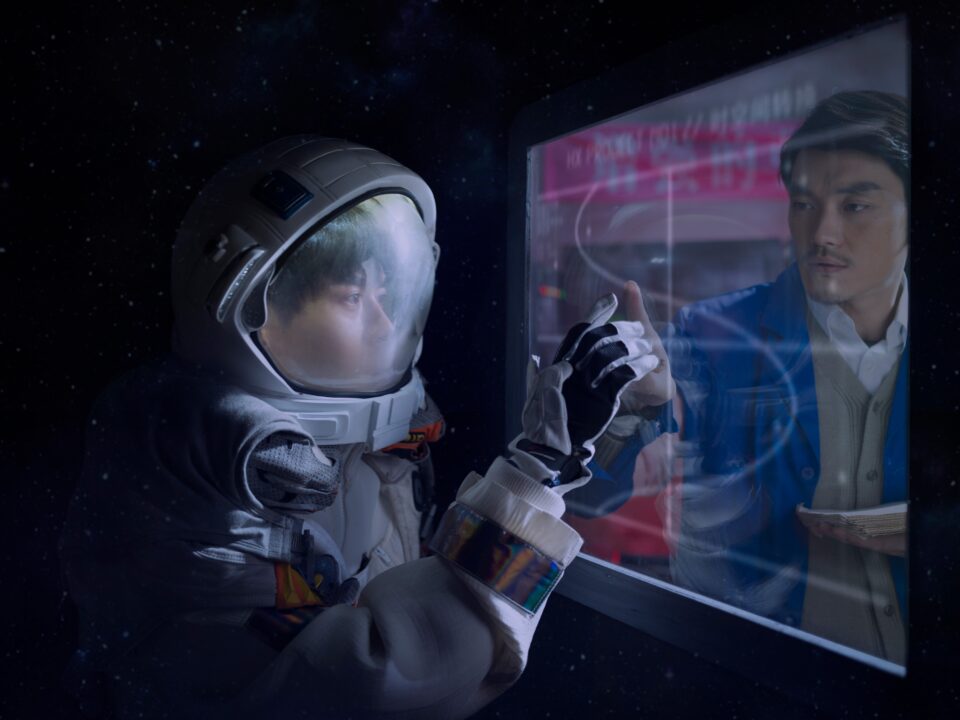
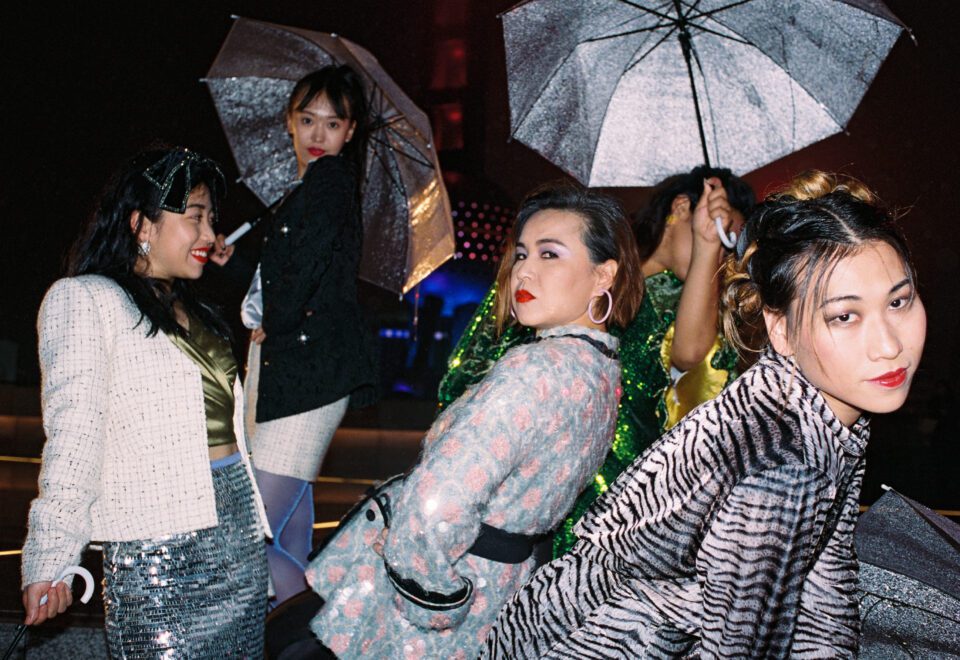
At Kunstmuseum Basel | Gegenwart, this logic is translated into spatial experience. The ground floor opens as a fabricated urban zone – a town square assembled from skate ramps, graffiti interventions and infrastructural signage reminiscent of airports and transit systems. The visitor enters not an exhibition but a simulated city. Suspended fabric structures evoke market stalls, within which the Hip Hop series (2003–) unfolds as a dispersed archive of movement, rhythm and urban improvisation. Filmed across Guangzhou, Shanghai, New York, Fukuoka and Sydney, these works document everyday subjects performing choreography in public space – pavements, shopfronts and car parks temporarily reconfigured as stages. The editing structure mirrors musical sampling, producing a global montage in which cultural fragments are continually reassembled into new forms of expression.
Nearby, Cosplayers (2004) extends this exploration of identity as performance within mediated environments. Set on the outskirts of Guangzhou, the work follows young participants who adopt characters from Japanese anime and manga, staging elaborate scenes amid half-finished architecture and construction debris. These spaces – neither fully urban nor entirely abandoned – become sites of projection, where fictional identities intersect with material precarity. The work resists easy categorisation: it is at once documentary, portrait and speculative fiction. What emerges is a generational portrait shaped by the internet, in which fantasy is not escape but a method of inhabiting unstable reality.
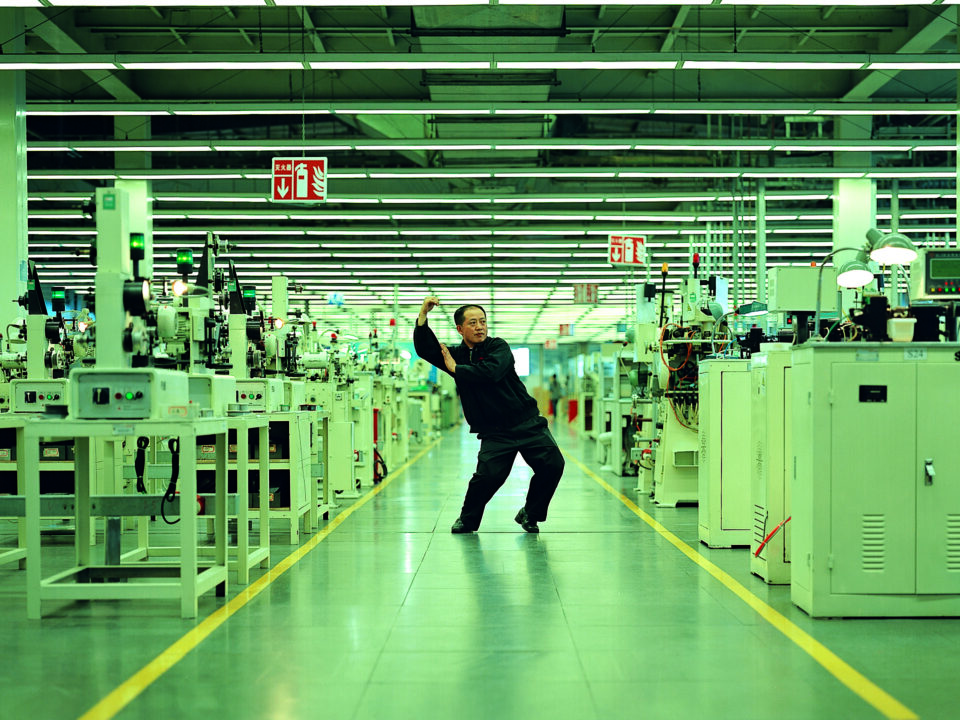
On the first floor, the exhibition shifts into the infrastructures of labour and logistics that underpin contemporary global systems. The installation environment incorporates warehouse structures, delivery vehicles and bunk beds, evoking the spatial logic of production and circulation. Within this setting, Whose Utopia (2006) remains a pivotal work. Produced during a residency at an Osram factory through the Siemens Art Programme, the film captures workers momentarily stepping outside repetitive industrial routines to enact private fantasies. A dancer moves through machinery; a guitarist performs within the factory floor. These gestures are brief but significant interruptions in the logic of efficiency, suggesting that imagination persists even within highly regulated systems of labour.
This negotiation between system and subject continues in Asia One (2018), which examines one of China’s first fully automated logistics centres near Shanghai. Through installation and moving image, Cao Fei traces the transition from manual production to AI-driven distribution networks. Rather than presenting automation as spectacle or critique, she focuses on its affective dimensions – the subtle reconfiguration of human relationships within systems designed for speed and optimisation. Works such as Hongxia (2019–2023) and MatryoshkaVerse (2022) extend this inquiry into speculative territories, drawing on abandoned theatres, historical industrial sites and imagined metaverse architectures to collapse temporal boundaries.
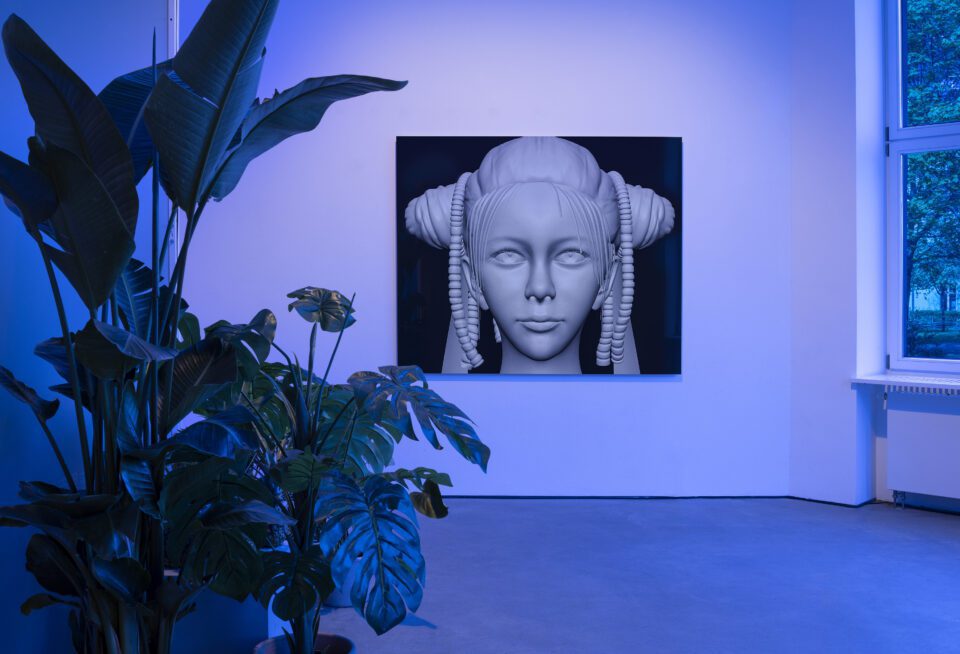
The second floor enters fully into digital speculation through Duotopia Vol. 1 (2022), Duotopia Vol. 2 (2024) and Oz (2022). Here, the avatar Oz navigates a constructed metaverse environment developed within Yuanbang Mega City. As an androgynous hybrid entity, Oz dissolves distinctions between organic and synthetic form, embodying the increasingly blurred boundary between human subjectivity and technological system. The works stage digital space not as escape but as continuation – an extension of contemporary social reality into programmable environments. Oz reflects a shift from techno-utopian optimism towards a more ambiguous terrain of coexistence between human and machine intelligence.
A crucial historical anchor within the exhibition is RMB City (2007–), widely regarded as a landmark in early internet-based art practice. Built within Second Life, the project constructed a fictional Chinese metropolis complete with its own economy, governance structure and speculative property market. The title – derived from the Renminbi – foregrounds the entanglement between virtuality and financial systems, positioning the city as both simulation and critique. Cao Fei’s avatar China Tracy operated as a hybrid figure of “cyber-mother and cyber-CEO”, hosting events and performing roles that collapsed artistic production, commerce and performance. Viewed retrospectively, the project reads as an early diagnosis of platform capitalism and virtual economies, anticipating many of the structures that now define digital life.
The exhibition concludes with Isle of Instability (2020), a work shaped by the conditions of pandemic isolation. Focusing on Cao Fei’s daughter, it presents a domestic environment transformed into a site of imaginative construction. Everyday objects become tools for world-building: a fan simulates ocean air, while projected imagery suggests distant landscapes. The work is modest in scale yet resonant in implication, foregrounding imagination as a survival strategy. It returns the exhibition’s broader concerns to an intimate register, where global systems are refracted through the smallest gestures of play.
Taken as a whole, Testimonies to the Near Future articulates a vision of contemporary life in which technological systems, economic infrastructures and subjective experience are inseparably entangled. Across its immersive environments, Cao Fei constructs a world that is neither utopian nor dystopian, but continuously in flux – shaped by labour, mediated by screens and animated by imagination. The exhibition’s lasting impact lies in its refusal of closure: it does not resolve the tensions it stages, but holds them in suspension. In doing so, it offers a compelling account of the present as a condition still being written, where the near future is already embedded in the textures of everyday life.
Testimonies to the Near Future is at Kunstmuseum Basel from 30 May – 11 October: kunstmuseumbasel.ch
Words: Shirley Stevenson
Image Credits:
1&3. Nova 17 (from Nova series), 2019. Photo Courtesy of the artist, Vitamin Creative Space and Sprüth Magers.
2. My Future Is Not A Dream 02 (from My Future Is Not A Dream series), 2006. Photo Courtesy of the artist, Vitamin Creative Space and Sprüth Magers.
4. My Future Is Not A Dream 03 (from My Future Is Not A Dream series), 2006. Photo Courtesy of the artist, Vitamin Creative Space and Sprüth Magers.
5. Hip Hop: Shanghai, 2025. Single channel HD video, 9:16, colour with sound, 5:04 min. Produced by NOWNESS, Courtesy of the artist, Vitamin Creative Space and Sprüth Magers.
6. Installation view of ‘Duotopia’ at Sprüth Magers, Berlin 2023. Photo: Timo Ohler. Courtesy of Sprüth Magers.


