

Liberation, modernism and the politics of self-determination form the conceptual spine of Architects of Liberation: Modernism in Western Africa, an exhibition opening this July at the Museum of Modern Art in New York. It examines how architecture became a critical medium through which newly independent West African nations articulated sovereignty, identity, and futurity in the decades following colonial rule. Rather than treating modernism as a neutral or imported style, the exhibition frames it as a charged and adaptive language, refracted through the urgencies of nation-building and rapid urban transformation. Across Benin, Cameroon, Côte d’Ivoire, Ghana, Nigeria, Senegal and Togo, architectural production is positioned as inseparable from the political and ideological conditions of independence. The exhibition foregrounds buildings, cities, and infrastructures as sites where aspirations for liberation were materially tested. It reframes modern architecture as a contested field of cultural production.
The historical horizon of the exhibition is anchored in the accelerated wave of decolonisation that reshaped West Africa between 1957 and 1961. This period is often associated with the symbolic consolidation of independence across the region, though its realities unfolded unevenly across distinct colonial systems. Ghana’s independence on 6 March 1957 marked an early rupture under Kwame Nkrumah, whose Pan-African vision profoundly shaped architectural and cultural imaginaries. Senegal followed on 4 April 1960, Togo on 27 April 1960, and Côte d’Ivoire on 7 August 1960, each negotiating independence from French colonial rule while constructing distinct national trajectories. The Republic of Dahomey (now Benin) gained independence on 1 August 1960, following administrative transition from French West Africa. Nigeria became independent on 1 October 1960 under British colonial withdrawal and rapid urban expansion. The Republic of Cameroon gained independence on 1 January 1960 in its French-administered territory, formerly known as French Cameroun, before later political unification with British Southern Cameroons in 1961 following a UN-organised plebiscite. Taken together, these timelines reveal a staggered and uneven process of political transformation, mirrored in diverse architectural responses rather than a singular condition of postcolonial experience.
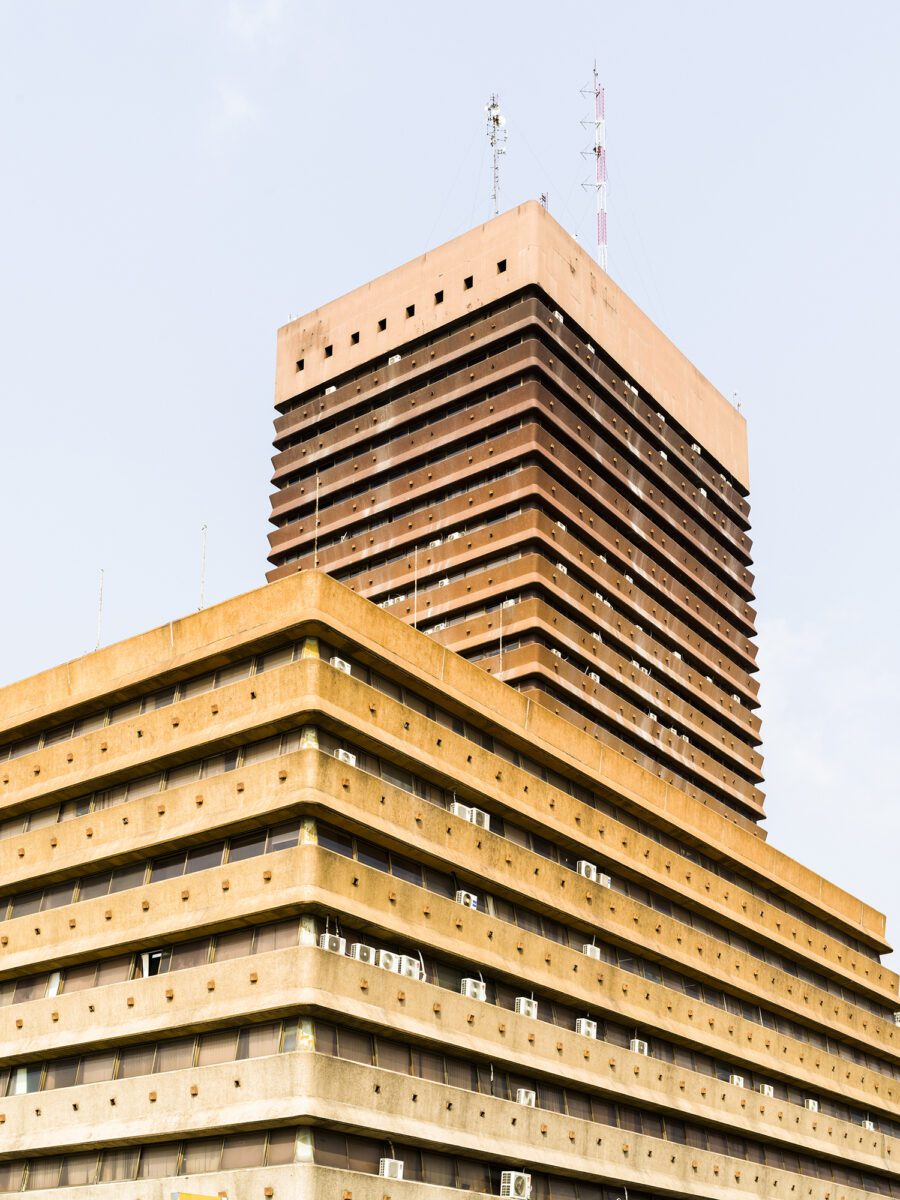
Postcolonial theory provides an interpretive framework, though the exhibition resists allowing it to fully exhaust the complexity of architectural production it describes. Frantz Fanon’s understanding of decolonisation as both rupture and reconstruction resonates in the way spatial orders were dismantled and reassembled through design and planning. Homi Bhabha’s concept of hybridity is visible in the plural modernisms that emerge across the region, where circulating architectural vocabularies are reworked rather than simply adopted or rejected. Pan-Africanism appears as both ideological structure and spatial ambition, informing civic projects that sought to articulate forms of continental belonging through public architecture and urban scale. Africanisation is understood here as a situated set of practices shaped by climate, material availability, technical expertise and state-led development priorities rather than a fixed stylistic category or singular aesthetic programme. Architecture becomes a field where multiple modernities coexist, overlap, and remain open-ended rather than resolved.
The curatorial structure of Architects of Liberation reflects this complexity through an extensive archive of approximately 450 objects drawn from over 50 international lenders across 17 countries. Architectural drawings, models, and archival photographs are organised thematically around civic categories such as education, housing, and urban infrastructure rather than national groupings. This approach allows shared architectural concerns to emerge across different political contexts while still acknowledging their specificity. It reveals patterns of convergence and divergence in post-independence planning shaped by differing economic conditions, institutional capacities, and urban pressures. Newly commissioned films and photographic works extend the archival material into the present, suggesting these architectural experiments continue to inform contemporary urban experience. The exhibition resists linear narrative structures, instead adopting a spatial logic that treats architecture as both document and proposition.
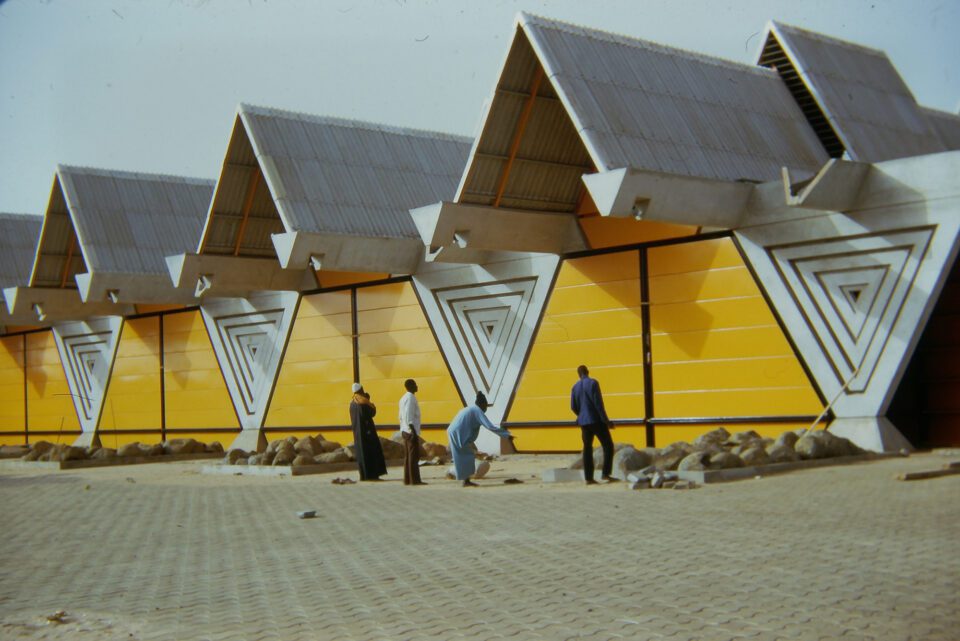
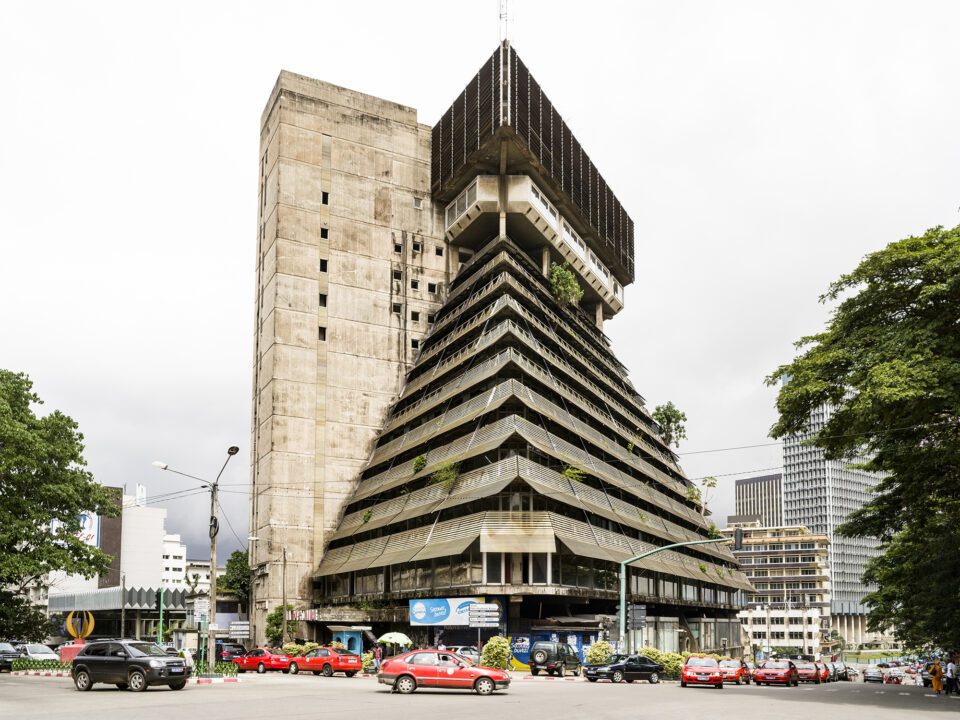
Key projects operate as focal points through which these broader ideas are articulated with particular clarity. The Africa Pavilion at the Accra Trade Fair in Ghana was designed between 1962 and 1967 by Victor Adegbite and collaborators. It embodies a civic modernism centred on unity, circularity, and collective identity. In Côte d’Ivoire, Rinaldo Olivieri’s Pyramide of 1973 transforms Abidjan’s skyline through vertical assertion, expressing economic ambition within a rapidly urbanising environment. Senegal’s CICES complex, designed by Jean-François Lamoureux and Jean Louis Marin, translates Léopold Sédar Senghor’s concept of “asymmetrical parallelism” into architectural form, producing structured variation within civic space. In Cameroon, the Gare de Bessengue by Jacques Nsangue Akwa and Emilien Douala Bell embeds infrastructural modernity within everyday mobility and exchange. Nigeria’s University of Ife masterplan by Arieh Sharon positions education as spatial organisation, linking institutional design to the formation of national intellectual life. Together, these works demonstrate modernism as a plural and adaptive field shaped through local negotiation and transnational exchange.
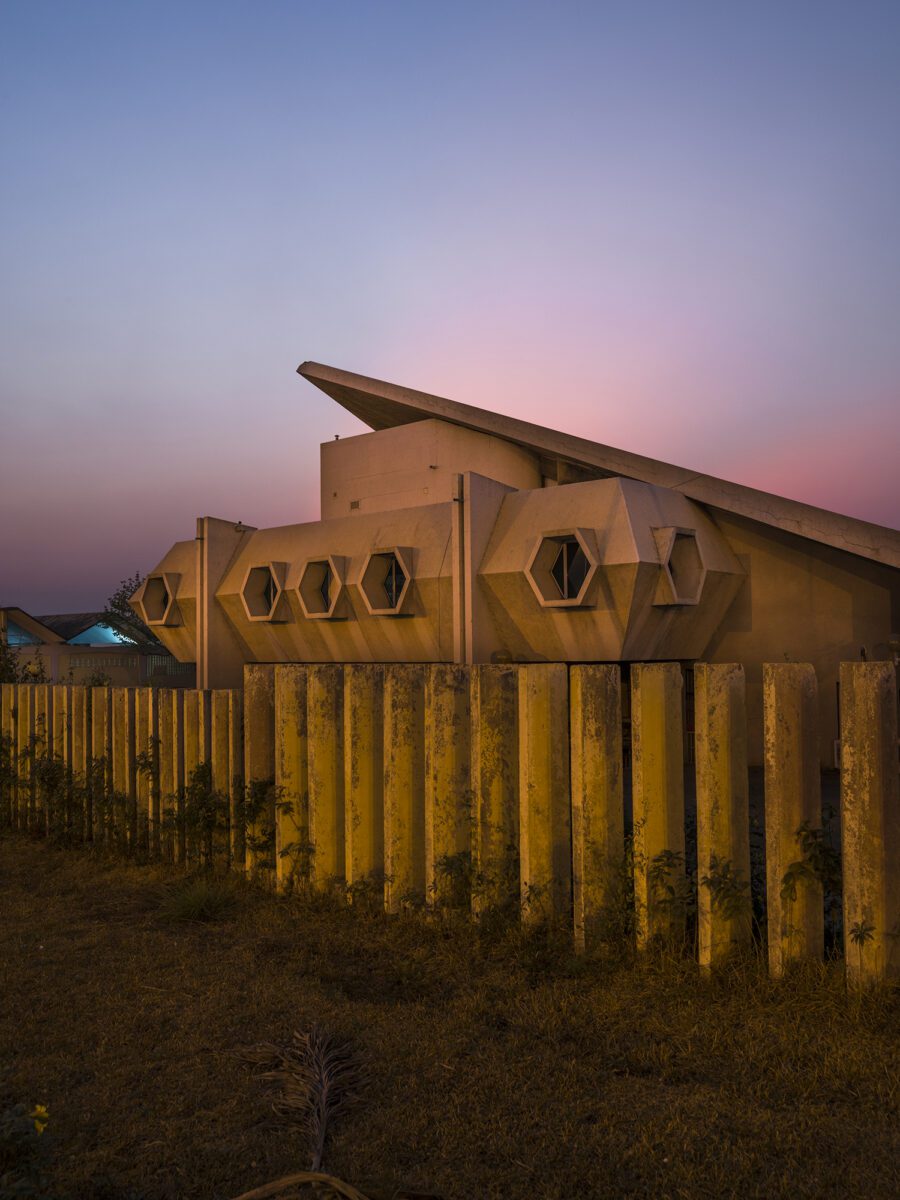
Alongside these projects, the exhibition presents a wide constellation of practitioners whose work reflects the complex conditions of architectural production in the post-independence period. John Owusu Addo in Ghana appears alongside Demas Nwoko in Nigeria and Cheikh Ngom in Senegal, each working within distinct institutional and cultural contexts. They are placed in dialogue with international architects including Pier Luigi Nervi, Zoran Bojović, and Rinaldo Olivieri, reflecting the entangled networks through which architectural knowledge circulated. Rather than reinforcing a binary between African and European practice, the show highlights architecture as a field shaped by circulation, collaboration and structural asymmetry. These conditions produced uneven access to resources and expertise, but also opened space for adaptation and reinterpretation. African architects emerge here not as peripheral interpreters of modernism, but as central agents in its reconfiguration across new political realities. Authorship is understood as distributed, relational and embedded within institutional and material constraints.
Architects of Liberation positions Western African modernism within global architectural history as a field of co-produced experimentation rather than peripheral adoption. It situates the built environment within the political urgency of independence, where architecture functioned simultaneously as instrument of state formation, spatial imagination, and civic projection. The grouping of Benin, Cameroon, Côte d’Ivoire, Ghana, Nigeria, Senegal and Togo is used not to homogenise but to trace overlapping yet distinct trajectories of post-independence development. Across these contexts, modernism emerges as a plural language shaped by ambition, adaptation, and constraint, but also by innovation and institutional creativity. The exhibition resists closure, allowing the tensions of the independence era to remain active within contemporary architectural discourse. In doing so, it restores depth and critical texture to a history that continues to shape how space, power and identity are produced, negotiated and lived today.
Architects of Liberation: Modernism in Western Africa is at Museum of Modern Art, New York from 5 July – 2 January: moma.org
Words: Shirley Stevenson
Image Credits:
1&6. Lycée Mamie Adjoua auditorium, Yamoussoukro, Côte d’Ivoire. Completed c. 1978. Jean Léon (1937–2002). 2025. Photograph: François-Xavier Gbré.
2. Banque Ouest Africaine de Développement (BOAD), Lomé, Togo. 1979–80. Guy Durand, Yves Ménard, and Messan Raphaël Ekoué-Hagbonon. 2025. Photograph: François-Xavier Gbré.
3. Alpha 2000 (Société Ivoirienne de Banque), Abidjan, Côte d’Ivoire. 1974–76. Bureaux d’Études Henri Chomette (est. 1948). 2025. Photograph: François-Xavier Gbré.
4. La Pyramide, Abidjan, Côte d’Ivoire. 1968–73. Rinaldo Olivieri (1931–1998). 2025. Photograph: François-Xavier Gbré.
5. Centre International du Commerce Extérieur du Sénégal (CICES), Dakar, Senegal. 1971–74. Jean-François Lamoureux (b. 1943) and Jean Louis Marin (b. 1943). 1974. Photograph: Michel Fegyveres.


