

Systems of power, cultural identity and “the fragile boundaries between perception and reality” are the ideas that drive Lucia Shuyu Li, a multidisciplinary artist whose practice spans installation, performance, painting and sound. They’re also some of the most relevant themes of our times, emerging from a contemporary era defined by misinformation, political polarisation and an endless news cycle. Li draws on her Chinese heritage and time spent in the US to create her works, which express her “experiences as an individual navigating the complexities of contemporary society.” The trio of paintings Judge Me, I Am Dead Therefore I Was Alive and Who Cried Walking Home are perhaps her most personal, and speak to these themes loud and clear. They navigate feelings of homesickness, injustice and frustration with the government – rendering her dreams and innermost subconscious thoughts in red, black and ultramarine.
Despite her talent in traditional oils and acrylic, Li is dedicated to challenging the confines of conventional painting, often through physical de- and re-construction. Her installation Singularities, for example, features two abstract self-portraits in which circular cut-outs have been made. Viewers are encouraged to investigate the voids – only to encounter a mirror, and therefore themselves. “This is the central concept of the work,” the artist explains. “When you look into the abyss, the abyss is looking at you.” Then there’s Painting Sickness, in which a canvas has been cut into strips, reconfigured and hung from the ceiling as a kind of hybrid sculpture-painting. Fluxing Nature, likewise, combines an array of materials to create a psychedelic space in which fabrics, mannequins, projections, videos and even 3D-printed elements collide.
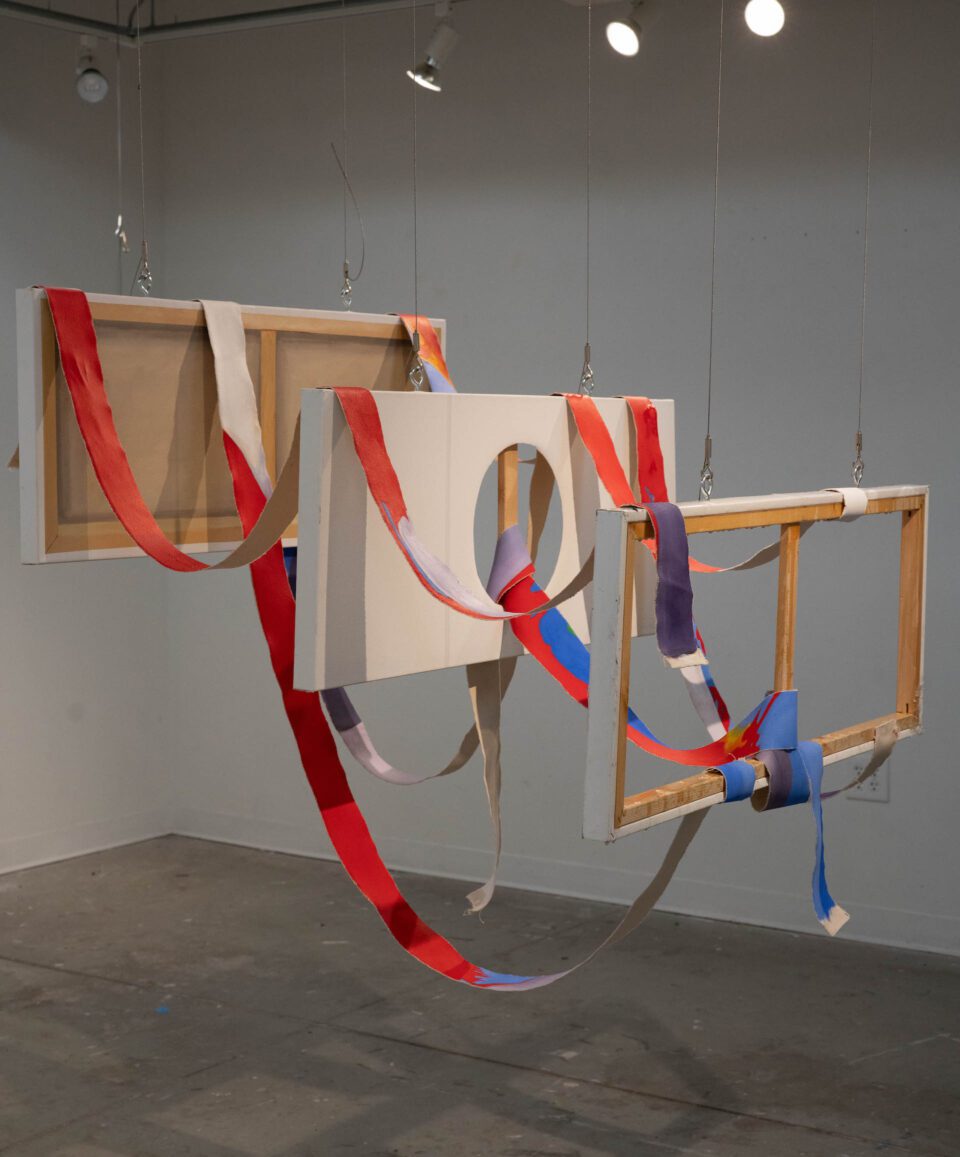
In recent years, Li has extended her investigations of materiality into performance art. Far Gone But So Close invites viewers to discover cloth in motion, frozen at a particular a point in time. Art enthusiasts might be reminded of Hans Haacke’s Blue Sail (1964-1965) in which a blue chiffon sheet – suspended over a fan – floats in the gallery space. Yet Li’s iteration is very much rooted in the 21st century. It is surrounded by four cameras, which appear to be taking photographs of the static scene. Yet, on closer inspection, their screens are playing video clips of the artist interacting with the fabric – covering her body and face. It’s a new way for audiences to watch performance, pushing beyond the conventions of traditional gallery screening rooms, whilst echoing the endless scroll of video content that defines life online.
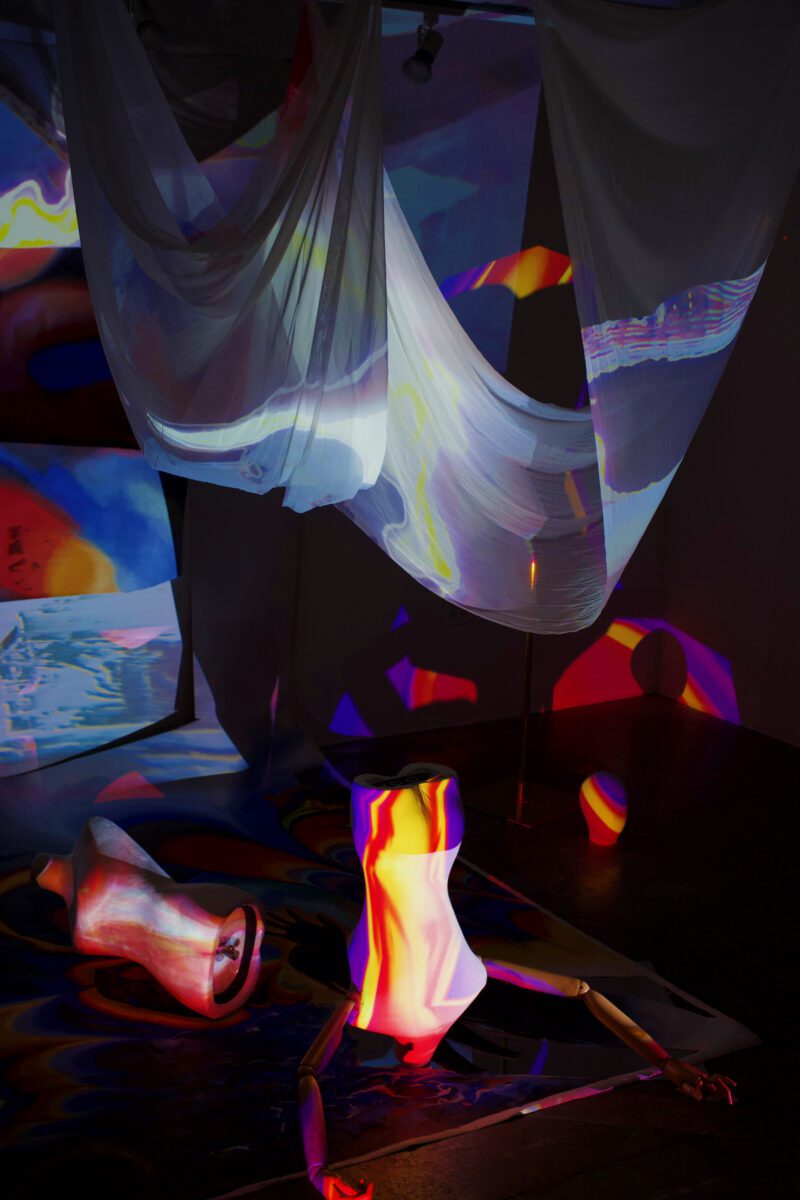
Li’s work offers a contemporary take on the Institutional Critique movement, pioneered by Hans Haacke, which interrogates the structures and ideologies embedded within museums and cultural institutions. It’s an approach that has already garnered significant recognition, with exhibitions at the Chinese American Museum, Washington, D.C., and coverage in Artforum. As her practice continues to evolve across disciplines, Li is not only expanding the possibilities of painting, but also reframing the role of the viewer – positioning them as both participant and subject within systems of looking, power and control.
Words: Eleanor Sutherland
1. Lucia Shuyu Li, Far Gone But So Close.
2. Oil painting. Image courtesy of Lucia Shuyu Li.
3. Lucia Shuyu Li, Painting Sickness.
4. Lucia Shuyu Li, Fluxing Nature.


