

It took a car, a motorcycle and a donkey to get to Haiti’s Citadelle Laferrière, the largest fortress in the Western Hemisphere and a Unesco World Heritage Site since 1982. The journey to the majestic citadel was so time-consuming and the road so steep that we were instructed at different elevation levels to lean forwards or backwards. It took deep breaths and a lot of faith to finally make it to our destination.
En route, I saw a number of people of different ages steadily walking up the mountain—seven miles stretched before them to get to the top. They had long wooden planks steady and balanced on their heads. Some had stopped on the side of the road for a break. When we arrived, it was clear what these wooden planks were for: a major conservation project.
When the Haitian king Henri Christophe commissioned the fortress, built between 1805 and 1820, he ordered the construction of many others like it across the northern coast of the newly independent Caribbean country. Preparing for future battles and in an effort to defend the nation from being reconquered, Jean-Jacques Dessalines (the revolutionary and first emperor of an independent Haiti) entrusted the first and only Haitian king with this project. Now, more than 200 years later, construction is underway again.
I was engulfed in the shadow of the citadel. Our tour guides pointed out the tens of thousands of iron cannon balls (for the more than 300 cannons made of bronze and iron) and the highest point that would allow the king to spot invaders coming by sea. It was a smart structure built to gather intelligence and to protect a new nation that emerged from the only successful slave rebellion in history.
There are more than 50,000 iron cannonballs still stacked neatly at Citadelle Laferrière Photo: Alan B Photography, via Flickr
The local tour guide Rose Beaulieu spoke about the looting after the king’s death in 1820, the earthquake of 1842 that furthered the fortress’s ruin and a number of other factors that have caused damage over the centuries.
The road we took was built by a government that saw the value of visiting the citadel. But on our way, the young men who led the donkey pointed out how they used to get up to the structure: narrow footpaths through the trees. If you know, you know.
The guide also pointed out the areas of the structure that were walled off, closed because there were several plots throughout the years involving theft and looting. Tourists would take cannon balls, and during earthquakes or other times of strife citizens would seize an opportunity to make fast cash.
The planks brought to the citadel were part of a preservation project that has lasted 25 years, an effort to reinforce the fortress against earthquakes and provide better visitor access. Some of the workers have been on the project since the beginning; it is scheduled for completion at the end of this month.
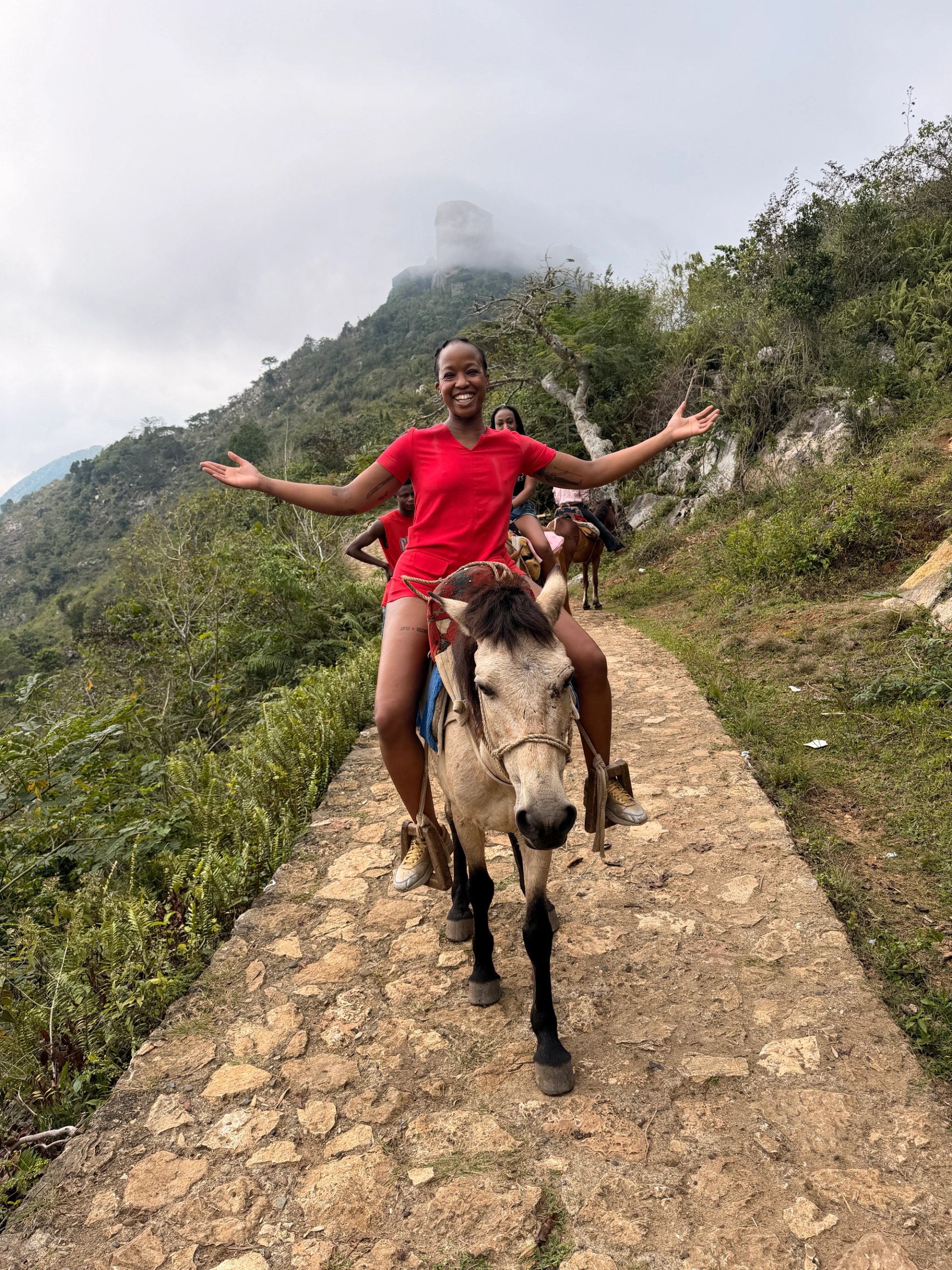
The author riding her donkey on the path leading to Citadelle Laferrière Courtesy Ruth Jean-Marie
“Caring for heritage is a shared responsibility,” a spokesperson for the World Monuments Fund (WMF) tells The Art Newspaper. “Governments can play a significant role, but communities, cultural institutions and partners all contribute to ensuring that historic places remain protected and valued for generations to come.”
The WMF’s work on the citadel has included waterproofing the structure. The organisation constructed a new roof from corrugated aluminium and spent more than a year planning the framing of the structure. Upper portions of the walls, some of them up to 45 metres high, were also reconstructed. The WMF also worked with Unesco to provide an expert to share 19-century conservation techniques with the local workers.
When I visited, the Haitian Institute for the Protection of National Heritage (ISPAN) was still forging ahead with construction. Workers were sealing cracks, working on a balcony and building small bridges. The wooden supports—the planks I saw brought up one by one—would be reinforced by injecting liquid cement into the citadel’s walls. They will help prevent damage in future earthquakes.
Beaulieu commented on the renovations in Kreyol with an awe-inspired, confident tone. “The areas that were closed off, for example near the Cross of David, there’s a very beautiful renovation occurring that we didn’t even think was going to happen,” she said. “In this area where they did the renovation, it’s a very large space for visitors. The renovations I’m seeing, there are more possibilities and more space to visit. It’s a beautiful initiative. What’s happening is necessary and it’s being done well. We’re watching to see if the rest of the renovations will be similar.”


