

It is estimated that by 2030, 1 in 6 people worldwide will be over 60. Meanwhile, 1 in ten children in the UK are now expected to live beyond 100. Yet, as people globally are living longer, many face health and social inequalities that impact later life. A new exhibition at Wellcome Collection, London, asks how societies can adapt to ensure everyone ages better. The Coming of Age is the first major museum show to explore experiences and perceptions of ageing, from adolescence to the elderly, through art, science and popular culture. More than 120 artworks and objects are featured in the exhibition, including Sebald Beham’s medieval woodcut depicting elders rejuvenated by the mythical fountain of youth, and 1930s adverts for Kellogg’s All-Bran cereal that claimed to keep consumers young. Contemporary works range from Deborah Roberts’ King Me (2019) – from a series that highlights the societal challenges that Black children face as they strive to build their identity –to Robert Mapplethorpe’s portrait of a playful and defiant 70-year-old Louise Bourgeois,ahead of her first major retrospective. Wellcome Collection’s curator Shamita Sharmacharja spoke to Aesthetica about how the show is tackling stereotypes about aging.
A: How was the idea for The Coming of Age first developed?
SS: At Wellcome Collection, we believe that everyone’s experience of health matters. Our exhibitions often explore subjects that feel both universal and deeply personal, examined across time, disciplines and perspectives, particularly through narratives beyond the cultural mainstream. Initially, I imagined an exhibition focused specifically on older age. Globally, we are living longer than ever before – a remarkable achievement – yet ageing is often framed through fear, decline and scarcity. I was interested in why this anxiety persists, and why longevity is rarely treated as blessing rather than a curse. The Covid pandemic also brought into sharp focus how we think about age, vulnerability and health inequality. It highlighted how structural inequities shape every stage of life, and how that gap widens as we age. As I developed research on the exhibition, it became less focused on later life alone, also addressing how age and ageing are culturally constructed across the lifespan. We are constantly bombarded with messages about how to look, feel and stay young. “Ageing well” is often presented as a personal responsibility, tied to lifestyle, diet and exercise, which can obscure the systemic conditions that profoundly influence how we age. The Coming of Age ultimately became an exploration of how cultural attitudes, social structures and health inequalities shape our experience of ageing – and how this affects all of us, all of the time.
A: Ageing is often framed as failure or decline. How did you avoid reinforcing that narrative while still addressing inequality, illness and loss?
SS: We wanted to show that there is no singular experience of ageing. It’s never wholly positive or negative – it’s shaped by circumstance, inequality and community as much as what’s going on in your body. We feature Born in Bradford, a public health study following 60,000 residents over 20-years so far, whose participants have become citizen scientists in understanding and shaping their own lives. Bradford is one of the UK’s youngest cities, and has one of the lowest life expectancies. A statistic that stayed with me is that a 30-minute train journey from inner-city Bradford to its wealthier suburbs corresponds to a 10-year increase in life expectancy – and a 20-year increase in “healthy life” expectancy. We’re showing a neon sculpture by Ian Beesley, who has been artist in residence since the project began, bearing its rallying cry: “everything is connected.” This phrasing points to the social determinants of health – the non-medical forces that shape how we live and die, such as where you live, the air you breathe, access to resources — and how profoundly they shape people’s life-courses. Similarly, Uncertain Futures, a five year participatory project led by Manchester Art Gallery with artist Suzanne Lacy, academic researchers and 100 women over 50, explored the impact of work and worklessness on later life. Many participants had spent years as unpaid carers, affecting their financial security and experience of ageing. Together they identified barriers to employment and developed practical solutions, resulting in exhibitions, workshops and a manifesto that has influenced policy locally and internationally. Both projects address illness, inequality and loss — but they also foreground agency, community and joy. That balance felt essential: acknowledging structural injustice without collapsing ageing into a story of decline.
A: The show spans a full lifetime. Which stage of life felt most misrepresented when you began?
SS: From early on, I knew I wanted to explore age as a cultural construct and to challenge the idea that life follows a fixed, linear path. That came in part from looking at prints in Wellcome’s historic collections depicting the “Ages of Man” as a stepped diagram – a prescribed ascent through childhood, education, heterosexual marriage and social success, peaking at midlife before an inevitable decline into frailty and death. In conversations with our Collections curator, Ruth Horry, we began questioning why this particular life arc is so persistently represented when, even in the past, it didn’t truly reflect the pattern of people’ lives and excludes many. We were also struck by how persistent these expectations remain, shaping ideas about what we “should” achieve at certain ages and fuelling anxieties around milestone birthdays. We explored where these stereotypes come from, placing them in juxtaposition with artistic perspectives. For example; Tam Joseph’s painting UK School Report (1983) looks at the harmful effects of adultification of Black boys in the British education system; Flo Brooks’ badge paintings (2018) explores their experience of a second puberty during their gender transition in their 30s; Serena Korda’s ceramic series Wild Apples (2014) upends the male-centred medical gaze with her exploration of menopause as a time of positive transformation; whilst Nursing (2000), a hand coloured print by Paula Rego, conveys the complex family dynamics at play when caring for an ageing parent. In the end I realised that all life stages are constrained by the stories we tell about them and can be enriched by better representations.
A: The exhibition opens with a silver sake cup gifted to Japanese centenarians. What does that object set in motion for the visitor?
SS: The very first objects visitors encounter are a pair of exquisite sakazuki sake cups, gifted to people in Japan on their 100th birthday. Until 2014 they were made of pure silver, but due to Japan’s rapidly ageing population – where almost 30% of people are over 65 – they are now produced in a silver-nickel alloy. Only 153 cups were given out when the scheme first started in 1963. Yet by 2014, over 29,000 cups were due to be given out, causing the change to the cheaper material on account of its expense. We are showing one of each type. They symbolise the dilemmas facing super-ageing societies in terms of value, commemoration and resource. As the 100 year life becomes more common, how do we value and care for it?
A: How can art be a means of empowerment as we age?
SS: We are showing the work of over 30 artists in the show, at varying ages and stages of their creative practice. This includes an iconic portrait of Louise Bourgeois that Robert Mapplethorpe took on the eve of her first museum solo retrospective at MoMA in 1982, at the age of 70. She poses with her sculpture Fillette (‘little daughter’), a phallic form made of latex, tucked cheekily under one arm, knowing glint in her eye. Bourgeois had an eight-decade long career; making work challenging conventions of gender and sexuality until her death at 98 in 2010. We’re showing this portrait alongside Bourgeois’ Ode à Ma Mère, a series of etchings she made processing the premature death of her mother, who died when Bourgeois was only 21. We’re also displaying work by Kimiko Nishimoto, who took up photography age 72. Known as InstaGran, or Japan’s “selfie grandma,” she learnt how to edit her photos to create comic and surreal images of herself. One shows her wrapped in a bin bag. On Instagram, she added the caption: “When you are old, being thrown away is just part of life”. Others are pure fantasy, as when she joyfully floats from a tree. She had over 400,000 followers by the time of her death in 2025, aged 98. William Utermohlen was an American artist who created self-portraits throughout his career, including after his diagnosis with Alzheimer’s disease in 1995. The Coming of Age features a selection of his self-portraits and life drawings, which show changes in his perception and spatial sense as his condition developed, but also how his central artistic practice was to his sense of self. Utermohlen and his wife Patricia worked with his neurologists on an academic paper about making art while living with dementia.

A: Birthday cards, advertising slogans and cereal boxes appear alongside canonical artworks. Why was popular culture essential to telling this story?
SS: Mass media felt essential because it’s one of the primary ways ideas about age are absorbed, normalised and internalised. We wanted to understand where ageist assumptions come from – and didn’t need to look far to find the everyday imagery that surrounds us. In the exhibition, we trace representations of age through folklore, film and comedy – from Disney’s Snow White (1937) to Harry Enfield’s Kevin the Teenager (1994) – alongside advertising that promises to manage or “correct” ageing, from 19th century beard dye to the supposed anti-ageing benefits of Kellogg’s All-Bran in the 1930s. These materials reveal how early and consistently we’re told what youth, midlife and older age should look like. We also collaborated with the Tower Hamlets–based charity Magic Me, which has spent over 30 years bringing generations together through creative projects. They worked with 9 and 10-year-old schoolchildren and local older adults to create “It’s on the Cards,” imagining a fictional design studio that debated and “hacked” commercially available birthday cards steeped in jokes about decline. The group redesigned them to reflect their own experiences and thoughts about age; what I found particularly joyous about that project was how much the group had in common rather than what set them apart.
A: What can art reveal about ageing that science and statistics simply can’t?
SS: The easy answer would be to say that art conveys lived experience, while science and statistics provide the broad-brush picture. But the exhibition deliberately complicates that distinction. We’re showing projects by organisations doing rigorous scientific and statistical work that also place lived experience at their centre. There is Born in Bradford, and the Centre for Ageing Better, whose annual State of Ageing report draws on national datasets alongside the voices and experiences of older people. We’re displaying infographics from that report to highlight structural health inequalities in later life, but always in dialogue with the realities those numbers represent. We’re also showing Unclaimed, an installation by creative agency Liminal Space, based on a recent University College London research project with 2,000 Camden residents over 70. They’ve created a surreal lost property office, where each object contains a personal story – some activating oral histories gathered during the research. Together, the objects evoke the sheer variety of ageing experiences today, and how easily they can be overlooked. So rather than positioning art and science in opposition, the show suggests that art can hold space for ambiguity, emotion and contradiction – reminding us that behind every data point is a life lived in all its complexity.
A: Queer, feminist and racialised perspectives run through the exhibition. How do they unsettle the idea of a “normal” life course?
SS: Pressures to conform to social norms are damaging for everyone, but they fall particularly heavily on those with marginalised identities – and we explore that in the show. For example, we show the 19th century “Ages of Man” prints alongside a 1980s version of The Game of Life board game. Both set out a template for success: heterosexual marriage, stable employment, property ownership, continued productivity – a life that can be measured, often financially. They present a narrow, supposedly universal model of what a “normal” life course should look like. These works sit in productive tension with a contemporary Queer Creative Health zine by Meg-John Barker for QueerCircle, and a series of short films by artists working with the Re·Vision Centre for Art and Social Justice in Canada. Together, they foreground experiences of ageing that resist dominant scripts around gender, sexuality, race and ability. As Barker writes, “many if not most people fall off the normative escalator at some point in their lives.” That plurality unsettles the notion that there is a single, coherent path through life. Instead, it reveals the so-called “normal” life course as culturally specific, exclusionary and ultimately fragile.
A: Do you have a particular item in the show that stands out as a personal favourite?
SS: There are so many extraordinary works in the exhibition across so many different disciplines that I genuinely couldn’t single one out as a “favourite.” But there was a moment in the research process that felt particularly special and unexpectedly personal. I knew from the outset that I wanted to include work by Paula Rego. Across her long career, she returned again and again to themes of transformation, power and the emotional complexity of ageing. I had initially been thinking about showing some of her fairy-tale works, but they were en route to a major retrospective in Norway. In conversation with her Estate and Victoria Miro Gallery, I instead learned about a series of self-portraits she made after falling at the age of 81. Rego rarely depicted herself directly – often working with her long-time model Lila Nunes as a proxy for self instead – so the fact she decided to do this after falling is especially meaningful. She portrays her bruised, swollen face with an extraordinary mixture of rage, revulsion and fascination. In transforming injury into image, she turns vulnerability into creative defiance. As she reflected at the time, “I didn’t like the fall… but the self-portraits I liked doing. I had something to show.” We’re also showing a pen-and-ink drawing she gave to her son Nick Willing for Christmas, playfully but pointedly exploring shifting family dynamics at this time of heightened tensions. On a personal level, including her work felt like a quiet full circle. I wrote to Paula Rego as a schoolchild – she was a hero of mine – so to find myself, years later, working with her estate on this exhibition inevitably made me reflect on my own past, present and future selves. It felt like a fitting echo. I kept that letter, all these years, and it is now in their archive.
A: How do you hope a 16-year-old and an 80-year-old might experience this exhibition differently?
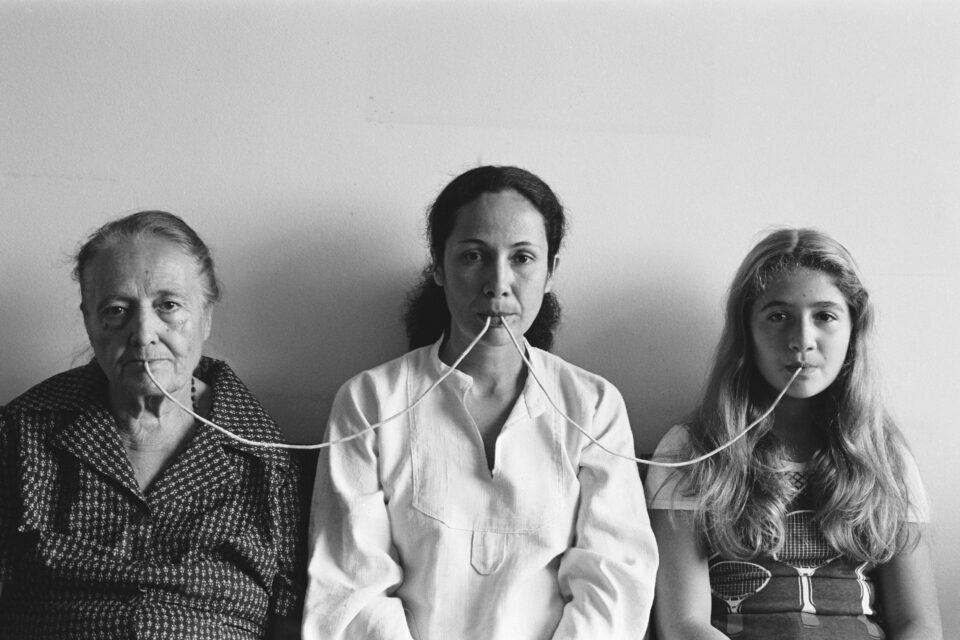
SS: My dream scenario would be for them to visit together – and to realise they have more in common than apart. In many ways, that intergenerational exchange echoes the birthday card project in the exhibition, where the children and older adults discovered unexpected common ground. Intergenerational connection is a key theme to the show, which is why we chose Anna Maria Maoilino’s Por um fio (By a Thread) (1976) as the lead image. The photograph shows the artist between her mother and her daughter connected by a spaghetti‑like string. The Portuguese title, which is similar to the phrase in English “by the skin of one’s teeth,” adds precarity and the hint of separation – one sudden bite and the connection breaks. The beautiful thing about the subject of ageing is that we all have a lived experience of it. I’d like to think that whether you’re 8 or 88, there is something here for you.
The Coming of Age is at Wellcome Collection, London from 26 March – 29 November: wellcomecollection.org
Words: Emma Jacob & Shamita Sharmacharja
Image Credits:
1&5. Anna Maria Maiolino, Por um fio (By A Thread), 1976-2017.
2. Maija Tammi, Problem of the Hydra. Still image.
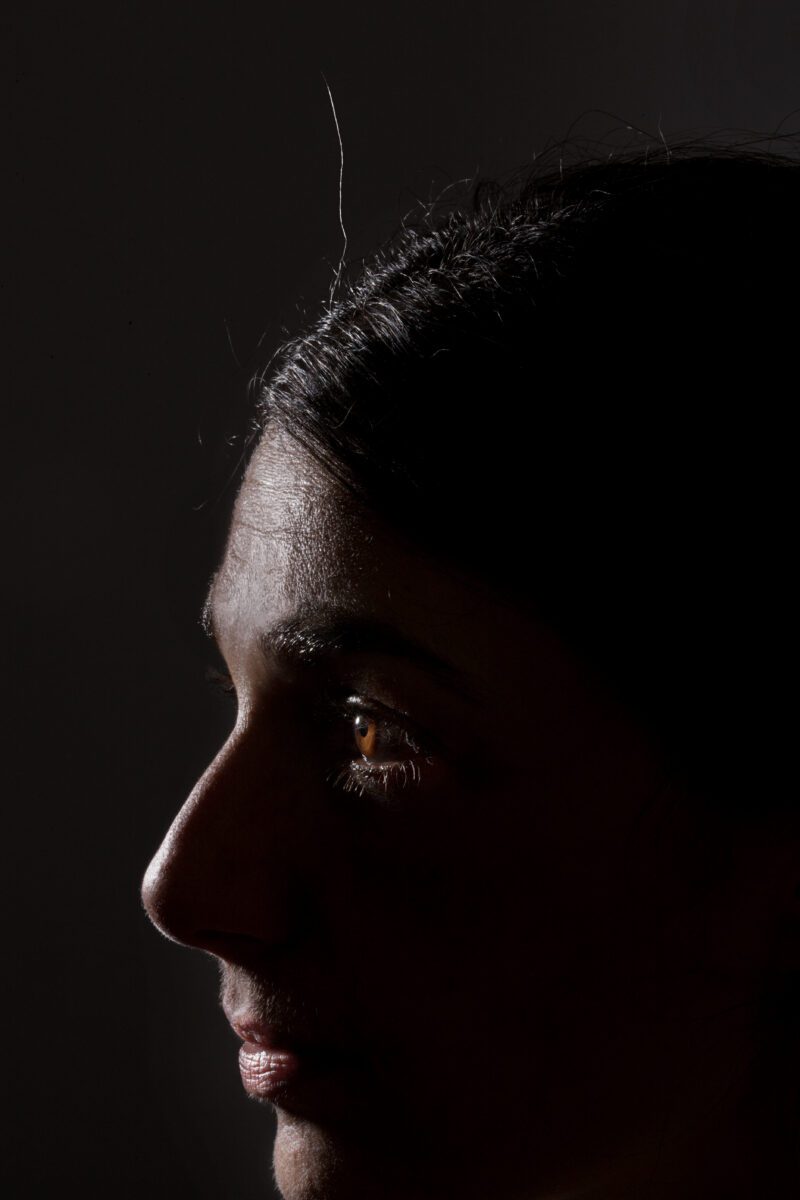
3. Elina Carucci, Gray hair sticking straight up, 2015. Courtesy the artist.
4. Maija Tammi, Problem of the Hydra. Still image.
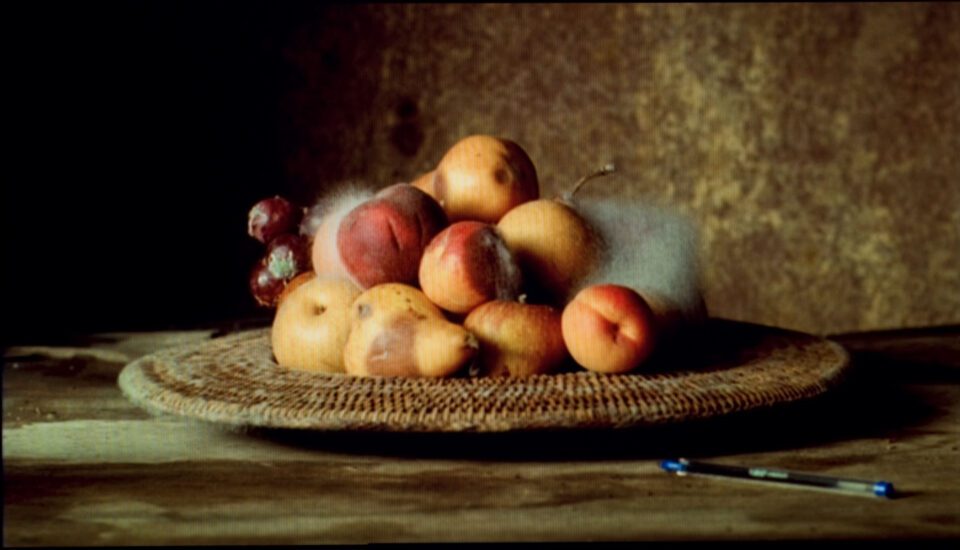
6. Sam Taylor-Johnson, Still from ‘Still Life’, 2001.


