

Architecture signals how we are meant to navigate, gather and inhabit a space. The threshold of a museum can command awe whilst inviting curiosity; a public square might encourage gathering or enforce distance. Take the Guggenheim Bilbao, designed by the late Frank Gehry, with its sweeping titanium curves, transforming an entire city. In Paris, the Centre Pompidou collapses the boundaries between interior, exterior and street. These buildings endure because they change how people feel, move and relate.
That belief underpins Maggie’s: Architecture that Cares at V&A Dundee, an exhibition marking the cancer charity’s 30th anniversary. Here, thoughtful building design comes to the fore, foregrounding spaces that are beautiful, intimate and nurturing. Since the initial Maggie’s location opened in Edinburgh in 1996, more than 30 centres have been realised across the UK and beyond. Over the years, leading architects including Frank Gehry, Norman Foster, Richard Rogers and Zaha Hadid have responded to a single human-centred brief. In response to her own experiences of cancer, co-founder Maggie Keswick Jencks dreamt of buildings that would help people “not to lose the joy of living in the fear of dying.” The exhibition brings these principles to life through models, sketches, new films and the voices of both centre users and staff.
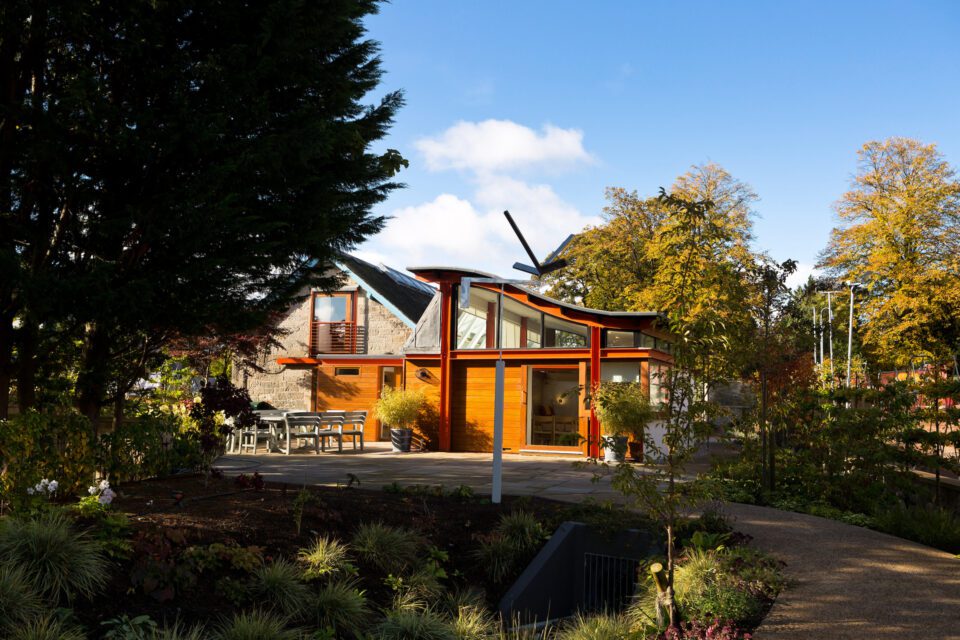
Maggie’s Edinburgh was the first to open, in 1996, and saw Richard Murphy redevelop an old stable blocks. The architect said his inspiration was “to slip a building within a building, with lots of little niches and intimate spaces.” The inaugural new-build centre would come in 2003. Designed by the late world-famous architect Frank Gehry (1929-2025), Maggie’s Dundee takes shape as a white, cottage-like building with a wavy silver roof – modelled on a traditional Scottish “butt ‘n’ ben” dwelling. It offers a welcoming sense of calm and sanctuary, yet maintains the sense of inventive play that defined Gehry’s other projects, like the Guggenheim Museum in Bilbao. The garden, planned by Arabella Lenox-Boyd, contains a labyrinth based on the one at Chartres Cathedral in France. “Maggie Keswick Jencks was a wonderful landscape designer,” says Lenox-Boyd. “Her original blueprint for the centres placed great emphasis on the role of the landscape and outdoor space in creating a relaxing environment with the emphasis on stress reduction and healing.” Indeed, scientific research has consistently demonstrated that spending time in nature – often called “ecotherapy” or “forest bathing” – has profound, measurable effects on wellbeing.
Plants are also at the heart of Maggie’s, Yorkshire, which was built in 2019 and designed by Heatherwick Studio. Fittingly, Heatherwick is best known for producing the UK Pavilion (Seed Cathedral) for the 2010 Shanghai World Expo, comprising 60,000 transparent fibre optic rods, each containing a seed from Kew Gardens at its tip. Inspired by Keswick Jencks’ love of gardening, they envisioned a Maggie’s centre that took the shape of three large-scale planters. Today, people who visit are encouraged to help take care of the 23,000 bulbs and 17,000 plants growing in its rooftop garden. “Our aim was to build a home for people affected by cancer that would be soulful and welcoming, unlike other typical clinical environments,” says Founder Thomas Heatherwick. “By only using natural, sustainable materials and immersing the building in thousands of plants, there was a chance for us to make an extraordinary environment capable of inspiring visitors with hope and perseverance during their difficult health journeys. Maggie’s, Yorkshire has been a very special project for me and my team because we are convinced that there are kinder, more empathic ways to design places that can have powerful impacts on the way that we feel. This is particularly important in the design of healthcare environments, but is so frequently overlooked.”
Architecture that Cares joins V&A Dundee’s 2026 programming alongside Catwalk: The Art of the Fashion Show, which charts over a century of runway innovation, and Design and Disability, celebrating the radical contributions of Disabled, Deaf and neurodivergent communities to art and culture. Together, V&A Dundee’s three shows argue that architecture is not just a neutral backdrop, it is a social force.
Maggie’s: Architecture that Cares is at V&A Dundee from 6 March.
Words: Shirley Stevenson
Image Credits:
1. Maggie’s Yorkshire, Heatherwick Studio, Garden design by Balston Aguis. © HUFTON AND CROW.
2. Maggie’s Dundee, Frank Gehry, Garden design by Arabella Lennox Boyd. © Maggie’s.
3. Maggie’s Edinburgh, Richard Murphy, Garden design by Emma Keswick. © Eoin Carey.


