

For its 20th anniversary, the Museum of the African Diaspora (MoAD) in downtown San Francisco has reopened with a facelift of its ground-floor lobby and two new exhibitions. One of the shows focuses on its institutional history, while the larger one, Unbound: Art, Blackness & the Universe (until 16 August 2026), explores Blackness and the cosmos.
MoAD’s revamped lobby has new ticketing and welcome counters, with enough open space to serve as a gathering point for visitors. “You’ll also find a primer for the exhibitions,” Monetta White, the director and chief executive of MoAD, tells The Art Newspaper. “You’ll find a framework, some vocabulary, some definitions of the themes.” Meanwhile, she points out, much of the rest of the $500,000 renovation has gone into critical infrastructure improvements visitors will hardly notice, such as lighting upgrades and a new heating, ventilation and air-conditioning system.
The museum’s Unbound exhibition covers the gamut of media, from painting to photography, sculpture and installation. It was curated by the museum’s first chief curator, Key Jo Lee, who had been researching the show ever since her arrival in January 2023. White says the exhibition encompasses “expanded considerations of the Black experience. It is important for a lot of reasons, like how we’re looking at the future of MoAD, this whole cosmic side.”
Installation view of Lorna Simpson’s Blue Turned Temporal (2019) Photo: Josef Jacques, courtesy Museum of the African Diaspora
Featured in Unbound are 17 artists, both well-known (like Torkwase Dyson, Barkley L. Hendricks and Lorna Simpson) and emerging. Their works are presented under three themes: ”Geo-Cartographic”, “Religio-Mythic” and “Techno-Cyborgian”.
Lee describes Geo-Cartographic as “literally geography and mapping, mapping Blackness across both cosmic and terrestrial realms”. She is keen on expanding what we might typically think of as Black art, or even Blackness. This section features Simpson’s monumental Blue Turned Temporal (2019), a glacial landscape rendered 12ft wide in ink, water and screenprint on gessoed fibreglass.
Simpson’s art makes us see beyond “commonplace representations”, Lee wrote in a catalogue essay for the Cleveland Museum of Art—where she worked as a curator before joining MoAD. “Instead, Simpson’s paintings, because they make demands, assert refusals and require physical and intellectual movement for enhanced apprehension. They engender what I call perceptual drift, a way of exploring Blackness as matter in art and thereby transforming art history with countless untold narratives and previously hidden meanings.”
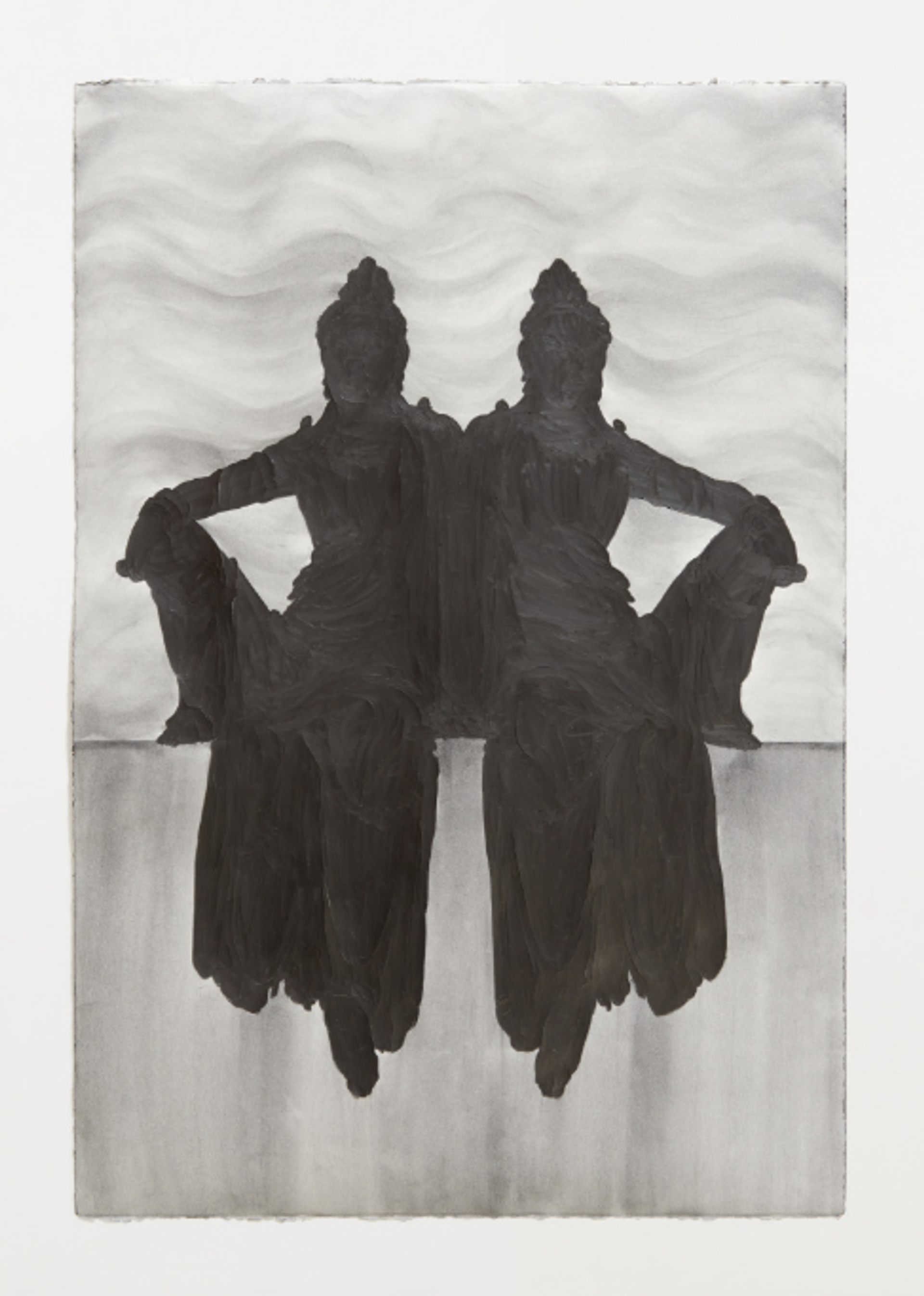
Oasa DuVerney’s BLACK POWER WAVE as Bodhisattva Manjushri Sankofa (2023) Courtesy the artist and Welancora Gallery
The second Unbound theme, Religio-Mythic, is “thinking about Blackness as sacred origin”, Lee says. “Everything from artists who are thinking about the Orishas—who are considered the pantheon at the origins of the universe in Yoruba culture—to Oasa DuVerney, who has this concept of a ‘Black power wave’.”
Three of DuVerney’s large drawings are in this section, including two from her BLACK POWER WAVE series. One is her version of the Virgin of Guadalupe, surrounded by a powerful aura and standing on a stylised tree; the other, BLACK POWER WAVE as Bodhisattva Manjushri Sankofa (2023), pairs an enlightened being from Buddhism with a Ghanaian symbol representing learning from the past in order to move forward.
“She thinks that if you can fill up all of these multicultural symbols of care with this idea of Black power, which is a universal kind of freedom, then maybe we can get there,” Lee says.
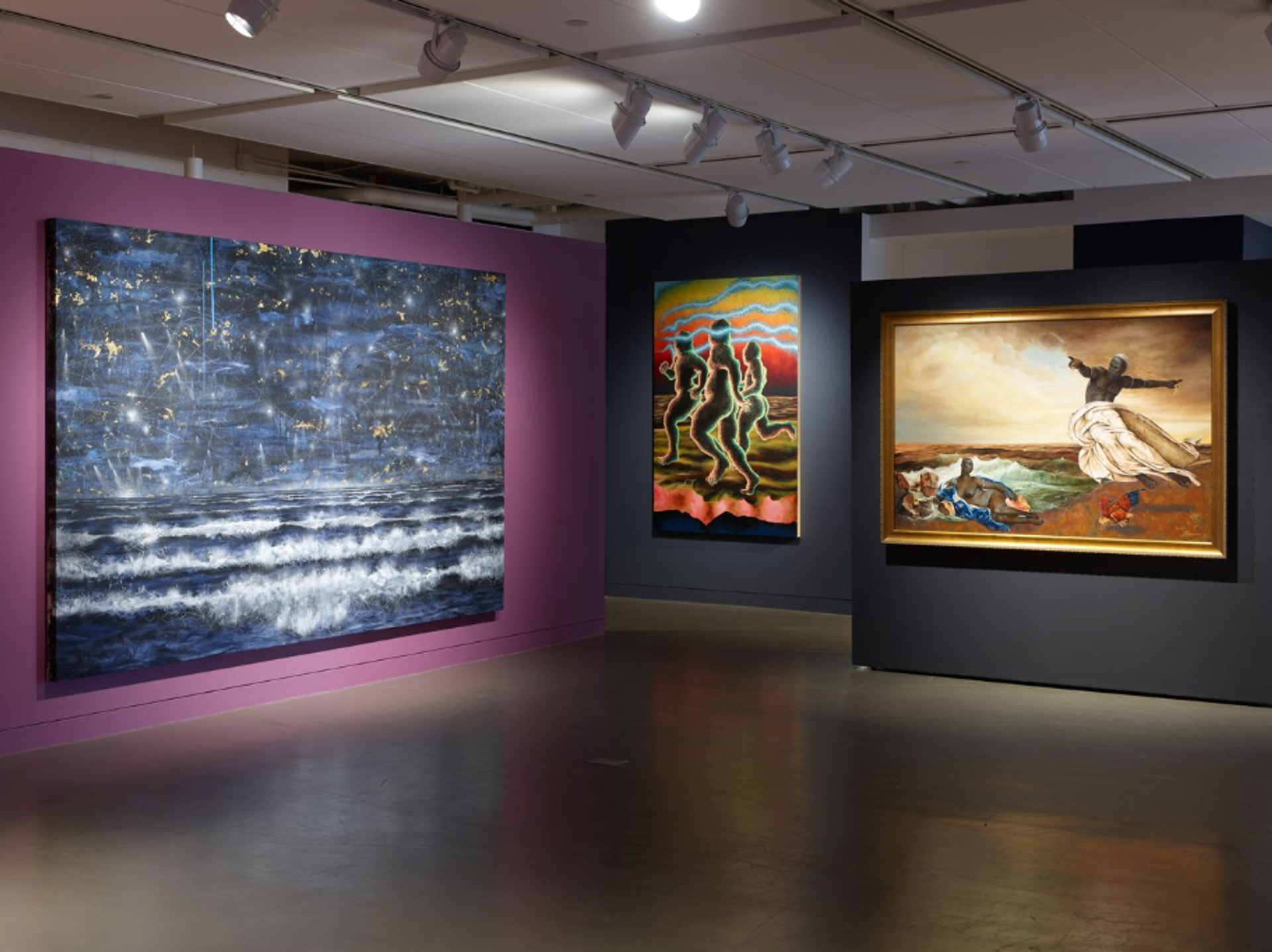
Installation view of Unbound: Art, Blackness & the Universe, with Harmonia Rosales’s Creation Story (2021) at right Photo: Josef Jacques, courtesy Museum of the African Diaspora
Also under the Religio-Mythic category is Mikael Owunna’s The Resurrection of Eke-Nnechukwu (2021), a large, dye-sublimation print on aluminium depicting a scene taken from the origin myth of the Igbo people of Cameroon, Gabon and Equatorial Guinea. According to the story, Eke-Nnechukwu was fatally wounded when an explosion was set off as she entered the personal space of her male counterpart, Chukwu. He weeps at her loss, and his tears revitalise her. In Owunna’s work, Eke-Nnechukwu is coming back to life and spinning the universe with her fingers. The piece is part of a series the artist photographed using ultraviolet light and live models wearing fluorescent body paint, giving the figures a glimmering, otherworldly appearance.
Harmonia Rosales’s six-foot-wide oil painting Creation Story (2021) is another work referencing a creation myth. It shows an Old Testament-like figure in midair—a Black man with his arms outstretched and appearing to form land and sky. Meanwhile Yemaya, ruler of the seas, wades below looking a bit dismayed.
Finally, the Techno-Cyborgian section reflects thinking about possible future identities. “This edge of the post-human—this is where technology, or this sort of liquid identity, comes into play,” Lee says. In this section are works by artists like David Alabo, Rodney Ewing and Rashaad Newsome. African objects, such as a Dogon figure and a Yoruba Oshe Shango staff, complement the contemporary works.


