

Water from a hailstorm leaked into the Musée du Louvre on Saturday (3 May), almost dripping on Cimabue’s Maestà, arguably the greatest early Western European painting. Dating from 1280-85, it is the centrepiece of the exhibition A New Look at Cimabue: At the Origins of Italian Painting (22 January-12 May). I was in the gallery, noticing the drops before the guards were alerted.
A Louvre spokesperson confirmed to The Art Newspaper today that the museum “did experience some water infiltration in areas where the glass roofs are located”. Importantly, “no works were damaged”.
Some drops of water actually fell on the base of the nearby Three Acolytes (1264-67), by the studio of the sculptor Nicola Pisano. He is considered the founder of modern sculpture. The work is on loan from the Museo Nazionale del Bargello in Florence.
Drips fell about one metre away from Duccio di Buoninsegna’s Madonna of the Franciscans (1285-88). This small painting, lent by Siena’s Pinacoteca Nazionale, is fortunately in a glass case.
Cimabue’s Maestà (1280-85) on display at the Louvre, with the first drips from a roof leak visible on the floor at bottom right © The Art Newspaper
A violent hailstorm hit central Paris around 4pm on 3 May. At 4.19pm I saw water dripping down from the tall ceiling in the Louvre’s Salle Rosa (room 717, just off the famed Grande Galerie), where the Cimabue exhibition is being held.
Guards were taken aback when they saw me looking at spots of water on the floor, just one metre in front of the raised platform supporting Cimabue’s Maestà (its title, “majesty” in Italian, refers to the enthroned Virgin and Christ child surrounded by angels).
The picture is 4.2m tall and 2.8m wide and is still in its original decorated frame with painted figures. It would be extremely difficult logistically and visually intrusive to protect it with glass and it is therefore displayed without any glazed protection. The work is more than twice the height of a tall man, so there was nothing that the guards could do to provide emergency protection.
The Maestà is on wooden panels, which would make it particularly vulnerable to water damage. Had the leak in the ceiling been just two metres away from where the water fell in, the effect on the Maestà could have been disastrous.
The painting was acquired by the Louvre in 1812 after it had been looted by Napoleon from the church of San Francesco in Pisa. Last year it was thoroughly restored, for the first time in nearly 200 years, and this was the main reason for holding this exhibition now. Discoloured varnish was removed, bringing the painting back closer to its original appearance and revealing the dazzling blue of the Virgin’s mantle.
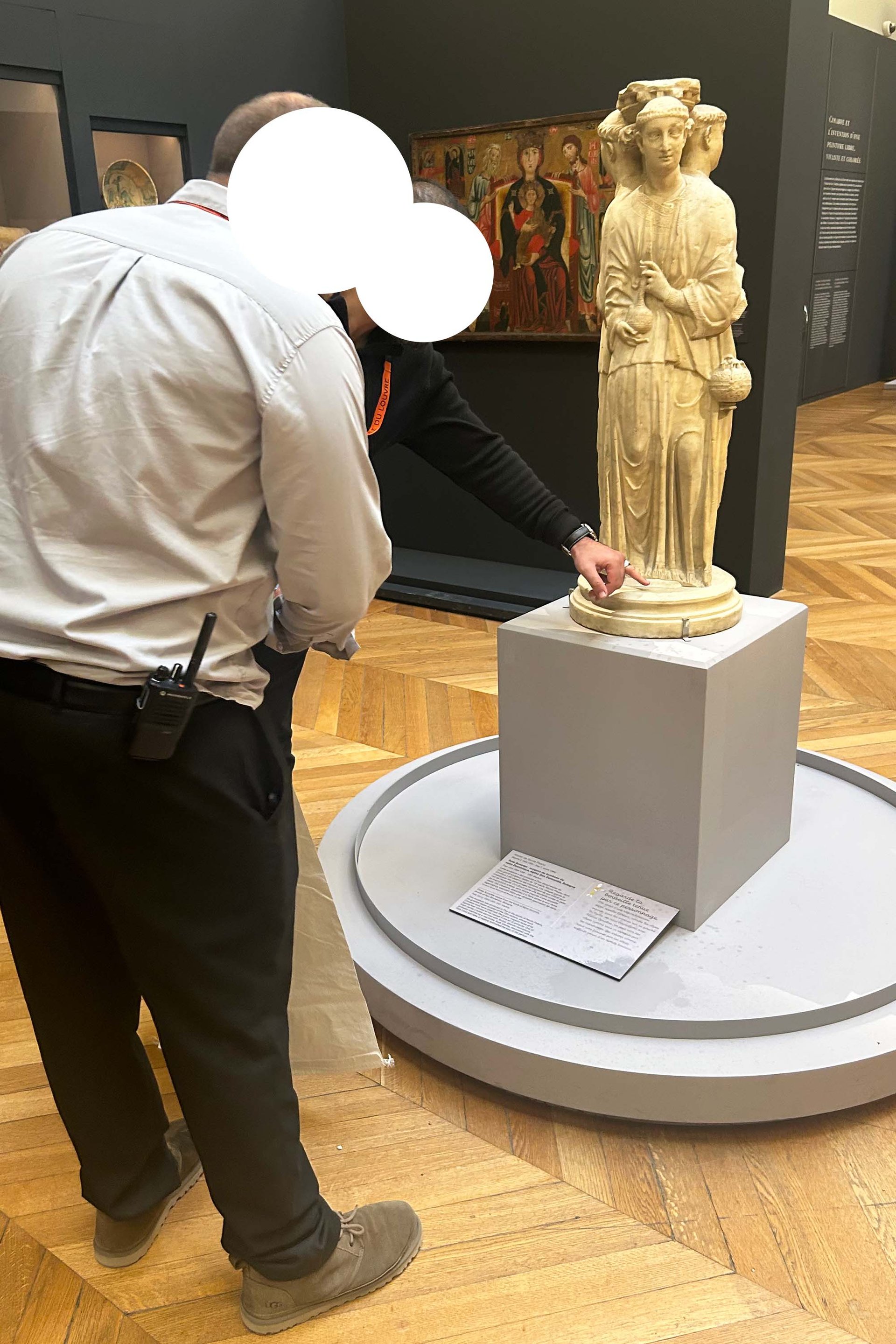
Two members of the Louvre security staff examining water falling on the base of the Pisano sculpture © The Art Newspaper
The nearby marble Pisano sculpture of the Three Acolytes, which stands nearly 1m high, was not in a display case. Water damaged the adjacent label and some drips fell on its stone base, which was probably made later than the 13th-century sculpture. It is unclear whether a few drips may have fallen on the Pisano, but as it is stone hopefully any damage would have been minimal.
Warding staff did what they could in terms of emergency action, with two of them later holding a small tarpaulin above the sculpture, like an umbrella. Other than this, there seemed little that the concerned employees could do, other than to alert their security supervisor. At least initially, there was no sign of a conservator.
The exhibition was closed to the public at 4.51pm, just over half an hour after the drips first appeared. A Louvre spokesperson says this was “to allow firefighters to inspect the roofs”. They added that “the cause was immediately identified: a damaged glass seal”. The exhibition was reopened as normal on Sunday morning.
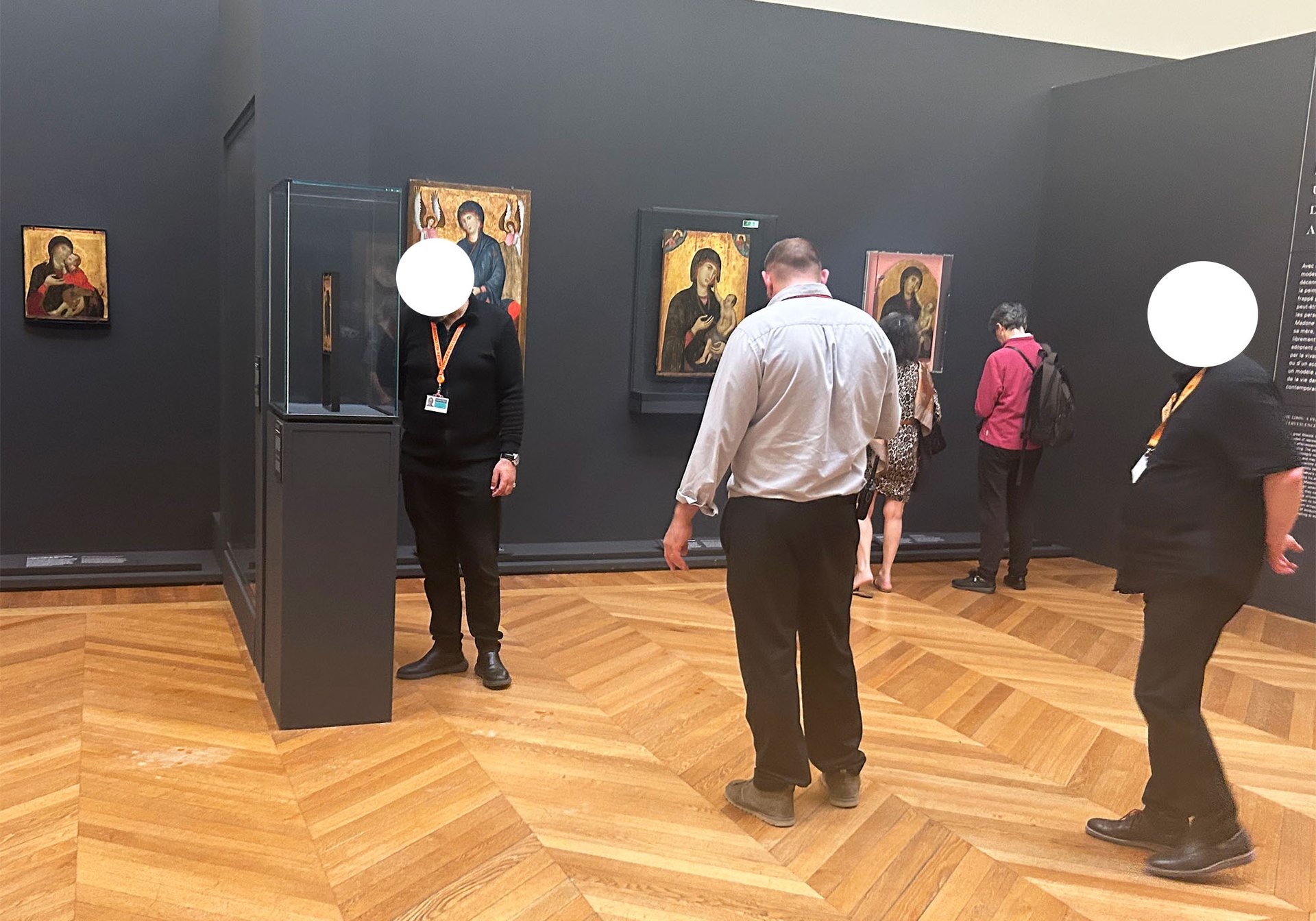
Three Louvre security staff inspect Duccio di Buoninsegna’s Madonna of the Franciscans (1285-88); water fell on both sides of the case © The Art Newspaper
No drops appear to have fallen directly on the Cimabue or Duccio, and hopefully no damage has been caused to the Pisano.
The leak in the roof backs up the concerns of the Louvre’s president, Laurence de Cars, who in January wrote in a confidential memorandum to France’s culture minister Rachida Dati that the building needed urgent and extensive renovation.
De Cars, who has headed the Louvre since 2021, added that some areas of the building complex “are no longer watertight”. However, this does not explain why what now seems a vulnerable room was used to house an exhibition with loans from foreign museums, particularly for a show with such fragile and important works. These include some of the very earliest masterpieces of Western European painting.
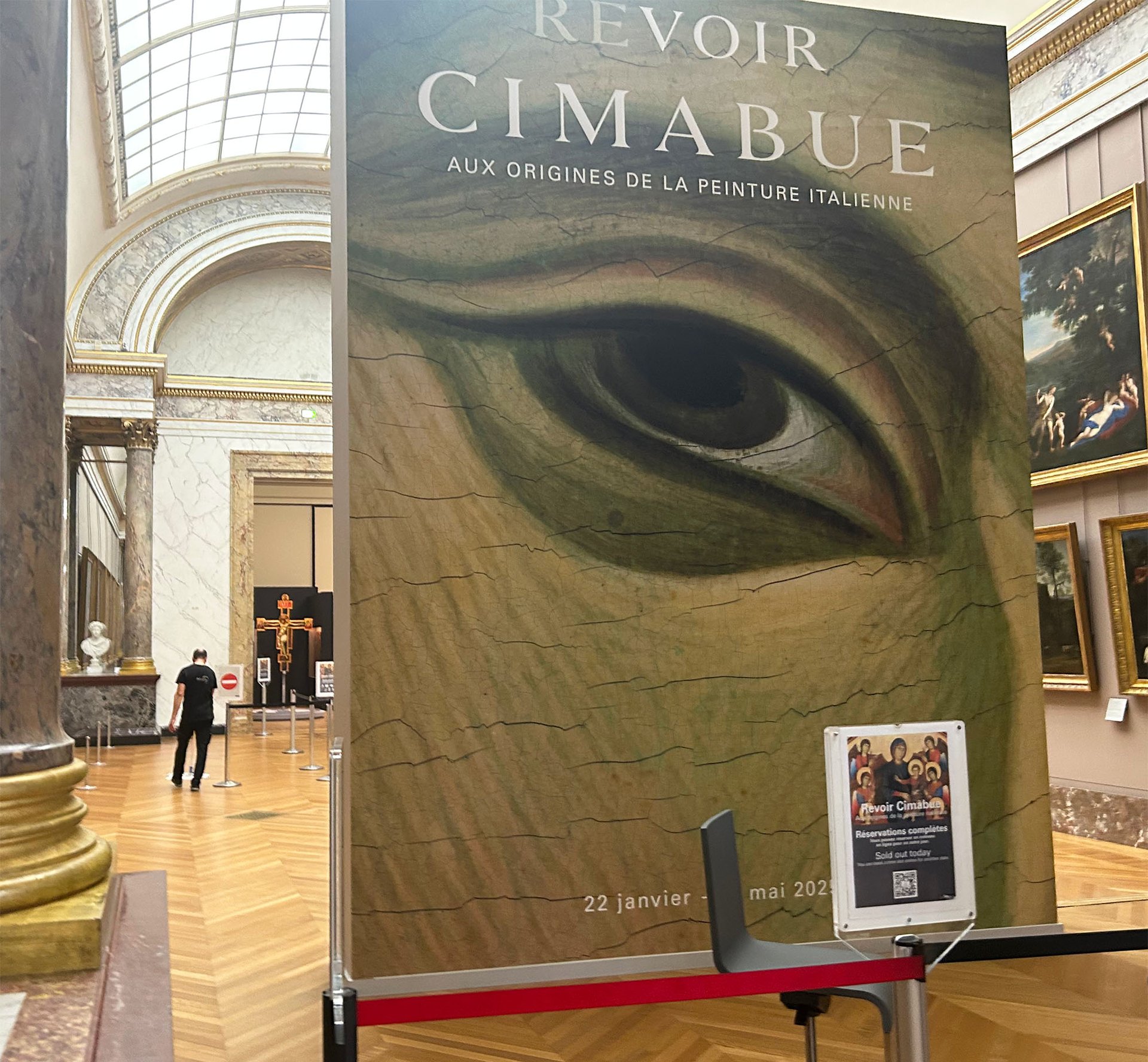
Louvre staff cleaning up near the entrance to the Cimabue exhibition just after the gallery was closed to the public © The Art Newspaper
Key works from two of Italy’s major museums were threatened with damage. Of the 44 works in the Cimabue exhibition, which was based on comprehensive research that has added greatly to our knowledge of the artist, only six pieces are from the Louvre’s own collection. Such monographic shows are highly dependent on loans from international museums.
French president Emmanuel Macron visited the Louvre on 28 January and pledged that the museum would embark on a major restoration project, which may cost around €750m. Completion is likely to be many years away, in the 2030s.
On this occasion, three masterpieces hopefully suffered a narrow escape. But the incident will put pressure on both the Louvre and the French government to protect its art and proceed with the planned restoration of its building.


