

In Van Gogh’s time, social life for men often revolved around the café. In Paris these were not simply coffee houses, there was always wine, most served food—and some offered entertainment. By 1886, when Vincent moved to the French capital to stay with his brother Theo, cafés had become a central part of modern life and an attractive subject for avant-garde painters.
For Van Gogh, a single man in Paris, cafés represented places to drink, eat or read a newspaper. But above all, they were congenial places to hang out with his fellow artists. Living at Theo’s apartment in Montmartre, Vincent was plunged into the centre of a dynamic social scene.
The culture of cafés is the lively subject for an exhibition opening shortly: Café Society: Art and Sociability in Belle Epoque Paris. With more than 50 paintings by a wide range of turn-of-the-century artists, its first stop is the Ordrupgaard museum, on the outskirts of Copenhagen, Denmark (6 February-31 May). The show will then go to America: to the Dixon Gallery and Gardens, Memphis, Tennessee (18 June-6 September) and the Joslyn Art Museum, Omaha, Nebraska (26 September-17 January 2027).
The presentation in Denmark includes three Van Gogh paintings of Parisian cafés. The two works from European museums are not going to America. That leaves Restaurant Rispal at Asnières (from the Nelson-Atkins Museum of Art in Kansas City, Missouri), which will be shown in Omaha. The painting is not going to Memphis, because the Nelson-Atkins wants to display it during the football World Cup in the city in June-July.
La Guinguette à Montmartre (October 1886) was presumably an establishment where Van Gogh regularly enjoyed a drink, close to Theo’s apartment in Rue Lepic. A guinguette is a simple rural café or tavern with outdoor seating. In Van Gogh’s time Montmartre was still almost semi-rural, although rapid development meant that the city was quickly encroaching on the hill.
La Bonne Franquette, Rue des Saules, Montmartre. Van Gogh’s outdoor seating might have been on far left, now occupied by an extension
The location of Van Gogh’s guinguette remains uncertain, although the restaurant La Bonne Franquette in Rue des Saules, five minutes’ walk from Theo’s apartment, now claims the honour. If indeed it is the place, then the outdoor seating area has been replaced by a 20th-century extension. A modern plaque on the restaurant’s facade records that it was once a “rendez-vous d’artistes”, with legendary regulars claimed (perhaps over ambitiously) to include Camille Pissarro, Paul Cezanne, Henri de Toulouse-Lautrec, Pierre-Auguste Renoir, Alfred Sisley, Edgar Degas and Claude Monet.
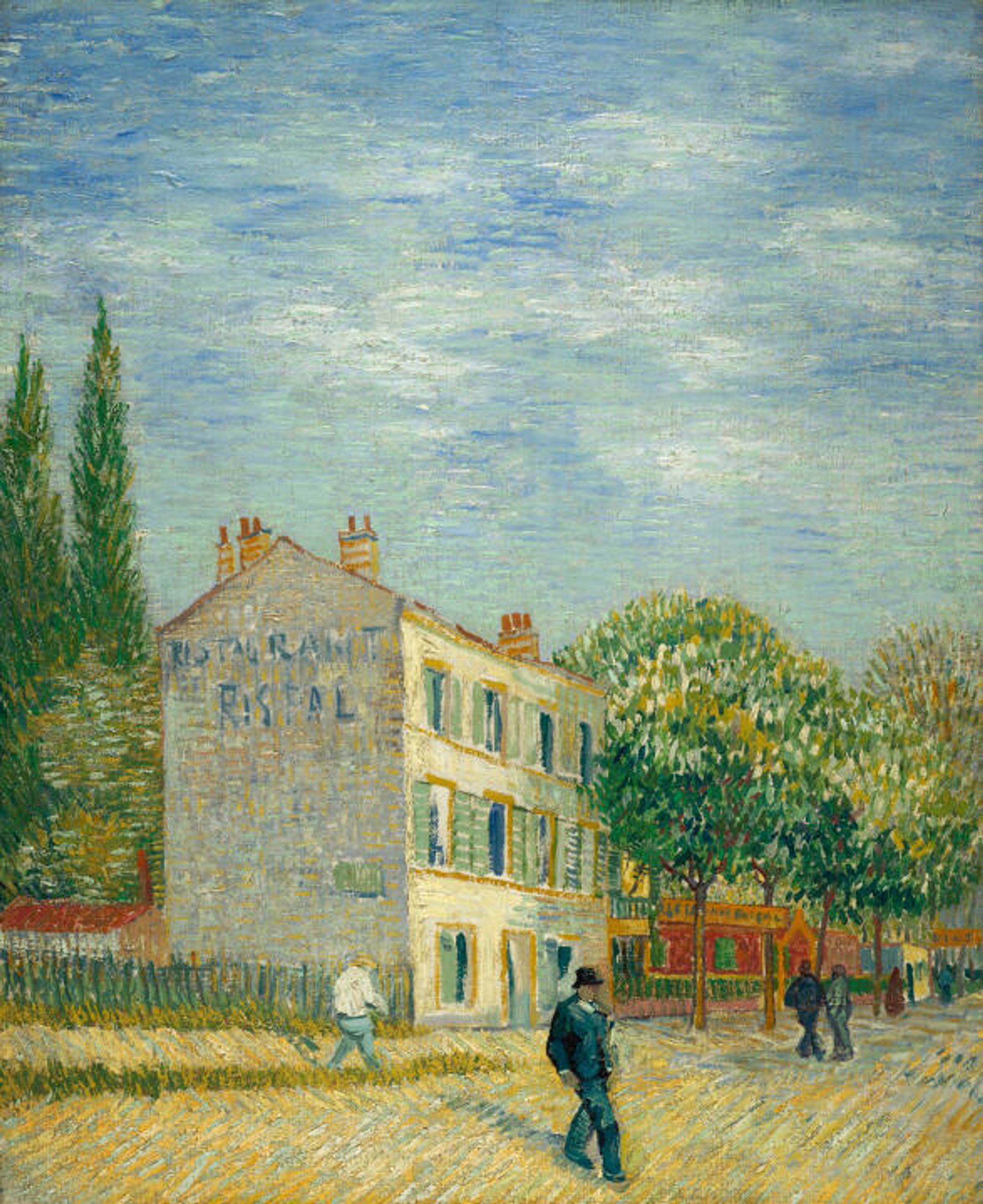
Van Gogh’s Restaurant Rispal at Asnières (May-June 1887) Nelson-Atkins Museum of Art, Kansas City (gift of Henry W. and Marion H. Bloch, 2015.13.10)
Restaurant Rispal at Asnières (May-June 1887) was painted in the northern suburbs of Paris, on the banks of the Seine. The Rispal restaurant was probably located at 117 Quai de Seine (now Quai Aulagnier), near the Pont de Clichy, although the site has now been replaced by a dual carriageway and modern blocks.
In the late spring and early summer of 1887 Van Gogh sometimes worked in Asnières with his artist friend Paul Signac. Years later Signac recalled: “We painted on the riverbanks of the river, ate in a guinguette and returned on foot to Paris”, a journey of just over an hour. Van Gogh walked “waving his freshly painted size-30 canvas”. Restaurant Rispal at Asnières is in fact the largest of Van Gogh’s Asnières pictures so it could have been the one referred to, although it is slightly smaller than a size-30 canvas.
On another occasion Signac recalled that Van Gogh would finish his day in a café: “Having no real home of his own, he would take his seat on the terrace of a café. And the absinthes and brandies would follow each other in quick succession.”
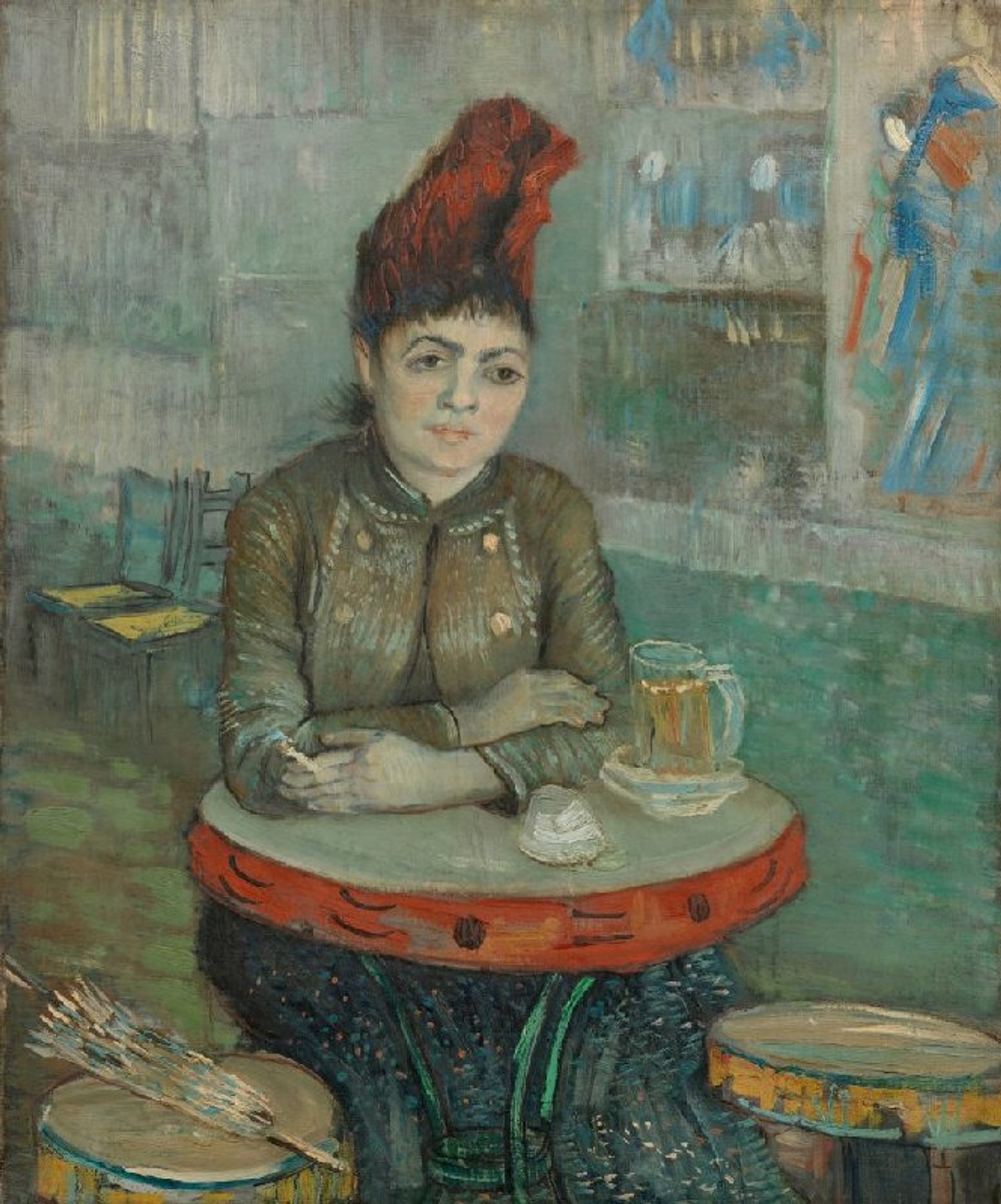
Van Gogh’s In the Café: Agostina Segatori in Le Tambourin (January-March 1887) Van Gogh Museum, Amsterdam (Vincent van Gogh Foundation)
The final Van Gogh painting in the Café Culture exhibition is by far the most personal, a portrait of the Italian woman who ran Le Tambourin bar and was for a time his girlfriend: former artists’ model Agostina Segatori. Le Tambourin was a lively haunt known for its tables with tambourine-shaped tops. Its signature dish, Timbale Bolonaise (a pasta bake with meat and tomatoes), was served in tambourine-shaped ceramic bowls.
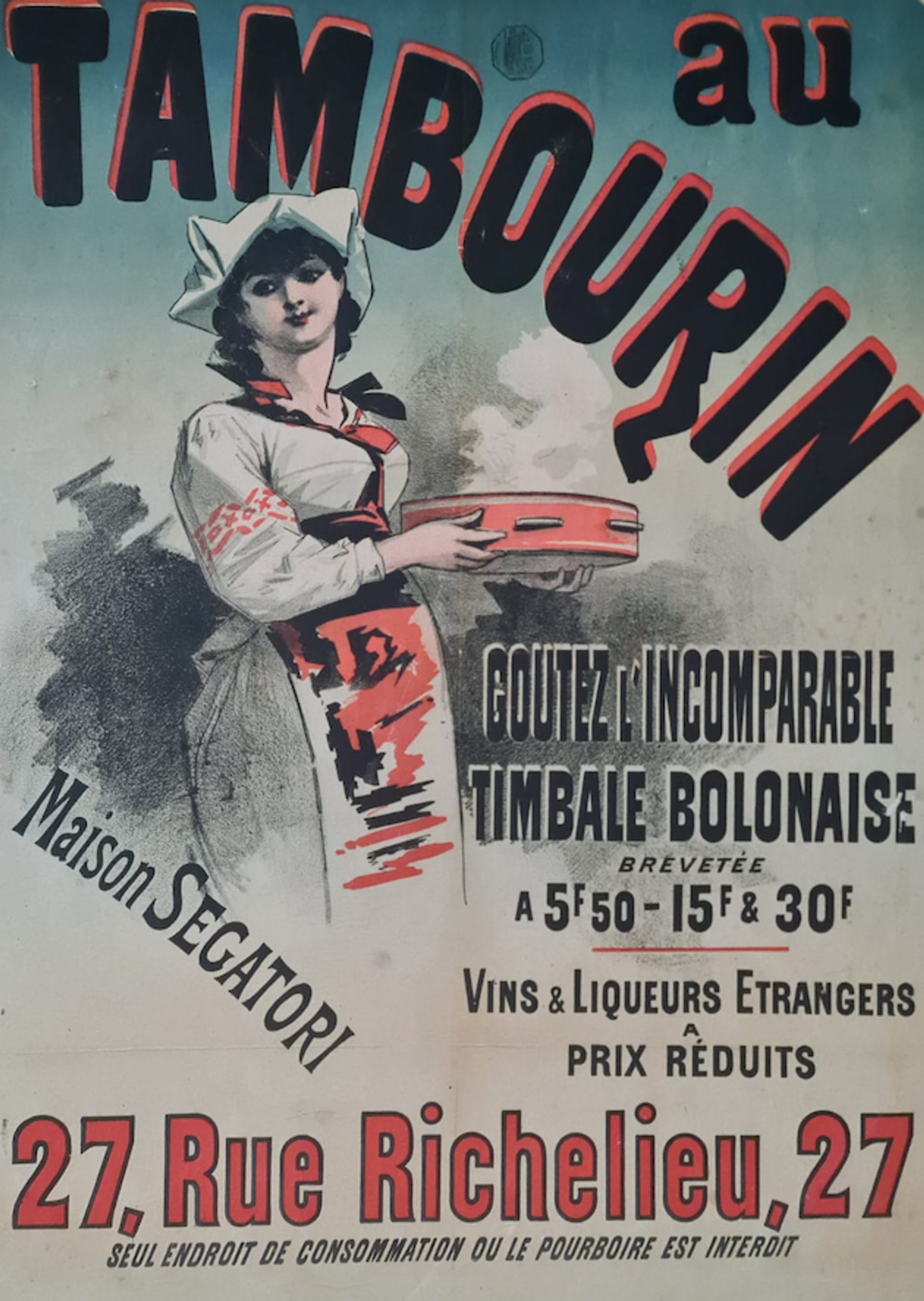
Jules Chéret’s poster advertising Le Tambourin (1883)
In the Café: Agostina Segatori in Le Tambourin (January-March 1887) shows the proprietor relaxing at a tambourine table, a beer and cigarette close at hand. On the wall behind her are Japanese prints, which are likely to be those lent by Van Gogh, who was a great admirer of them.
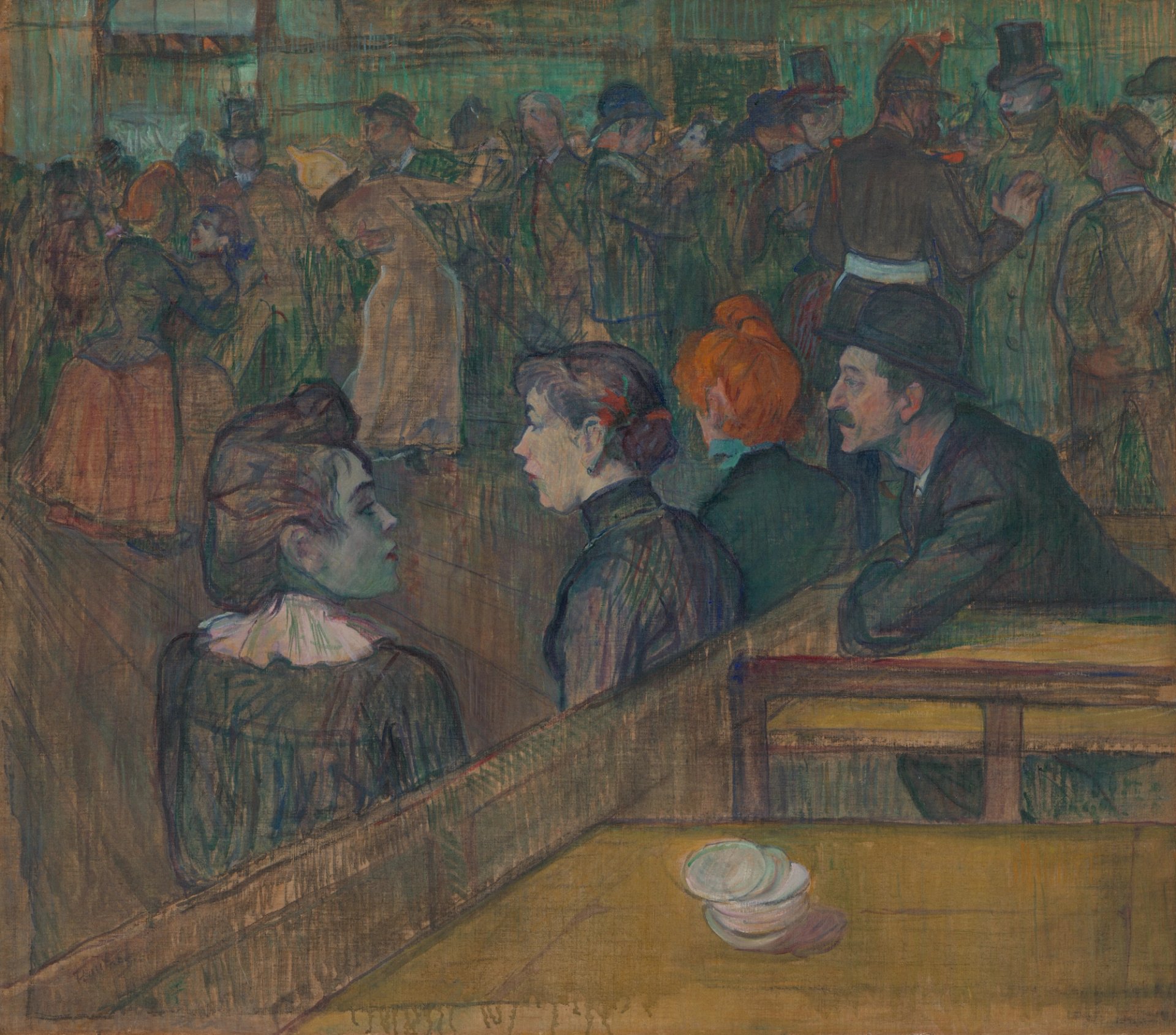
Henri de Toulouse-Lautrec’s Moulin de la Galette (1889) Art Institute of Chicago (Mr and Mrs Lewis Larned Coburn Memorial Collection)
The Ordrupgaard show also includes a painting by Henri de Toulouse-Lautrec which is closely related to Van Gogh’s life. Moulin de la Galette (1889) depicts customers in the famed café and dance hall at the top of the hill of Montmartre, five minutes’ walk from Theo’s apartment. Although Van Gogh never did a painting its interior, he made more than a dozen landscapes of the windmills and the area around the entertainment complex.
Other artists featured in the Café Society exhibition include Renoir, Degas, Edouard Manet, Edvard Munch, James Whistler, Edouard Vuillard, Maurice Utrillo and Pablo Picasso.
As the catalogue of the show stresses, what is fascinating about Parisian cafés at the turn of the century is the sheer variety of the clientele: “Artists, musicians and writers; dandies, oddballs and lovers; labourers, socialites and prostitutes; dancers, singers and actors; partiers, alcoholics and loners.”
These welcoming venues were creative hubbubs of people sharing and debating their thoughts. As the exhibition catalogue puts it: “Cafés created the first social networking sites”.
Martin Bailey is a leading Van Gogh specialist and special correspondent for The Art Newspaper. He has curated exhibitions at the Barbican Art Gallery, Compton Verney/National Gallery of Scotland and Tate Britain.
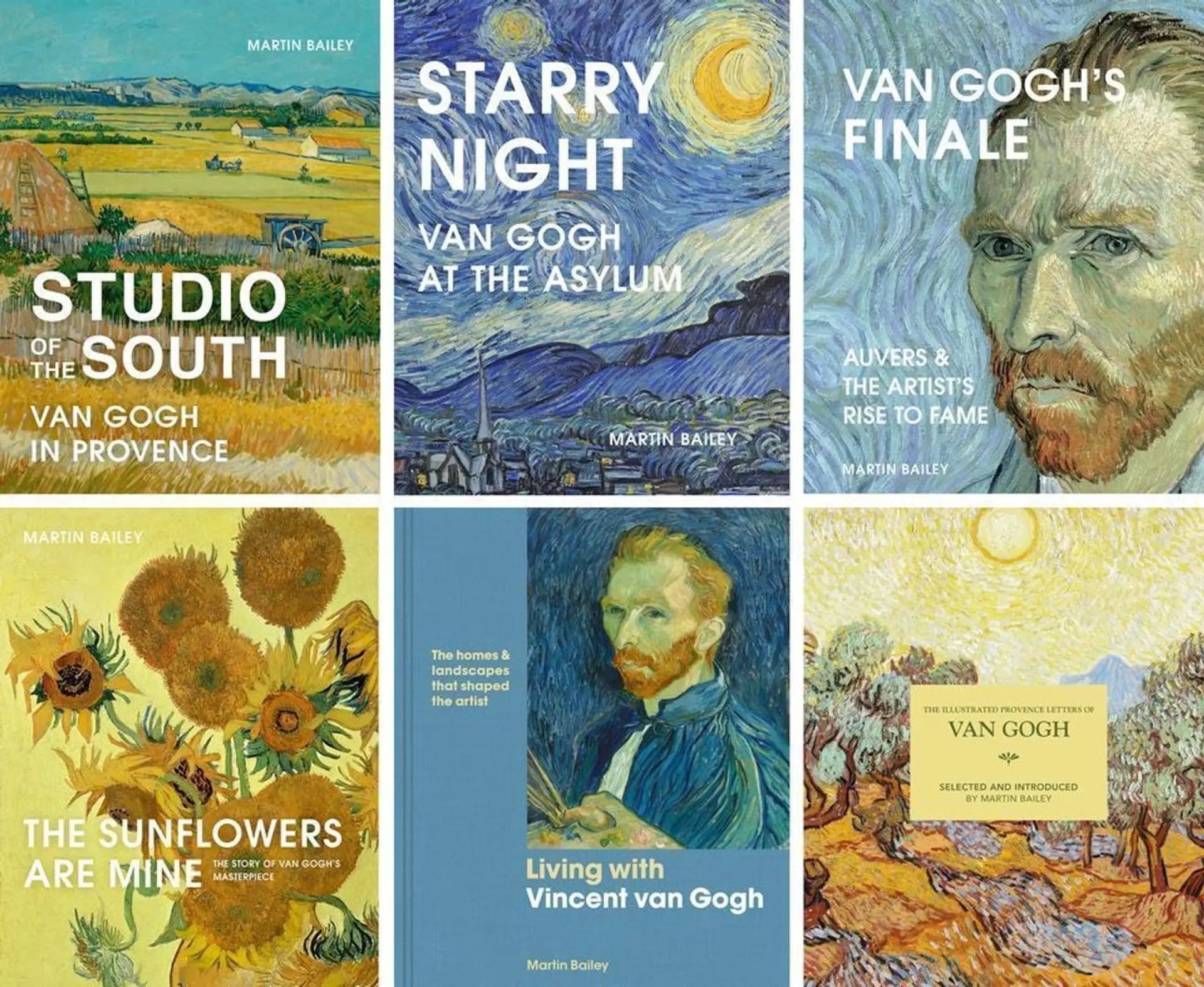
Martin Bailey’s recent Van Gogh books
Martin has written a number of bestselling books on Van Gogh’s years in France: The Sunflowers Are Mine: The Story of Van Gogh’s Masterpiece (Frances Lincoln 2013, UK and US), Studio of the South: Van Gogh in Provence (Frances Lincoln 2016, UK and US), Starry Night: Van Gogh at the Asylum (White Lion Publishing 2018, UK and US) and Van Gogh’s Finale: Auvers and the Artist’s Rise to Fame (Frances Lincoln 2021, UK and US). The Sunflowers are Mine (2024, UK and US) and Van Gogh’s Finale (2024, UK and US) are also now available in a more compact paperback format.
His other recent books include Living with Vincent van Gogh: The Homes & Landscapes that shaped the Artist (White Lion Publishing 2019, UK and US), which provides an overview of the artist’s life. The Illustrated Provence Letters of Van Gogh has been reissued (Batsford 2021, UK and US). My Friend Van Gogh/Emile Bernard provides the first English translation of Bernard’s writings on Van Gogh (David Zwirner Books 2023, UKand US).
To contact Martin Bailey, please email vangogh@theartnewspaper.com
Please note that he does not undertake authentications.


