

Abu Dhabi has finished a year of major announcements by opening two further museums: the Zayed National Museum (ZNM), designed by Norman Foster, and the Natural History Museum, both on Saadiyat Island. These latest additions follow the news that Frieze Abu Dhabi will launch next year, also on Saadiyat, and wii coincide with the first auctions in the emirate by Sotheby’s, in which Abu Dhabi’s sovereign wealth fund ADQ now has a minority stake.
Opening on the country’s 54th National Day (2 December), the 56,000 sq. m ZNM tells the story of the UAE—both of the ancient civilisations on the Arabian Peninsula and the more recent history of the country’s founding.
“The importance of knowing your culture, knowing your history, and [the idea] that culture in itself is the true building block of any forward-thinking society is very much vested in the DNA of every single museum we have here in Abu Dhabi,” says Mohamed Khalifa Al Mubarak, the chairman of the Department of Culture and Tourism, at a round-table discussion at the ZNM. “This national museum… takes you on a voyage that goes back 300,000 years, from the earliest human interaction with the land all the way to who we are in our present and where we’re going to go in our future.”
The ZNM was one of the original five institutions proposed for the Saadiyat Cultural District in 2007. Three of the five have now opened or are soon to open: the ZNM, the Louvre Abu Dhabi and the Guggenheim Abu Dhabi.
A maritime museum was also initially planned, to be designed by Tadao Ando, and some of that material has been absorbed into the two museums that recently opened. Zaha Hadid was also to design a performing arts complex. Both were quietly put on indefinite hold around 2016 and 2017, when construction on all the museums, except for the Louvre Abu Dhabi, stalled.
In 2009 the ZNM signed a ten-year contract with the British Museum for consultation, capacity-building, and loan-sharing, but this partnership ended prematurely in 2017. At the time, reports put the annulment down to the construction delays. The ZNM today has no major international partners, but earlier this year it signed a loan-sharing agreement with the British Museum, as it did with other lenders across the world.
Construction on the ZNM picked up around 2019, buoyed in part by the success of the Louvre Abu Dhabi. This meant that much of the museum was initially built during the Covid-19 pandemic, which added to the logistical hurdles of the architecturally ambitious project.
Topped by five grills on the exterior—meant to resemble the wings of a falcon—the museum is organised internally like a series of pods. Each of the four upper galleries floats within the curving cylinders of the building, anchored to the wall in select places.
The technology allows natural light to come in from the building’s skylights, flowing around these pods, and also enables its innovative cooling system. The signature curved grills are also solar chimneys, pulling up hot air from inside the museum while underground pipes, from the garden, pull cooler air in.
The Magan boat Zayed National Museum
Inside, in the atrium, visitors encounter a vast, 18m-long reconstruction of a black-sailed trading ship from the Bronze Age Magan civilisation, which would have travelled all the way westwards to the Mesopotamia and eastwards to the Indus Valley. It was painstakingly made for the museum based on information contained on a cuneiform tablet, also on display in the ZNM.
Like many of the 1,500 archaeological objects on show, the tablet came from one of the dig sites around the UAE—some of which were led by the ZNM’s director, Peter Magee, an archaeologist who has worked in the UAE for decades. Other objects on view are on loan, while photographs and video documentation underline the way that many ancient traditions remain culturally alive today.
“Our museums are living assets, and that’s what’s critical about them,” says Al Mubarak. “They are not just really beautiful mausoleums that store archaeology and art. They are places that tell stories of history, whether it’s the history of art or the history of cultures and heritages.”
The museum is named after Sheikh Zayed bin Sultan Al Nahyan, who was born in 1918 in Al Ain, the original capital of Abu Dhabi, and died in 2004. The Nahyans—now the ruling family of the UAE—were then already the rulers of Abu Dhabi, having united the surrounding tribes in the 1800s in what is known as the Bani Yas federation. After succeeding to the role of leader in 1966, Sheikh Zayed successfully negotiated the withdrawal of the British from the Arabian Peninsula in 1971—who had held a protectorate over what was then known as the Trucial States—and then united seven of the existing emirates together.
Popularly called the father of the UAE, Sheikh Zayed remains a towering figure across all the emirates, perhaps singularly uniting them still. The confederation of seven emirates remains loose: Abu Dhabi, as the capital (and the richest) of the emirates, holds most of the political and economic power. However, each emirate also maintains their own histories, such as that of the Qawasim, the ruling family of Sharjah and Ras al-Khaimah, and Al Maktoum, the ruling family of Dubai, who were also part of the Bani Yas federation.
One of the challenges for the ZNM as the country’s first major national museum has been to thread this needle, honouring Sheikh Zayed and the Nahyans as the rulers of the nation, while also folding in the ongoing histories of the confederation.
The ZNM brings the Saadiyat Cultural District a significant step closer to completion. It is in walkable distance from the Louvre Abu Dhabi, as well as teamLab Abu Dhabi, which opened in March, and the Natural History Museum, which itself only opened in late November this year.
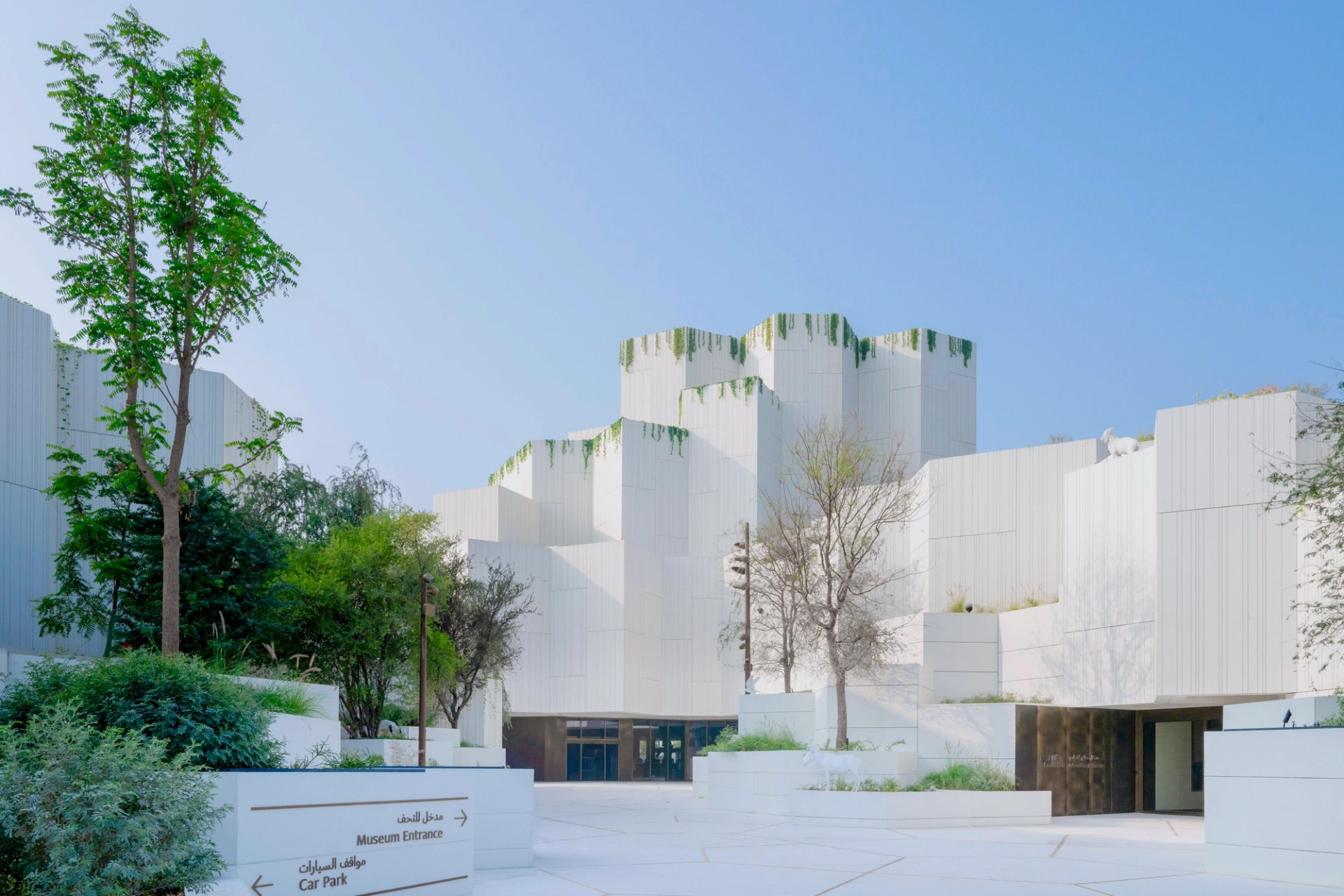
The Natural History Museum Abu Dhabi © Natural History Museum Abu Dhabi
Also run by the Department of Culture and Tourism Abu Dhabi, the Natural History Museum focuses on the sea, land and animals found both internationally and in the Arabian Peninsula. Designed by the Dutch firm of Mecanoo, with plants trailing down its blocky exterior, the foyer of the 35,000 sq. m museum contains enormous skeletons of newly found dinosaur species.
Downstairs, visitors travels through time, from meteorites and skeletons to the present day, with a significant highlight being “Lucy”, on loan from the Ethiopian cultural authority. Lucy is one of the oldest skeletons ever discovered, and was found in 1974 in Ethiopia. Her Amharic name translates as “you are marvellous”, and the museum’s presentation shows both the real skeleton and a reconstruction of the short figure walking.
“The museography and the curatorial intent inside the Natural History Museum is quite different than anything else,” says Al Mubarak. “It was important for us that we capture the awe and the curiosity and the imagination of our next generation.”


