

In his new exhibition at 65Grand, The Division Street Riots, the Chicago multimedia artist Carlos Rolón is showing works referencing the 1966 uprising in the Humboldt Park neighbourhood that occurred the day after the city’s first-ever Puerto Rican Day Parade. The catalyst for the unrest was the police shooting of 20-year-old Arcelis Cruz and the fighting lasted three days. Rolón was born in Chicago in 1970 to Puerto Rican parents and grew up visiting his parents’ native island. Over the years he has produced work that explores and celebrates issues of Puerto Rican culture, identity and the diaspora.
Rebellion II (2026) features in Rolón’s show at 65GRAND Photo: Clare Britt; courtesy the artist and 65GRAND
The artist worked under the name Dzine for many years, creating bright, ornate installations and lush works bursting with colour—and often punctuated with Swarovski crystals, mirrors or gold. His 2007 work Pimp Juice, a customised cherry-red, white-topped 1993 Cadillac Fleetwood lowrider with 14 speakers, five video screens and 24-carat gold hydraulics, made a splash at that year’s Art Basel Miami Beach fair. For this tight exhibition at 65Grand, Rolón’s tone is almost sombre, seemingly taking visual cues from the black-and-white images and newspaper articles he examined at various archives in Chicago. It includes, for instance, four dye sublimation prints that he created by cropping and enlarging small segments of historic photographs, as if to make sure visitors notice revealing details. Rolón spoke with The Art Newspaper about what drew him to this history and imagery.
The Art Newspaper:Materially, this exhibition is almost traditional, at least by your usual standards. You are mostly working in graphite, making black-and-white images that are nearly documentary in their realism. What drew you to this topic and how did it inform your approach?
Carlos Rolón: What drew me to this subject was both personal proximity and a sense of historical responsibility. I grew up with most of my family living in Humboldt Park in Chicago, where the history of the 1966 Division Street Riots still resonates within the community and where I currently live. For many years I heard fragments of this story from residents and elders, and I became increasingly aware that this pivotal moment in Puerto Rican civic history in Chicago was largely absent from the broader narrative of the city and on a national level.
As part of my broad studio practice, the use of materials such as mirrors, crystals and textiles is connected to aspirational and domestic spaces and what this looks like for families that arrived in the US along with the use of gold as part of the colonial landscape and history.
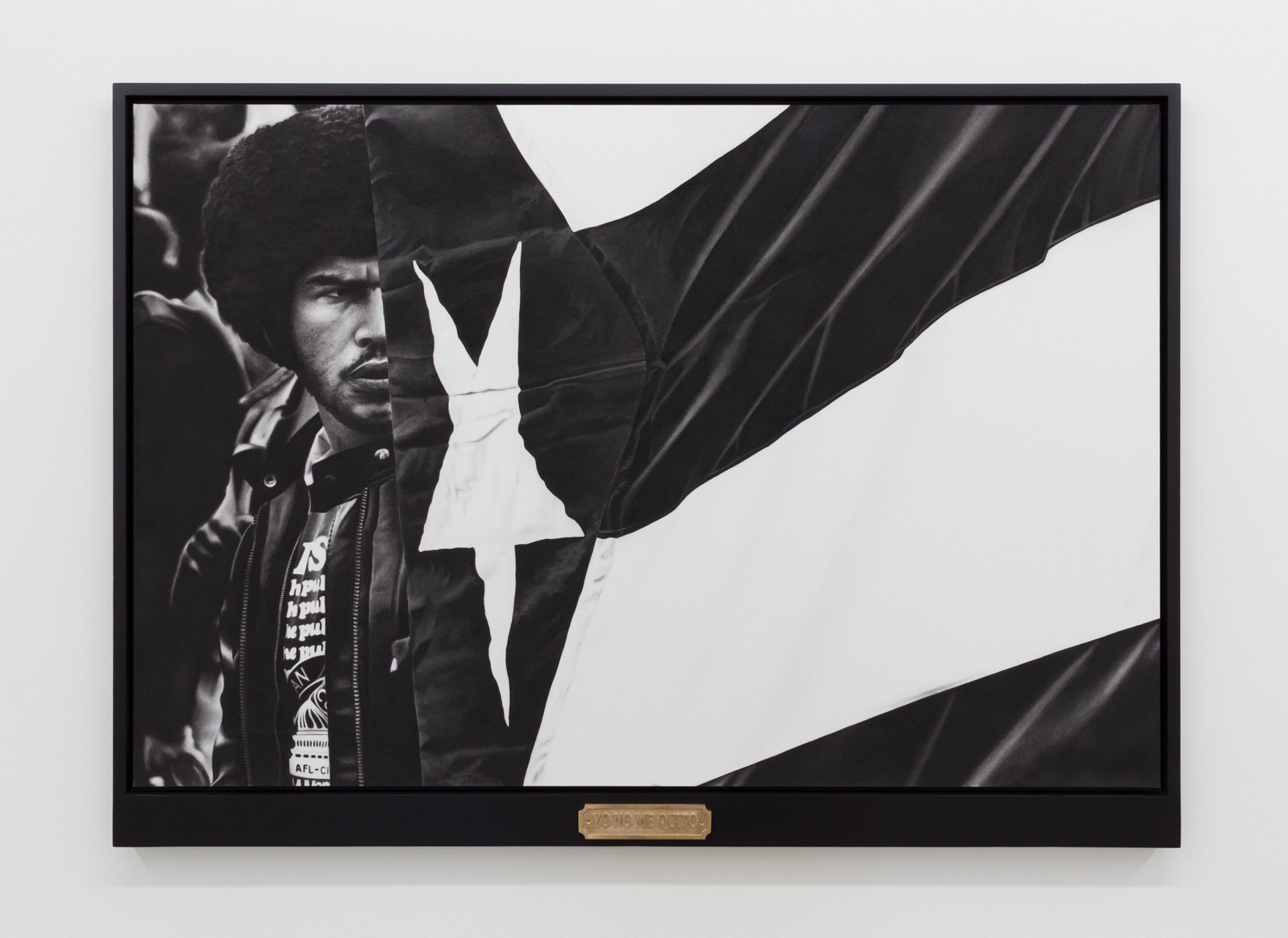
Yo No Me Quito (Man With Flag, After Frank Espada) (2024-26) Holly Murkerson; courtesy the artist and 65GRAND
For this project, however, the subject demanded a more restrained approach. Working primarily with graphite and charcoal allowed the drawings to function almost as acts of witnessing. Many of the works are based on archival photographs from the uprising, and the black-and-white palette acknowledges their documentary origins while creating space for reflection rather than spectacle.
How did your art practice change when you started spending more time in Puerto Rico?
Growing up in Chicago, my visits to Puerto Rico were formative. I was fascinated by the visual language of the homes there, the ornamental wrought-iron gates or rejas, patterned tile, the use of colour and the careful way people constructed beauty within modest spaces. The gates in particular have stayed with me. By reproducing these works, incorporating a reflective material such as mirror and crystals, they function as both protection and decoration, a kind of threshold between the public and private, and that duality became an important motif in my studio practice.
Many of the wrought-iron fence patterns created as part of the island’s architecture are incredibly intricate, almost like drawings in space. As a child I didn’t think about them conceptually, but they stayed in my visual memory. When I began spending more time on the island as an adult, my understanding deepened beyond the aesthetics. I became more attentive to how craft traditions, spirituality and colonial architectural history shape everyday life. My work began to incorporate references to domestic altars, devotional objects, tropical flora with the use of gold leaf, and architectural elements that carry both cultural pride and the legacy of colonial influence.
Can you talk about the bicycle sculpture in the exhibition, from the sounds it projects to what
it represents?
Custom vehicles and bicycles that have been made into functional works of art are more polished and reflective of the Chicano lowriding community. They have appeared in my work for many years because of the layered meanings they carry. They speak to movement, migration and aspiration, but also to labour and everyday life. In places like Chicago and New York, custom Schwinn bicycles in particular symbolised mobility and status in Puerto Rican communities and represent a kind of arrival—a status symbol, but also a metaphor for navigating American urban space.
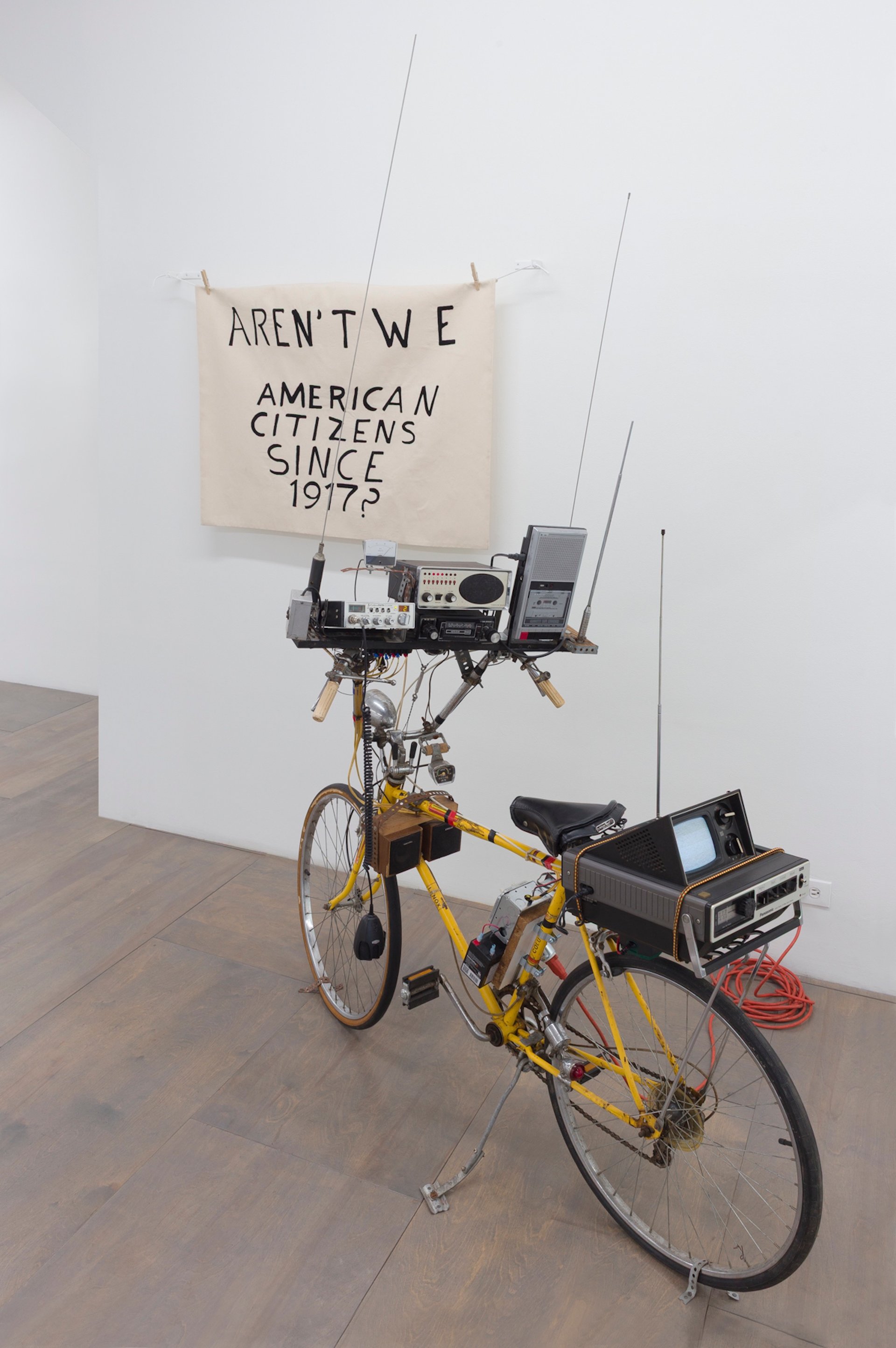
Installation image including Carlos Rolón’s Protest Banner (2026) and Humboldt Park Bicycle (2026) Courtesy the Artist and 65Grand. Photo: Holly Murkerson
The bicycle in this exhibition, Humboldt Park Bicycle, is more DIY than polished. It’s a response to and reflection of the ingenuity and resourcefulness of the Caribbean community that must adapt to daily disruptions on the island to resources like electricity, which people in the US take for granted.
I had held onto this bicycle in storage for over ten years without fully knowing why. I feel artists in general tend to keep objects because they feel charged with potential meaning. When I began researching the events surrounding the 1966 Division Street Riots, I was struck by how bicycles appear in archival photographs and community memories moving through the neighbourhood.
This bicycle sculpture became a way of activating that object as both artefact and symbol. With the television and audio components, it functions almost like a vessel for memory. It’s a quiet monument to movement within the community, how people circulated stories, warnings and solidarity during a moment of upheaval.
- Carlos Rolón: The Division Street Riots, until 12 April, 65Grand, 3252 West North Avenue, Chicago


