

In a city where the sea is never far away, the Hong Kong artist Chan Wai Lap has become fascinated not with the open water but with the far more regulated world of the public swimming pool. In drawings and installations, Chan focuses on the visual order of these spaces from tiled surfaces and lane markings to the subtle rules that shape behaviour within them.
That fascination surfaces in several projects appearing around Art Basel Hong Kong this week. For a UBS commission, Chan is presenting Mimimomo Pool (2026), a playful jacuzzi-like seating installation. Meanwhile, his exhibition Jeremy’s Bathhouse at Oi!—an arts and heritage complex in North Point—imagines a bathhouse environment filled with ceramic objects and subtle biological references.
Chan spoke to The Art Newspaper about learning to swim as an adult, watching the quiet choreography of public pools—and how these everyday spaces are structured by tacit rules and routines. Chan’s practice spans drawing, painting, installation and artist books; he graduated from Birmingham City University in 2011.
Chan Wai Lap became interested in swimming pools as social spaces after taking up the activity as an adult Courtesy of the artist
The Art Newspaper: You started swimming relatively late in life—what prompted you to teach yourself?
Chan Wai Lap: It was a form of escape. After finishing a series of work on schools and feeling stuck, I wanted to get out of the studio. I watched some YouTube videos on swimming, and eavesdropped on swim coaches.
In the morning there were maybe ten people in the pool, and nobody really cared whether I knew how to swim or not. It was a very low-pressure situation. After a summer of picking up the basics, I started noticing the space and structure of swimming pools.
What patterns or behaviours stood out?
Well, in the pool, your mind loosens up. You don’t have your phone with you to distract you. The smallest details start catching your attention, leading to all sorts of associations, from the banal to the bizarre. Swimming pools can feel like a society in miniature—different rhythms and generations appearing at various points in the day, from after-work swimmers in office districts to families and children in residential ones. Yet pools are also a very controlled environment, unlike the sea.
One of your works, Chromatic Uniforms, is being presented at the Centre for Heritage, Arts and Textile (CHAT) booth at Art Basel Hong Kong, revisiting your earlier work on schools and uniforms. How does that connect to your more recent interest in swimming pools and bathhouses?
Many of my works previously focused on schools: uniforms, report cards and institutional forms. Schools operate through standardisation and bureaucratic structures, as do swimming pools, in their own way.
These rules shape how people behave once they enter that environment. Even visual elements like the tiles become part of that structure, almost like how desks and chairs structure a classroom.
In my drawings, the pools are usually empty. But in a way the viewer is the swimmer.
Ultimately, I’m interested in the rules around the body. What is acceptable in a swimming pool isn’t quite acceptable on the street
Bathhouses and swimming pools also come with their own codes of behaviour.
Right. Ultimately, I’m interested in the rules around the body. What is acceptable in a swimming pool—for everyone to strip to their bathers—isn’t quite acceptable on the street. How does the presence of water suddenly make wearing only swimming trunks acceptable? For the CHAT project, I collected uniforms from different Hong Kong schools and arranged them by colour—from red to orange, yellow, green, blue and purple, something like a catalogue for a school uniform company. The styles are actually quite different, but they form a kind of system.
You are also presenting a jacuzzi-like installation, Mimimomo Pool (2026), in the UBS Art Studio at Art Basel Hong Kong, commissioned by the UBS Art Collection. How did that idea come about?
It began with the idea of exhaustion in art fairs. I did dream of a real jacuzzi but, for five days, that was out of the question even if it would have been very pleasurable.
The title comes from the Cantonese expression mi1 mi1 mo1 mo1, which describes acting or being slow, dawdling or fussing about.
There are 12 seats, with colourful pool umbrellas, so you might end up next to someone you’ve never met before—12 people brought together by chance.
It’s a bit like swimming. When you’re in a pool you often don’t know the people around you. Sometimes it’s slightly awkward—you look at them, they look at you. Sometimes you talk, sometimes you don’t.
What actually happens is up to the people. That’s one of the most interesting things about public installations for me—seeing how people use them and what kinds of conversations emerge.
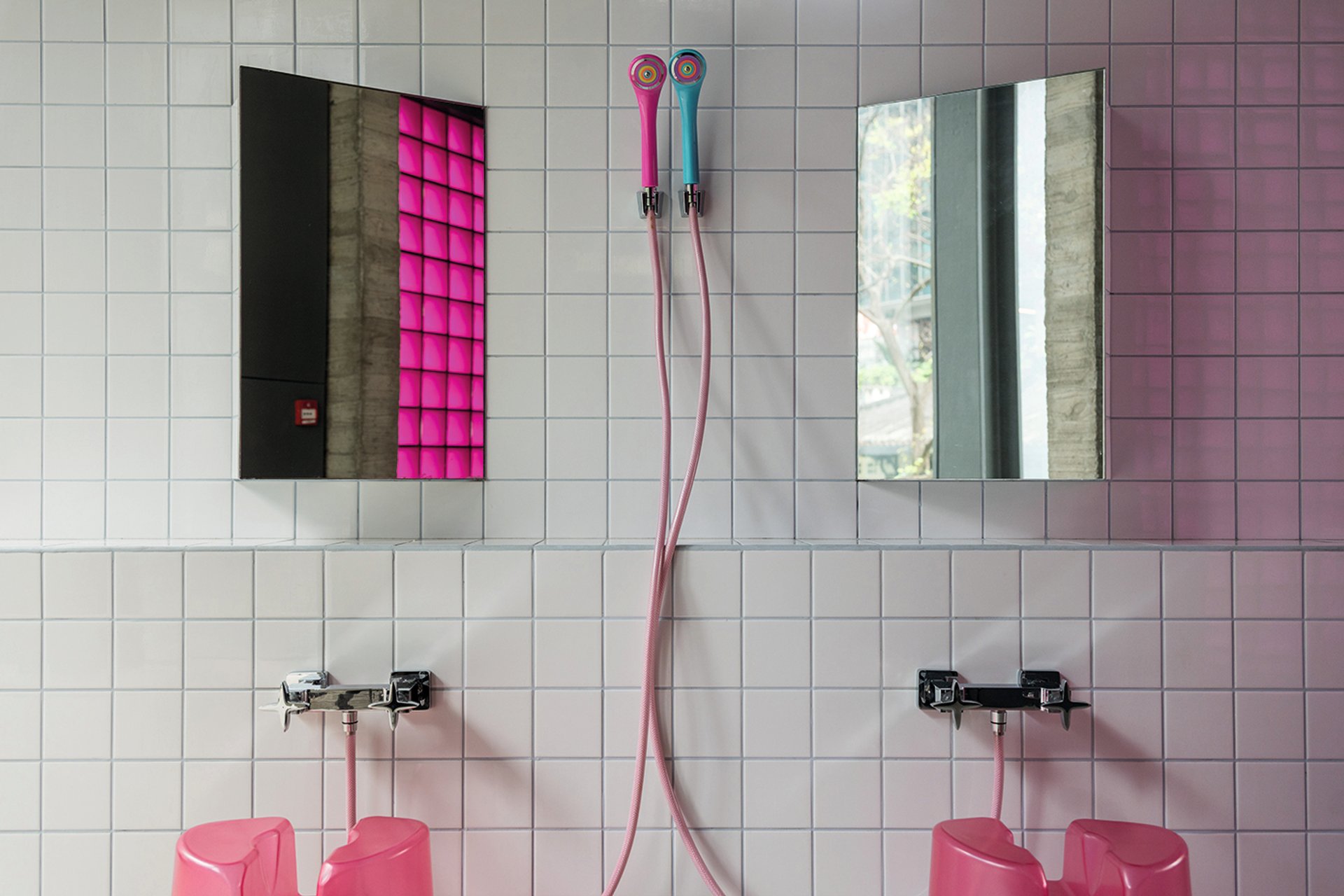
Chan Wai Lap’s recreated bathhouse at the Oi! arts space Photo: Tai Ngai Lung
Your exhibition at Oi!, Jeremy’s Bathhouse, turns to the idea of the bathhouse itself—a space historically associated with hygiene, ritual and, occasionally, chance encounters. There’s also a story of a rather lonely snail.
The title of the exhibition refers to a biological oddity. There is a species of snail whose shell normally turns to the right, but someone discovered one called “Jeremy”, whose shell turned to the left. A genetic mutation, scientists said. The thing is, a left-coiling snail has to find another left-coiling snail in order to mate—but only about one in 40,000 snails has that orientation.
I actually started noticing snails much more after moving my studio to Fo Tan. I would go running nearby and, after the rain, all these snails would appear, and I would have to dodge them. I like the idea of this animal being slow, fragile and often hidden—it’s a metaphor for certain people or personalities.
The exhibition imagines a bathhouse environment, borrowing many of its elements from bathhouse cultures around the world—tiles, soap, seating, washing areas. I worked with craftsmen in Jingdezhen to produce some of the ceramic soap because I wanted the materials to feel physical and slightly imperfect. But the space is not complete without people. A bathhouse only becomes meaningful when bodies enter it—when people sit, move or simply spend time there.
I visited Naoshima Bath “I” (“I Love YU”, 2009) [an art installation that doubles as a public bath], created by the Japanese artist Shinro Ohtake. I assumed it would mostly be tourists, because the area attracts visitors—I was a tourist, too. But I saw that local residents were actually using it. At that point, I felt the work was really successful.
Would you ever want to build a real swimming pool or bathhouse?
Definitely, no question. An exhibition, you would go once, maybe twice. A swimming pool or bathhouse is somewhere you might go regularly, two or three times a week even. In that sense, the artwork has quietly entered everyday life.
For those visiting Hong Kong during art week, which public pool would you recommend?
Lei Cheng Uk Swimming Pool is quite strange: it sits beneath a flyover. I sometimes imagine if a car crashed above, it might fall straight into the pool—which feels a little terrifying, but also fascinating. It’s tucked away in a quiet corner of the city.
The Kowloon Park pool is interesting because it sits inside the park. Visitors can look down and watch the swimmers very closely—it almost feels like being on display, like animals in a zoo [Kowloon Park does have animals, like the flamingos in the pond].
And then there’s Tai Wan Shan pool, where for HK$17 you get an open view of Victoria Harbour while you swim.
• Chan Wai Lap: Mimimomo Pool, UBS Art Studio, Art Basel Hong Kong, until 29 March; Chan Wai Lap: Jeremy’s Bathhouse, Oi!, Hong Kong, until 20 August


