

Archaeologists working at the ancient Roman city of Pompeii have revealed beautifully preserved frescoes in the “Black Room,” a banqueting hall in a newly excavated part of the site. It is the latest stunning find from Pompeii, which is almost perfectly preserved beneath ash and pumice deposited by the eruption of Mount Vesuvius in AD 79.
The two frescoes, which are painted on the hall’s walls, show scenes from Greek mythology and literature. One presents Paris, the prince of Troy, who fell in love with the beautiful Spartan princess Helen, standing before him, who is better known as Helen of Troy. These are the events that triggered the Trojan War, as described in Homer’s Iliad.
The fresco depicting Apollo trying to seduce the Trojan priestess Cassandra Image: courtesy of Pompeii
The second fresco depicts the Trojan priestess Cassandra seated, while the god Apollo, one arm resting on a lyre, attempts to seduce her. When she rejects the god, he dooms her to proclaim prophecies that will never be believed.
As a banqueting hall, the “Black Room” would have been used to entertain guests at night. Its walls are painted black, probably so that smoke stains, caused by burning lamps, would not be visible.
“In the shimmering light, the paintings would have almost come to life,” Gabriel Zuchtriegel, the director of the archaeological park of Pompeii, told the BBC.
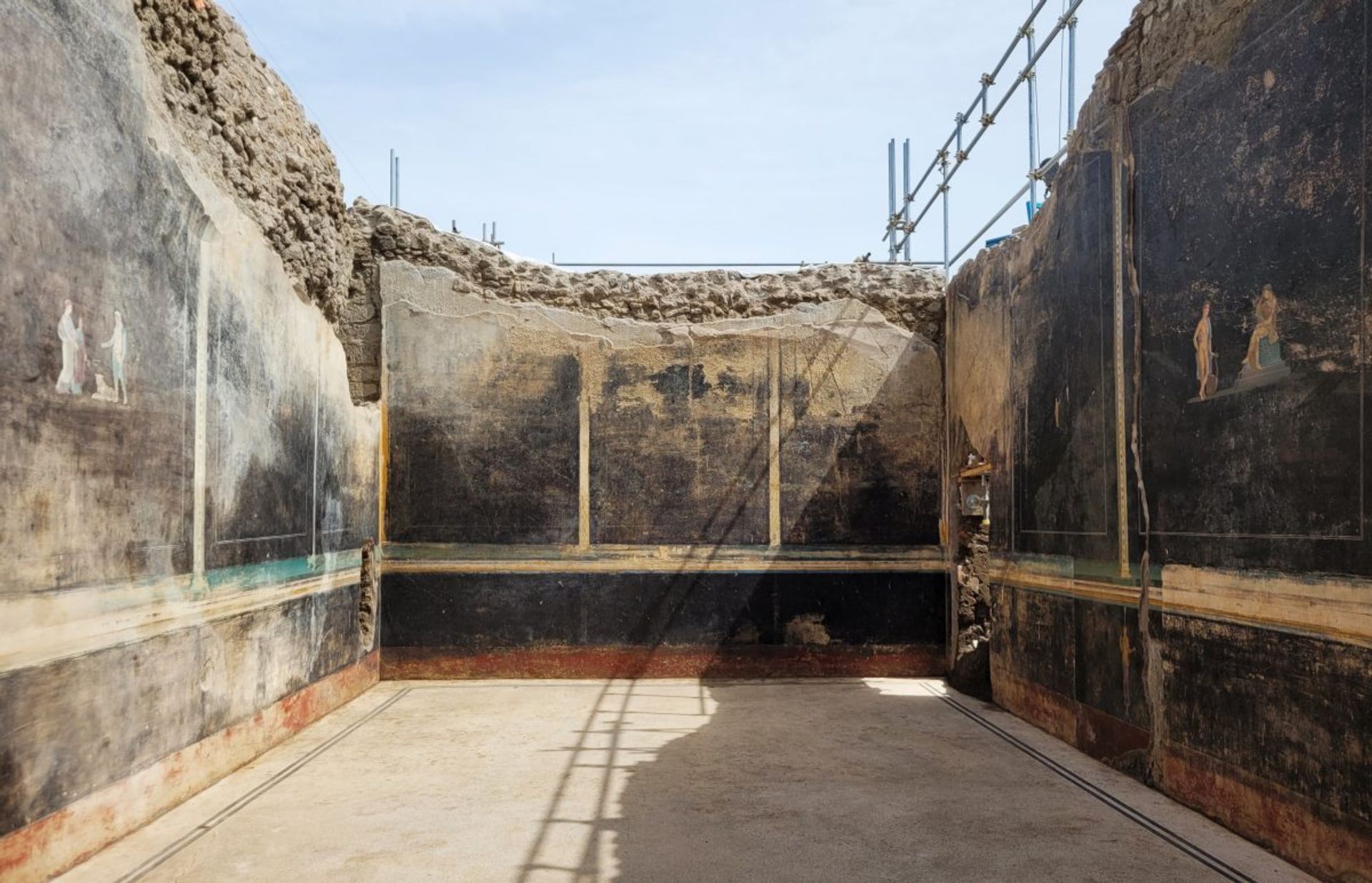
The “Black Room” being excavated Image: courtesy of Pompeii
The banqueting hall also features a well-preserved mosaic floor, formed from over a million tiny white tiles, which contrasts starkly with the black walls above.
The “Black Room” is just one part of a larger house, found within a residential and commercial block called Region Nine by archaeologists, which has been under excavation for a year.
The house had a reception room and garden, while next door there was a bakery, where skeletons and a shrine were uncovered, and beside that, a laundry. The skeletons—a child and two adults—may have been slaves, who were killed by falling stones during the eruption of Mount Vesuvius.
Archaeologists suspect that these three areas—the house, bakery, and laundry—were owned by the same person. The presence of roof tiles, pots of lime mortar, and trowels, also suggests that these areas were being renovated together during Pompeii’s final days.
Intriguingly, archaeologists have also found the initials “ARV” on walls and millstones.
“We know who ARV is: he’s Aulus Rustius Verus,” the archaeological park of Pompeii archaeologist Sophie Hay told the BBC. “We know him from other political propaganda in Pompeii. He’s a politician. He’s super-rich. We think he may be the one who owns the posh house behind the bakery and the laundry.”


