

In music, a pause for the player can be indicated by a caesura, sometimes referred to as “railroad tracks”. Caesura is also the title of a new collaborative graphic musical score by the artists and composers Raven Chacon and Guillermo Galindo that will be performed on 1 February at the Albuquerque Rail Yards in Albuquerque, New Mexico. Caesura is a reimagining of the train routes that shaped the American West, centring an anonymous traveller as conductor and utilising found train fragments as instruments, a score as a performative path and hobo graffiti for notations.
The rise of industrial capitalism after the American Civil War resulted in thousands of people travelling to find work. Many avoided expensive train tickets by making the illegal and dangerous choice to ride between or on top of train cars. In the book Marginal People in Deviant Places (2022), Jeff MacGregor writes that the hobo population consisted mostly of migratory workers mythologised as wandering romantics. Hobos actually did the jobs no one wanted to do, such as agriculture and construction, often in locations far from healthcare and regulation. The “hobo code” was the internal communication system that loosely connected this community. The code’s pictographic graffiti warned of danger, such as a town hostile to visitors, while other symbols shared the author’s destination. Galindo and Chacon’s research on the markings found some aspects of the marks documented as historic fact, but many meanings remain elusive and open to interpretation.
Instruments and notations by Raven Chacon and Guillermo Galindo for Caesura Chapter 1 at Union Station in Ogden, Utah Photo by Austin Luckett, courtesy Ogden Contemporary Art Center
Caesura contains elements of sound, movement and visual expression as part of the exhibition The Other Side of the Tracks at 516 Arts in Albuquerque (until 8 February). Printed on a rain poncho in the gallery is a musical score that looks more like a map, with branching limbs instead of the traditional bars and measures. Punctuating pathways are hobo symbols combined with Western musical notations. For example, the fermata is as an arch over a dot, which resembles a known hobo code. Since the fermata signifies a rest, Chacon says that when considering the perspective of a traveller, the symbol could be an interruption, both physical and audible. “The score is a guide that provides a series of options,” he says. For the upcoming performance Chacon, Galindo and guest percussionist Alan Zimmerman will traverse the score, which will exist as a path on the ground.
Chacon and Galindo have been friends and colleagues for over a decade. “We work with classical instruments and chamber music, but the work also extends to a visual art practice,” Chacon says. “There are not a lot of us that work across those fields, so it was a matter time before we collaborated.”
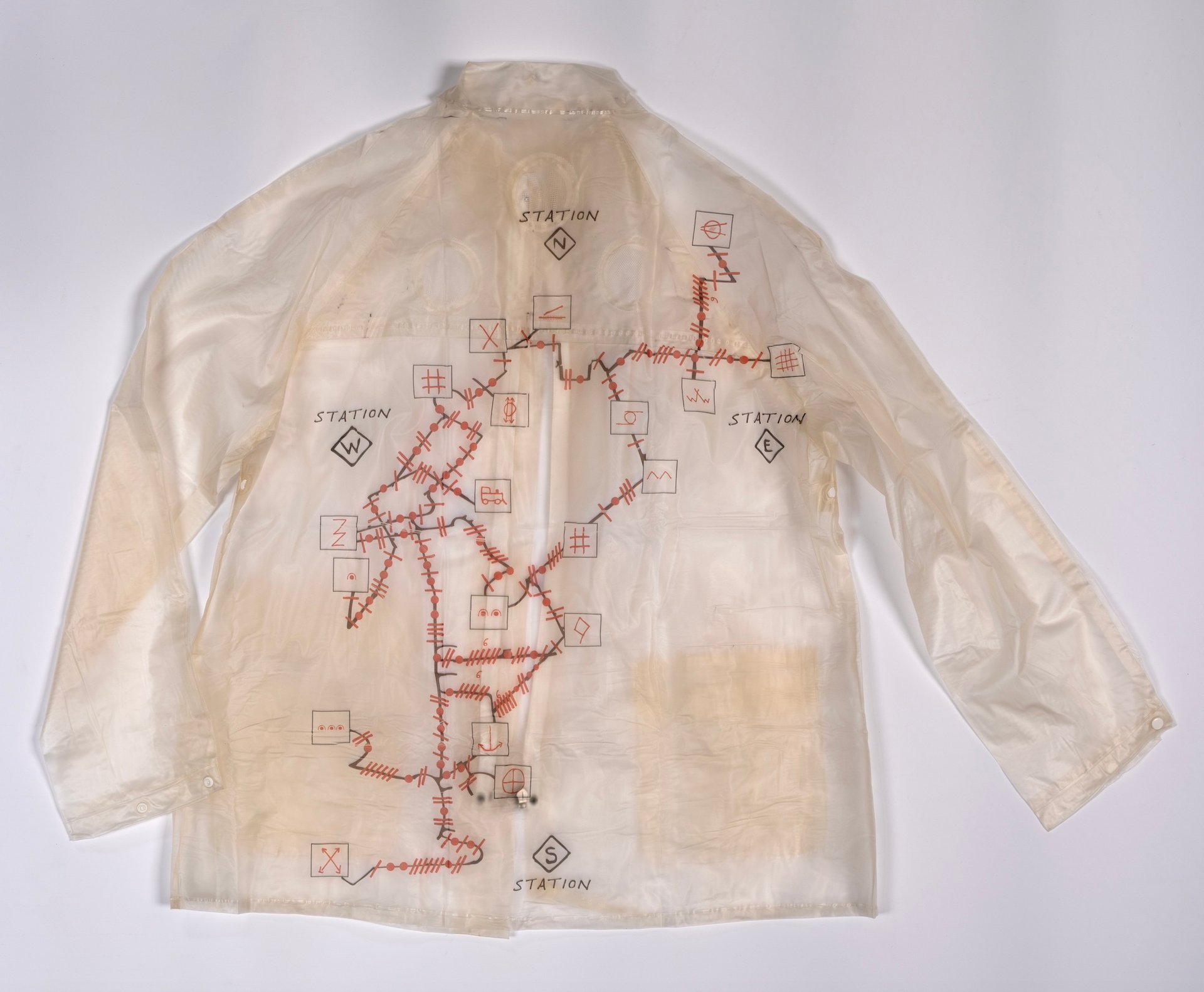
Guillermo Galindo and Raven Chacon, Scores on Rain Ponchos, 2024 Courtesy of Magnolia Editions
Jorge Rojas, the curator of the exhibition and founding director of Material, an art gallery in Salt Lake City, Utah, commissioned Caesura with the support of the National Performance Network. The piece’s uniquely shaped score and site-specific engagement reiterate elements of Chacon’s practice seen in works such as Vertical Neighbors (2024) or Storm Patterns (2022). For Galindo’s Borders Cantos (which premiered in 2014), the artist collected objects left behind by migrants at the border between Mexico and the US including a pink comb, child’s tennis shoes and a toothbrush, which became instruments he plucks and rolls.
Caesura’s composition contains three movements of which the first was performed in Ogden, Utah, and the second in Denver. The Albuquerque performance will be the last and most expansive. The nomadic sounds of the train are constructed through instruments of steel and iron train detritus Galindo retrieved while exploring train tracks in Utah.
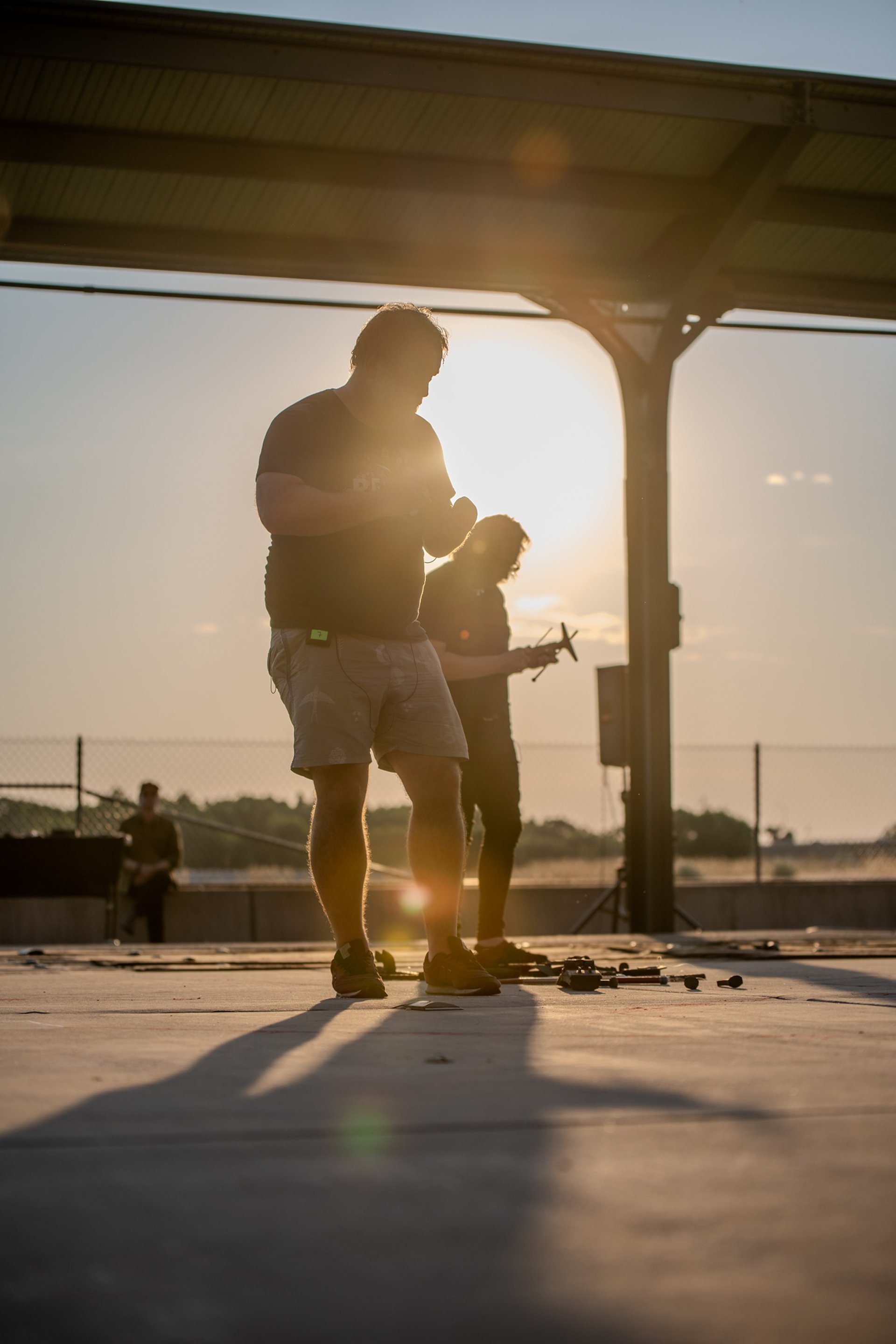
Raven Chacon and Guillermo Galindo performing Caesura Chapter 1 at Union Station in Ogden, Utah Photo by Austin Luckett, courtesy Ogden Contemporary Art Center
“We spent two full days on abandoned, old, historic railroad sites,” says Rojas. After Galindo found the first rusted spike, he knew what he was looking for. Eventually they uncovered enough discarded rail material to fill Rojas’s car. Galindo says each object is unique and can be dropped, rolled and rattled to create rhythms and textures.
Caesura reminds audiences that the hobo and the train represent a material rupture in our knowledge of US history. There was a collective effort required for the trains to break through to new territories. The unmoored figure of the hobo was a friction and foil for railroad companies. Summoning that tension today, through sound and sight, evokes conflicting impulses toward isolation and the desire for community on the edges of an unknown tomorrow.
- Raven Chacon and Guillermo Galindo’s Caesura, 1 February 3-4pm, Albuquerque Rail Yards, Albuquerque, New Mexico
- The Other Side of The Tracks, until 8 February, 516 Arts, Albuquerque, New Mexico


