

The Mexico-based artist and designer Pedro Friedeberg, best known for his hand-shaped chair, Mano Silla (1962), died on 5 March at age 90 in San Miguel de Allende. In addition to his famous design and a cynical, at times eccentric persona, Friedeberg’s life and career made him a key figure in Mexican 20th-century art.
Born in Florence, in 1936, Friedeberg’s German Jewish family moved to Mexico when he was three years old to escape the Second World War. As a child he was interested in geometry and perspective, both of which became central to his work as an artist. “Even after 60 years, I am still in love with perspective,” he said in a 2014 interview. “One-point, two-point, three-point, false perspective, metaphysical perspective… there are about 25 types of perspective, right?”
While studying architecture at Mexico City’s Universidad Iberoamericana, Friedeberg met the German artist Mathias Goeritz, a teacher at the time who has been credited with introducing much of the European vanguard to Mexico in the 1950s. Goeritz became a mentor and, as Friedeberg said in the 2022 documentary Pedro, “a fatherly figure”. The art historian Ida Rodríguez Prampolini was also a key influence on his career.
A singular universe
Though Friedeberg came of age at a time of experimentation in Mexico, the influence of Muralism persisted and Surrealism, mainly represented by Remedios Varo and Leonora Carrington, also loomed large. Even so, he set his own path beyond Minimalism and geometric abstraction, using ornament as his compass. Often called “the last Surrealist artist”, his signature intricate, fantastical architectural scenes nonetheless elude tidy labels.
View of Ciudad Épsilon at Museo de Arte Contemporáneo Querétaro (2025-26), Querétaro Courtesy: Museo de Arte Contemporáneo Querétaro
“Drawing on classical traditions while criticising Western society, he created an atemporal language that avoids interpretation through styles or avant-garde conventions,” says David Miranda, the curator of Salón de los Astrólogos Homeopáticos (2021), which featured Friedeberg and Goeritz’s work at Museo Experimental El Eco. Friedeberg’s perception-altering scenes and use of everyday imagery tangentially connect him with Op and Pop art. “He belongs to all and none of these movements,” wrote James Oles, the curator of Friedeberg’s first retrospective, Pedro Friedeberg: arquitecto de confusiones impecables at the Palacio de Bellas Artes (2009-10), in the exhibition catalogue.
In 1959, at age 23, thanks to Varo and Goeritz, Friedeberg held his first exhibition at Galería Diana; soon after he began exhibiting internationally. “From then until 2026, his practice was vast and continuous, unlike almost any other artist of his generation,” Miranda says.
Friedeberg also challenged the status quo. In 1961, alongside Chucho Reyes, Alice Rahon, Rodríguez Prampolini, José Luis Cuevas and Goeritz, he founded Los Hartos. “The group manifested itself against the exhaustion of modern art, proposing new categories for artistic practice,” Miranda says.
Beyond Mano Silla
In 1962, he created the wooden hand-shaped Mano Silla, which quickly became a widely reproduced, copied and plagiarised design. In his deadpan style, Friedeberg, for whom the hand was a recurring motif, sometimes dismissed the piece: “It does not have any meaning,” he said in the documentary Pedro. “I made it, it was successful and I repeated it 17,500 times, but I am now fed up.” Oles says: “There is a brilliance in the hand chair that is often overlooked because of its massive reproduction.” It was this chair that prompted André Breton to invite Friedeberg to join the Surrealist group.
“Especially the paintings created in the 1960s and 70s are key to understanding Friedeberg’s intellectual complexity, discipline, drawing mastery and creativity,” Oles says. “Behind his cynicism lies a profound and dense practice, which we made an effort to trace when we organised his first retrospective.” One of these earlier works, The Gioconda Palace During Mona Lisa Week (1963), is now part of the Museo Universitario de Arte Contemporáneo’s (Muac) collection. Alongside the image’s conceptual depth, symbolism and precision, the piece’s title reflects Friedeberg’s ironic and humorous approach to language. Another key work is a mural he made at Mexico City’s Camino Real Hotel in the late 1960s. Though it has since been altered, it presents an immersive architectural layout in which perspective becomes the protagonist.
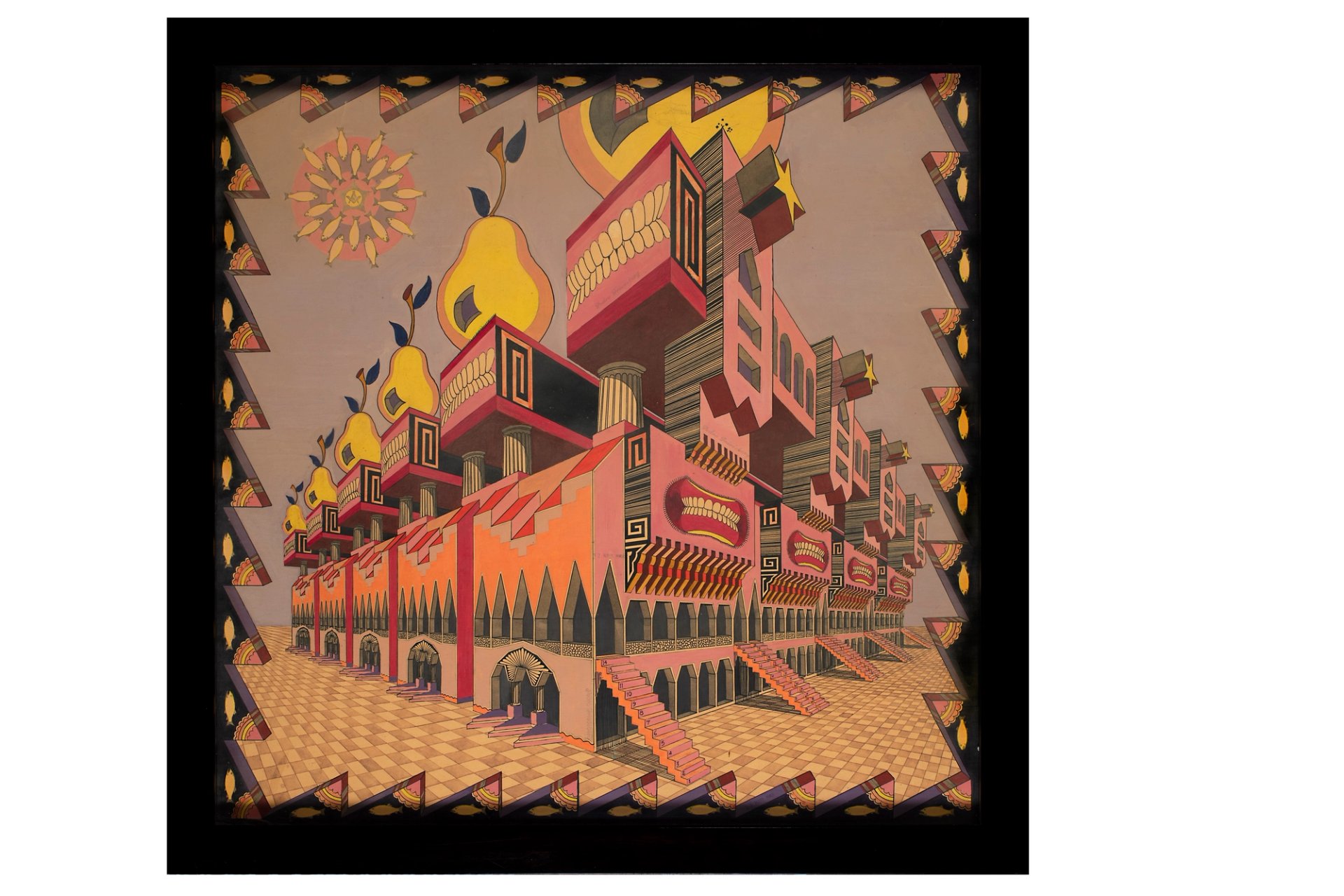
Pedro Friedeberg, The Gioconda Palace, During Mona Lisa Week, 1963 Museo Universitario Arte Contemporáneo Collection (DGAV, UNAM). Courtesy: Museo Universitario Arte Contemporáneo
Friedeberg experimented continually across different projects and media. In the late 1970s, with fellow artist Xavier Girón, he created a short-lived, 12-sq.-m gallery called La Chinche, which playfully challenged conventional exhibition practices. Much of Friedeberg’s later work focused on prints. “Commercialisation somehow obscures the complexity of one of the most incredible artists and minds of Mexican art in the 20th century,” Oles says.
“Friedeberg’s artistic richness spans more than seven decades,” says Carla García, the curator of Ciudad Épsilon at the Museo de Arte Contemporáneo Querétaro (2025-26), which focused on his three-dimensional works. “He always sought to make art part of daily life, free from strict intellectualism, erudite exclusivity or even good taste.”
“Friedeberg’s work has been described as Surrealist, kitsch, and iconoclastic, often compared with Edward James and Leonora Carrington,” Miranda stated. “Yet the continuity of his vision allowed him to move across art, architecture, and design without compromising poetic substance.”
In 2012, Friedeberg was awarded Mexico’s Medal of Fine Arts. He remained active until very recently. The Fundación Friedeberg, which now manages the artist’s estate, is expected to oversee forthcoming exhibitions of his work.
“I hope one day we can rediscover Friedeberg, especially his earlier works,” Oles says. “He was the most original, sui generis and immediately identifiable artist of his generation.”


