

One week before the 1988 Olympic Games opened in Seoul, one of South Korea’s most famous artists, Nam June Paik, linked a dozen countries and millions of people together with one of his visionary satellite television broadcasts. The numerous segments included David Bowie singing, Thai elephants playing football and a rain-sodden car race in Ireland. As the world’s attention was turning to his birth land, Paik’s work underscored the importance of cultural communication and global solidarity, embodying the Olympic spirit.
Thirty-six years later, the echoes of this work will be felt in a new exhibition opening in Paris on the same day as the 2024 Olympics. Decoding Korea brings ten contemporary artists from the country to the Grand Palais Immersif, a venue for immersive, audiovisual and digital works that opened in the Opéra Bastille in 2022. Paik’s 1988 piece, Wrap Around the World, will also be included.
“Digital technology has further transformed art from being something privately owned to something widely shared,” says the exhibition’s curator, Lee Daehyung, who is a board member of the Nam June Paik Cultural Foundation and curated the Korean pavilion at the 2017 Venice Biennale, among many other roles. “This shift makes Paik’s vision of a globally connected artistic community increasingly tangible. Decoding Korea aligns with these ideals by questioning the values urgently needed in today’s world. It reflects on Korea’s complex modern history, marked by both pain and glory, division and unity, offering a nuanced perspective on the nation’s journey.”
Kwon Hayoun’s 489 Years (2016), video still
The works use a range of cutting-edge technologies to tell this story, encouraging visitors to explore and connect with Korea’s deeper cultural and historical currents. In one, Kwon Hayoun’s 489 Years, visitors are taken onto a virtual reality journey through the mysterious world of the Demilitarised Zone that divides South Korea from North Korea. The title refers to the estimated time required to clear all the landmines from the zone. Elsewhere, a room-filling video by Jung Yeondoo gives a—literal—bird’s eye view of the industrialisation of the city of Ulsan, while Park Junebum’s Land for School delves into the complex structures and control mechanisms of modern cities through urban sociology and surveillance theory.
South Korea’s rapid rise to a global power is in large part founded on its high-tech industries. And for many Korean artists, technology is fundamental to their work, Lee says.
“Artists born between the late 1960s and early 1990s in Korea have lived through a dynamic period of democratisation and rapid industrialisation. These experiences have imbued their work with a unique blend of traditional and contemporary elements, allowing them to offer a cross-century perspective that bridges Korea’s rich cultural heritage with its modern advancements. Their art often reflects a deep understanding of historical contexts while simultaneously engaging with current global issues, creating a dialogue between the past and the present.”
Unlike many of the immersive art experiences that have sprung up in recent years, which some criticise as being shallow reinterpretations of existing works, Decoding Korea shows artists who are using the technologies to push the boundaries of traditional art forms, says Lee. “For these artists, technology is not merely a tool for creation but a philosophical lens through which they understand and interpret the world. This philosophical framework allows them to explore complex themes such as identity, memory, and social change. They prioritise conceptual depth and intellectual engagement over mere technical prowess.”
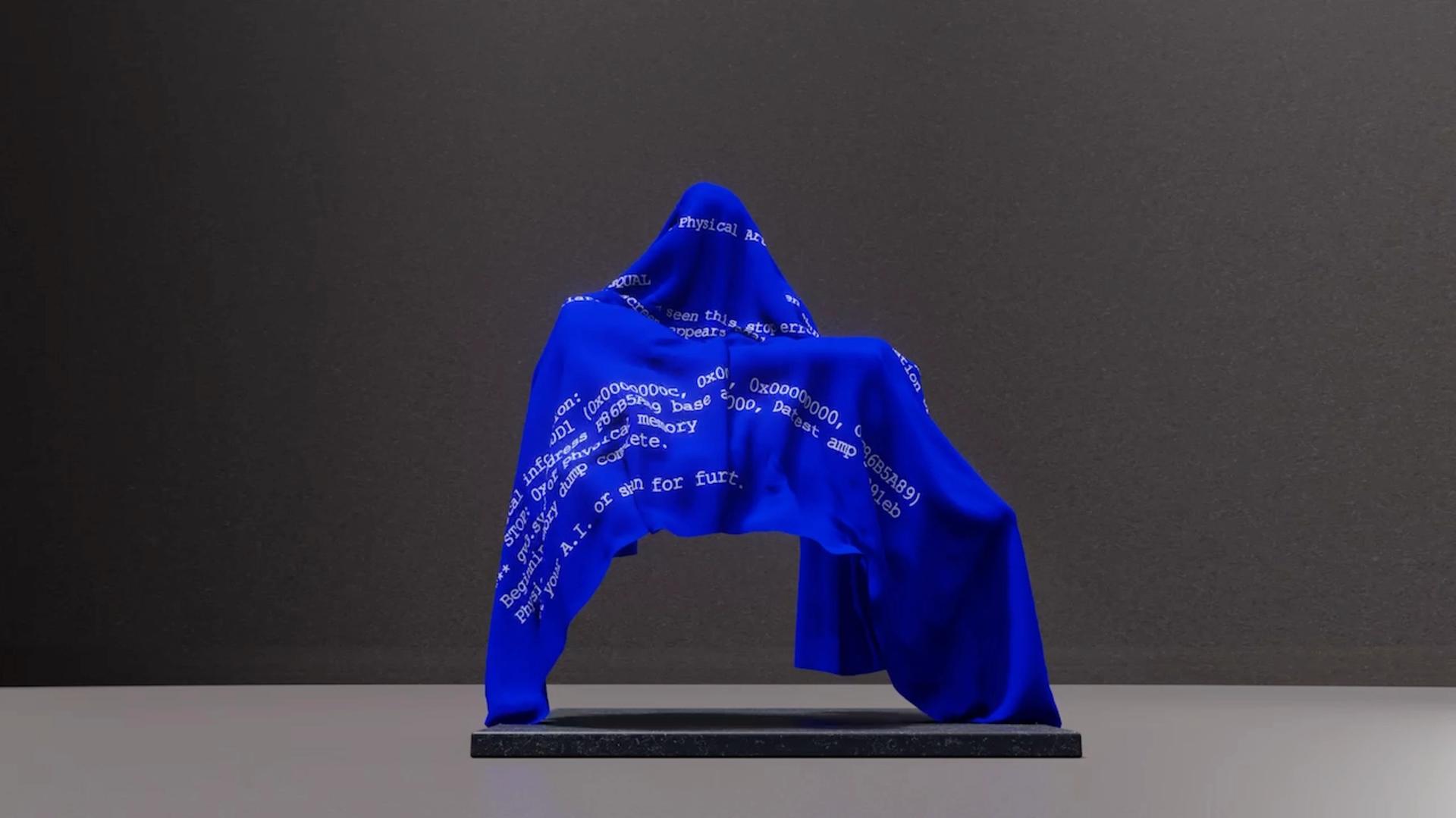
Lee Yongbaek’s NFT Museum: Pieta (2022), video still
One work that epitomises this approach is Lee Yongbaek’s NFT Museum: Pieta. He transforms the traditionally physical Pieta into the digital, collectible form of the NFT, delving into the nuanced interplay between human desires and religious values. Elsewhere, you can eat simulated food in Ram Han’s Full of Fortune, using VR, hand-tracking and AI to engage in a “post-human experience”, while Kim Heechoen’s Double Poser uses video game technology to “deconstruct the concept of time”.
Lee hopes that the exhibition will provide visitors with a “transgenerational perspective” and that, by reflecting on the complex journey of Korea’s modern history, it will “emphasise the importance of empathy and shared cultural experiences in overcoming contemporary geopolitical challenges” and “embody the Olympic spirit by fostering global unity through art.”
• Decoding Korea, Grand Palais Immersif, Paris, 26 July-25 August
Exhibition hosted by the Ministry of Culture, Sports, and Tourism of the Republic of Korea. Organised by Korea Arts Management Service


