

Amber Creswell Bell is an author of seven books. Her titles are, characteristically, “not elitist anthologies of ‘best in show’ artists.” Instead, she’s dedicated to exploring “the very humanness of art” – looking for those who demonstrate “bravery, authenticity and sensitivity.” The latest is Exposure, a who’s who of contemporary image-makers from Australia and New Zealand. There are 40 names, from proponents of point-and-shoot to those who meticulously plan each frame.
Featured creatives include Atong Atem, whose portraits explore the history of studio photography in Africa, as well as playful images by Gerwyn Davies, who constructs elaborate costumes to transform the body into sculptural forms. Both artists are interested in self-representation. The collection also offers a fresh look at the urban environment, from futuristic, neon-noir cityscapes by Tom Blachford to George Byrne’s clean, minimal architectural depictions. Nature and the environment come to the fore in flower-drenched compositions by Tamara Dean and Narelle Autio’s coastal scenes.
Autio (b. 1969) attended art school in South Australia, thinking she would end up either a painter or a novelist. Yet the magic of the darkroom – and a chance opportunity working at a newspaper – took her career in a different direction: photojournalism, across Australia, Europe and the USA. Now, she lives and works in Adelaide, making work “en plein air” – a term borrowed from painting – at the beach or in the ocean. She is known for her use of light, joyful subjects and sense of movement, capturing people as they enter the sea, “cocooned in an explosion of bubbles.” Aesthetica speaks to Autio about her influences, approach and contributions to the new book.
A: How did journalism shape your path into the medium?
NA: I became a photojournalist by accident. I was offered a job immediately after graduating, whilst doing work experience at the local newspaper. I decided discovering the world through reportage suited my curious nature. I am thankful to have this background. It exposed me to all aspects of society and enriched my life through travel. It taught me to work quickly, read the room, anticipate action and think outside the box. It also gave me a lifelong understanding of light. My practice is rooted in those early years. As a photojournalist, you are expected to observe, not manipulate. It gave me a love of all stories: newsworthy, historically important, tragically real, but also the common. I am interested in moments that go unnoticed, and candid photography still excites me.
A: Your work plunges viewers beneath the surface of the water. What’s the process of making one of these images?
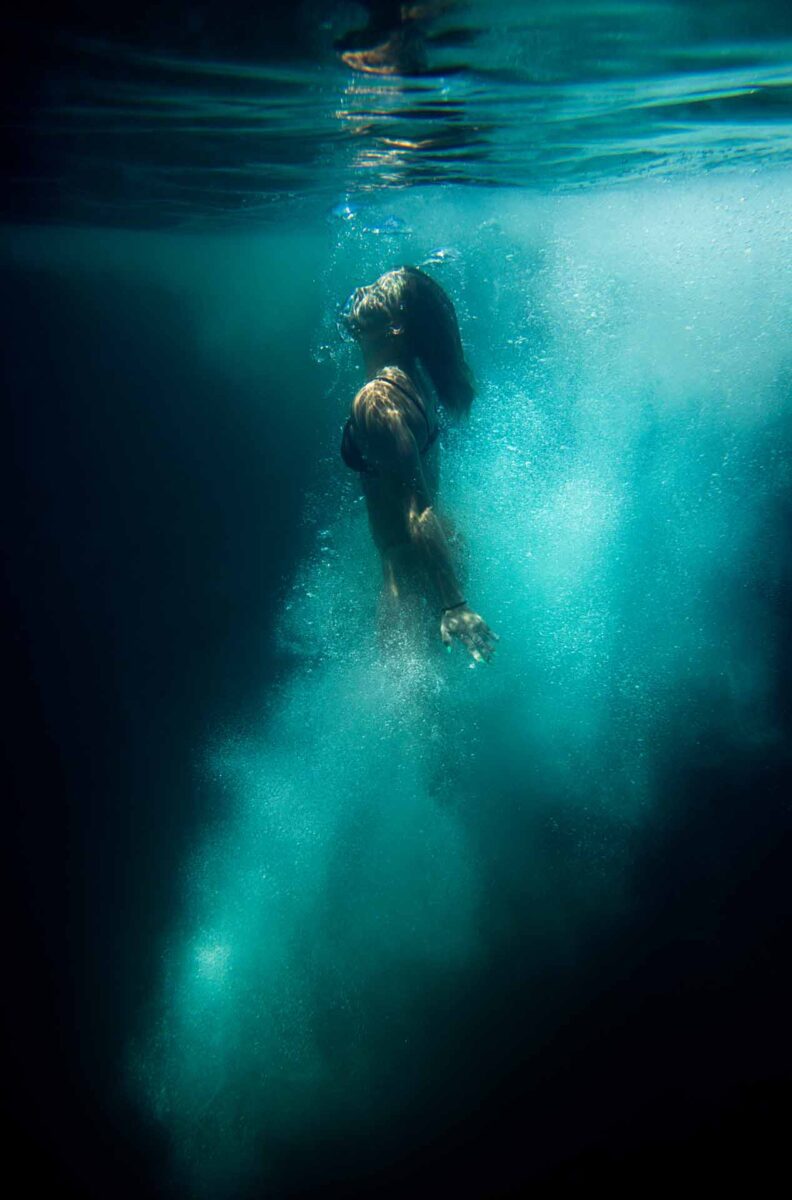
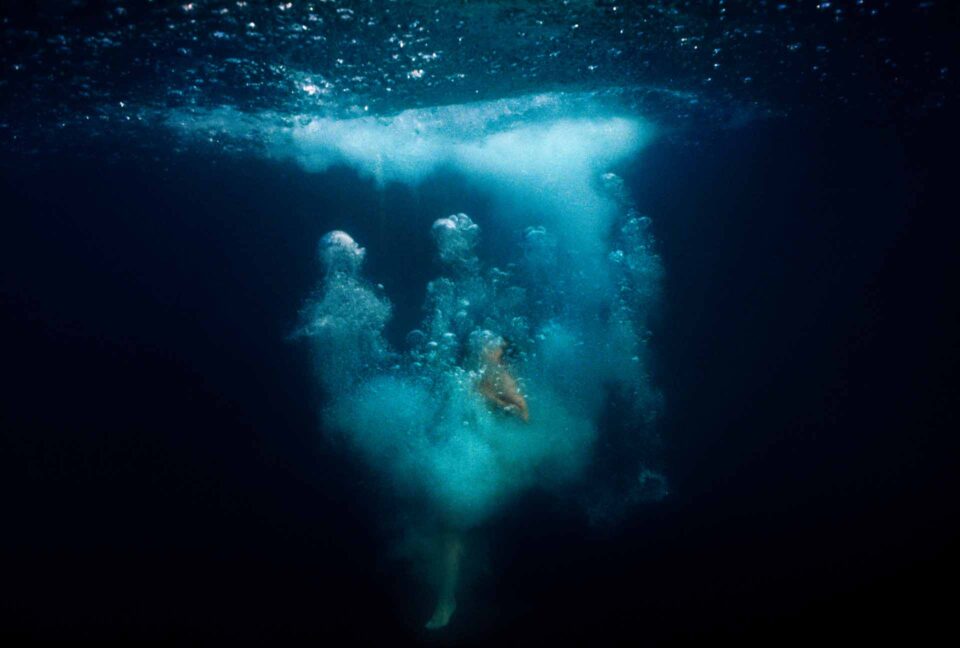
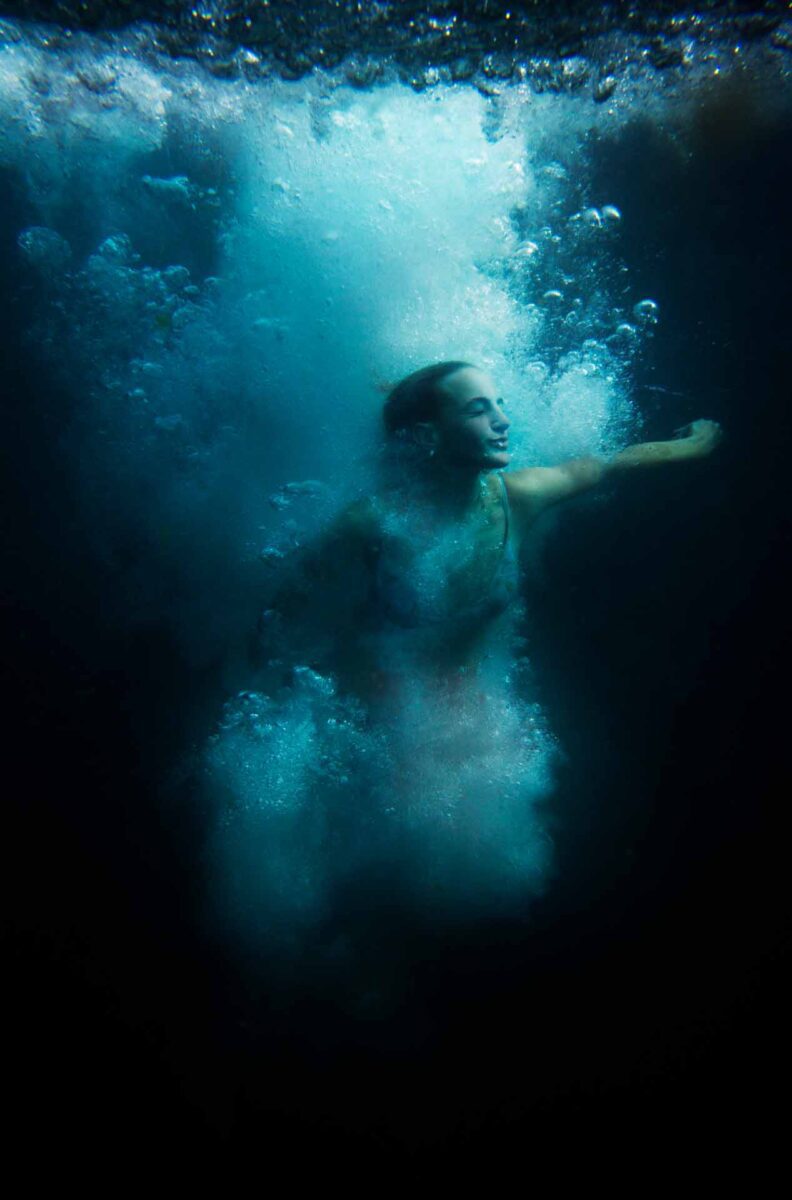
NA: On a hot day, South Australians flock to the coast and many spend time at the end of a jetty. Families and friends meet to play and leap from the tall structures, escaping the heat. I float out in the deep water under the jetty and watch and wait. I will dive and stay down as long as my breath allows, watching for swimmers above me as they burst through the surface. I will do this all day, conditions permitting. It can become exhausting! With a mask on, it is not easy to tell if I am pointing in the right direction. Shooting film, there is no way of knowing if I am successful at the time. I find something meditative about not being sure of what I have. There is no checking, and film has a precision that I like.
A: What draws you back to coastlines and the seaside?
NA: My relationship with the ocean is one of contradiction. I have always been drawn to it, and my life has been lived in and around the sea. It is a place where I find peace. At the same time, I have always felt a mystery and danger I cannot see; at times I find myself overcome with fear. I am curious about the dual sides of my ocean love affair, and pursuing an understanding of this has become important to me.
A: In 2002, you won the Leica Oskar Barnack Award for The Coastal Dwellers, becoming the first Australian artist to do so. Did you learn anything through making that series?
NA: I made it when I returned to Australia in 1999 after living abroad for four years. I had become jaded with the news industry, and missed my home. I rediscovered photography through the colours and cinematic light of Australia. Winning the Oskar Barnack gave me confidence. I no longer wanted to live elsewhere. I wanted to make imagery in my own backyard. Australians, as a whole, are very connected to the outdoors. Humans like to play – it’s when we are at our best. Often this involves water. We seem to become children again.
A: Where did you find inspiration for your more recent series, such as the otherworldly The Eyes of Her (2024)?
NA: Across the world, folktales regale us with stories of mermaids, selkies and water sprites. All enticing us into the sea. Mythology has always interested me. I love the idea we might become something else when we enter the ocean. Throughout history, water has been symbolic of change and transformation. Women seem to be uniquely tied up in these ancient maritime stories. They were once banned from sailing on ships, but often their feminine shape was celebrated as the figurehead, guiding the crew safely across the sea. Burnt at stakes, banished from Eden and banned from voting. Blame has been the woman’s burden – and they have paid a price throughout history, forever tied up with guilt and mistrust.
The Eyes of Her pushed these ideas a little further and takes inspiration from my own experiences. I shot this with a digital Leica in a housing; having a motor drive allowed me to capture more of the moment. I was able to see the swimmers emerge from the bubbles. They were reminiscent of ships’ figureheads, as they headed back to the surface.
A: Can you tell us more about The Summer of Us (2009), a body of work which seems to mark a stylistic departure?
NA: Summer of Us is a collection of discarded objects, but most importantly it is a portrait of my boys. The project came when I was struggling with postpartum blues, grieving the loss of artistic freedom and time. Instead of hours swimming making photographs, I was housebound with two small children. I would escape the monotony of domesticity by walking with them along the beach. Often, because they were toddlers, they would pick up bits of plastic and admire them the same way I would a pretty shell. It sparked an idea, which grew into a statement about how we use the coast. We saw so much natural beauty, but the amount of rubbish we collected horrified me. My shed was full. I took the items back to my studio with light boxes and a large format camera. I wanted the work to feel like illustrations from an early explorer. Each one was photographed carefully to show intricate detail. Later, when they were grouped together, stories formed. It became a testament to how humans use and abuse beaches.
A: You’ve previously described yourself as an impressionist. Which aspects of that term do you relate to?
NA: I focus on the ordinary and work outside in the changing light. I am interested in how the sun moves across the landscape, and how humanity moves within it. I like waiting in the dark and painting with colour. It’s a dance with the environment, working fast and using the conditions of the moment. I find it satisfying when life, light, energy and emotion collide and a photograph emerges. It is what got me into photography in the first place. I love the work of Clarice Beckett (1887-1935). Whilst she never identified with a particular movement, her work was produced outside on location, chasing soft early mornings, twilight or dusk. She often worked near water, or even during rain, to create a sense of atmosphere.
A: Exposure highlights a cross-section of photography in Australia and New Zealand today. What ideas and concerns are emerging across the two countries?
NA: It is almost impossible to answer this question in a definitive way. I see a diverse group of artists working with complex themes across all forms of image-making. They are treading their own paths, holding a mirror up to their lives and producing deeply personal work. The camera, effectively a box with a hole in it, in the hands of a thoughtful individual, will teach us something about ourselves and the world we inhabit. It was born as a truth-teller, and is still being used to educate and effect change. It can take us to amazing places, teach us about love, or entertain with humour. It can reveal incredible beauty and surprise us with a decisive moment, captured in a split second. The themes in this book are the same as they have always been: the human spirit, in all its technicolour glory.
A: Author Amber Creswell Bell asked Exposure participantsto define a “good image.” How did you respond?
NA: I love all types of photography, but I’m always attracted to pictures I wish I took myself, or that take me by surprise: full of energy, light, perfect stillness or complexity. But they should also have a whisper of something else that is hard to describe – something intangible and personal. I am drawn to images that ask a question, are not fully explained and leave room for interpretation. Girl Playing Under Green Car, New York City (1980) by Helen Levitt (1913-2009) is an example. It’s a beautiful, slightly awkward composition of a small child sitting in the gutter, almost under a vehicle. The photograph has an exquisite colour palette. I feel connected to Levitt; I can see her sense of humour, curiosity and empathy. Perhaps it is this experience of human connection that produces a great photograph.
A: Are there any artists you are particularly excited to be profiled alongside in this publication? How does it feel?
NA: I spent much of my early career working in an industry that elevated one group of humans to the exclusion of all others. Often, I was the only woman in the room. It was frustrating, alienating and, ultimately, boring. I am thrilled to be in such a beautiful book with so many diverse creatives, telling their own stories. I recognise some whom I have admired for years, and there are others that I am excited to discover.
A: Finally, what’s next for you? In what direction are you hoping to take your practice into the future?
NA: At the moment, I am in the middle of making a film. Otherwise, you will find me in the sea at the end of my street.
Exposure Thames & Hudson | Available Now
Words: Eleanor Sutherland
Image Credits:
- Parthenope (The Siren) : The Eyes of Her © Narelle Autio
- Amphitrite (Of the Sea) : The Eyes of Her © Narelle Autio
- Changeling V: Place in Between © Narelle Autio
- Vedenemo (Mother of Waters):The Eyes of Her © Narelle Autio
The post Oceanic Immersion appeared first on Aesthetica Magazine.


