

Two new site-specific outdoor sculptures at the Coastal Maine Botanical Gardens, located in the town of Boothbay, highlight Indigenous traditions and knowledge and challenge visitors to consider the Indigeneity of the land. Created by Anna Tsouhlarakis—an interdisciplinary artist and enrolled citizen of the Navajo Nation who is also of Creek and Greek descent—and Shane Perley-Dutcher—a mixed media artist and silversmith from the Neqotkuk Wolasqiyik (Tobique First Nation) in New Brunswick, Canada—the sculptures were commissioned by the gardens and Indigo Arts Alliance (IAA), the Portland, Maine-based non-profit and artist residency supporting Black and Brown artists.
“We’re proud to unveil the work of our artists-in-residence on the grounds of the gardens,” says Jordia Benjamin, the executive director of IAA—where Tsouhlarakis and Perley-Dutcher were artists-in-residence for the month of July. The gardens and IAA unveiled the artists’ sculptures on 20 July during “Deconstructing the Boundaries: The Land Fights Back,” a day-long symposium exploring the experiences of Bipoc communities with the land. “‘Deconstructing the Boundaries’ is an amazing ongoing collaboration with the gardens that provides us with a unique opportunity to examine and re-evaluate our relationship to the land we occupy,” Benjamin adds.
For his commission, Perley-Dutcher created Eci-Mahsosiyil/Fiddleheads (2024), two woven copper baskets in the form of fiddleheads—the curled fronds of young ferns. Visitors can interact with the sculptures and sit at the base, with the sides and furled tips of the fiddleheads surrounding them. Perley-Dutcher grew up picking fiddleheads, an important food source in Indigenous cultures. A sign of spring, the seasonal plant also represents the close relationship of reciprocity and sustainability that Wolastoqey people have with the land, as tradition says an offering should be made to the land before harvesting and that some of the fiddleheads should always be left for others to pick.
Shane Perley-Dutcher’s Eci-Mahsosiyil/Fiddleheads (2024) Courtesy the Coastal Maine Botanical Gardens
“Fiddleheads also symbolise the resiliency of our culture to survive, no matter the surroundings,” Perley-Dutcher said during the symposium. “Picking fiddleheads each year is an act of fighting for what was ours prior to colonisation and a reconnection to my identity as an Indigenous person. Passing on Indigenous knowledge is a form of social justice.”
For Tsouhlarakis’s work The Native Guide Project: CMBG (2024), she created a series of four structures that resemble grassy mounds from one vantage point but reveal sheared walls covered in oyster shells from another. The mounds are inspired by middens, piles of food remnants, artefacts and cultural materials commonly left behind by communities across the world for millennia, including many extant coastal examples from the Wabanaki population native to the region. Embedded in the oyster walls on three of Tsouhlarakis’s mounds are slabs of granite with the messages: “It’s good that you know water holds knowledge”, “I love how you listen when the land speaks” and “You’re right! This is Native land.”
Tsouhlarakis’s messages implore the viewer to consider what environmental awareness and land acknowledgements mean without action. “Knowledge is right in front of us,” she says. “This is about whether we’re going to do anything about it.”
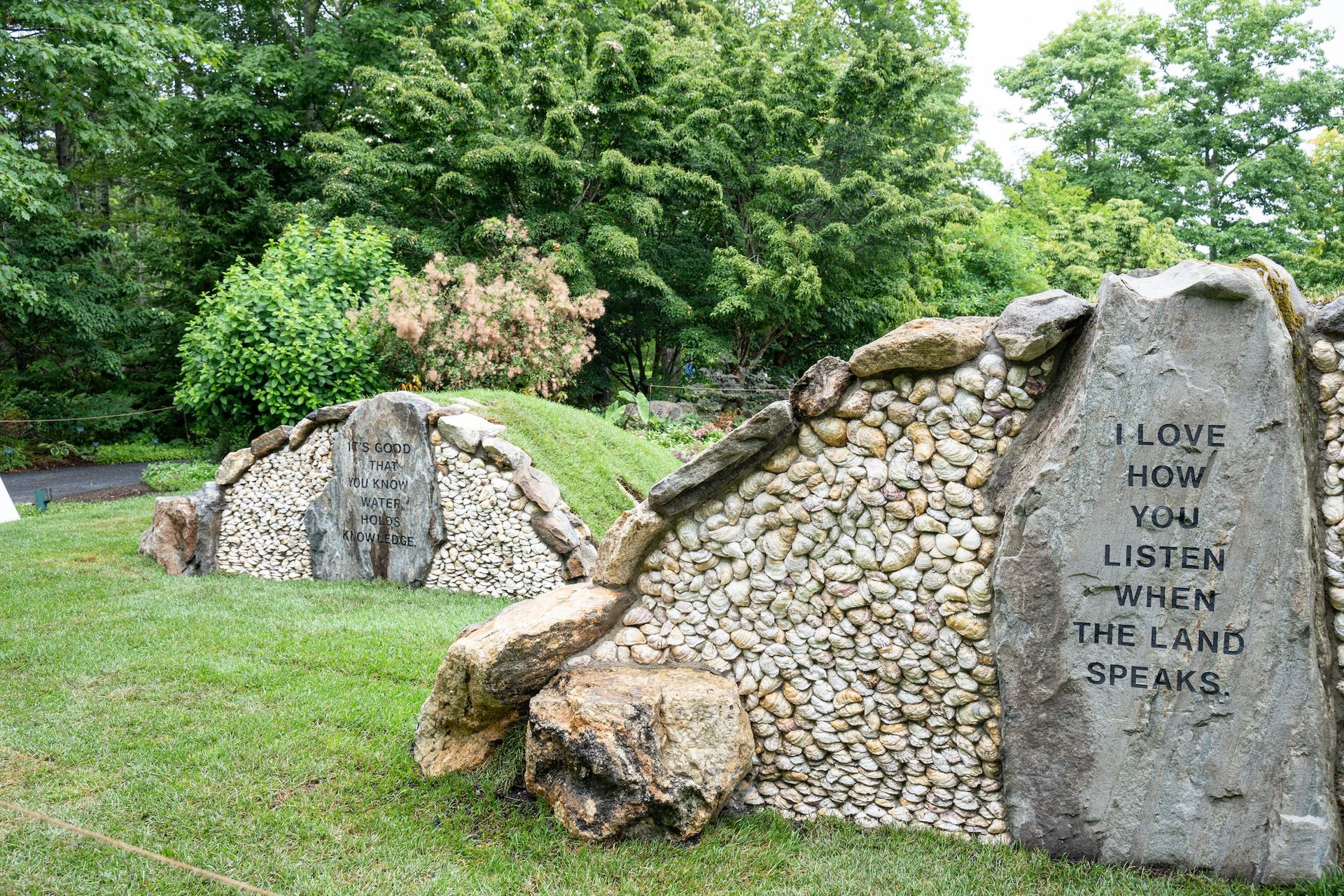
Anna Tsouhlarakis’s The Native Guide Project: CMBG (2024) Courtesy the Coastal Maine Botanical Gardens
Tsouhlarakis also intends for the sculpture to show Indigenous people that they belong. With ties to the region through her husband’s family, Tsouhlarakis has been visiting for over 20 years. “When I first started coming here, I’d never see people of colour,” she says. “I loved it here, but I didn’t know if I’d belong. Indigo Arts Alliance had this crazy idea to make sure we feel we belong, and it’s a beautiful thing to feel that way.”
Expanding the notion of belonging is also a mission of the gardens. This is done through initiatives like Guardians of the Seeds (2021)—a series of family-friendly giant troll sculptures by the Danish artist Thomas Dambo that teach environmental issues—and a nearly one-acre garden that engages all five senses for visitors with visual impairments.
Programmes like “Deconstructing the Boundaries” and the commissioning of Tsouhlarakis and Perley-Dutcher’s work are also part of the institution’s commitment to turning land acknowledgement into action and addressing the colonial history of botanical gardens more broadly.
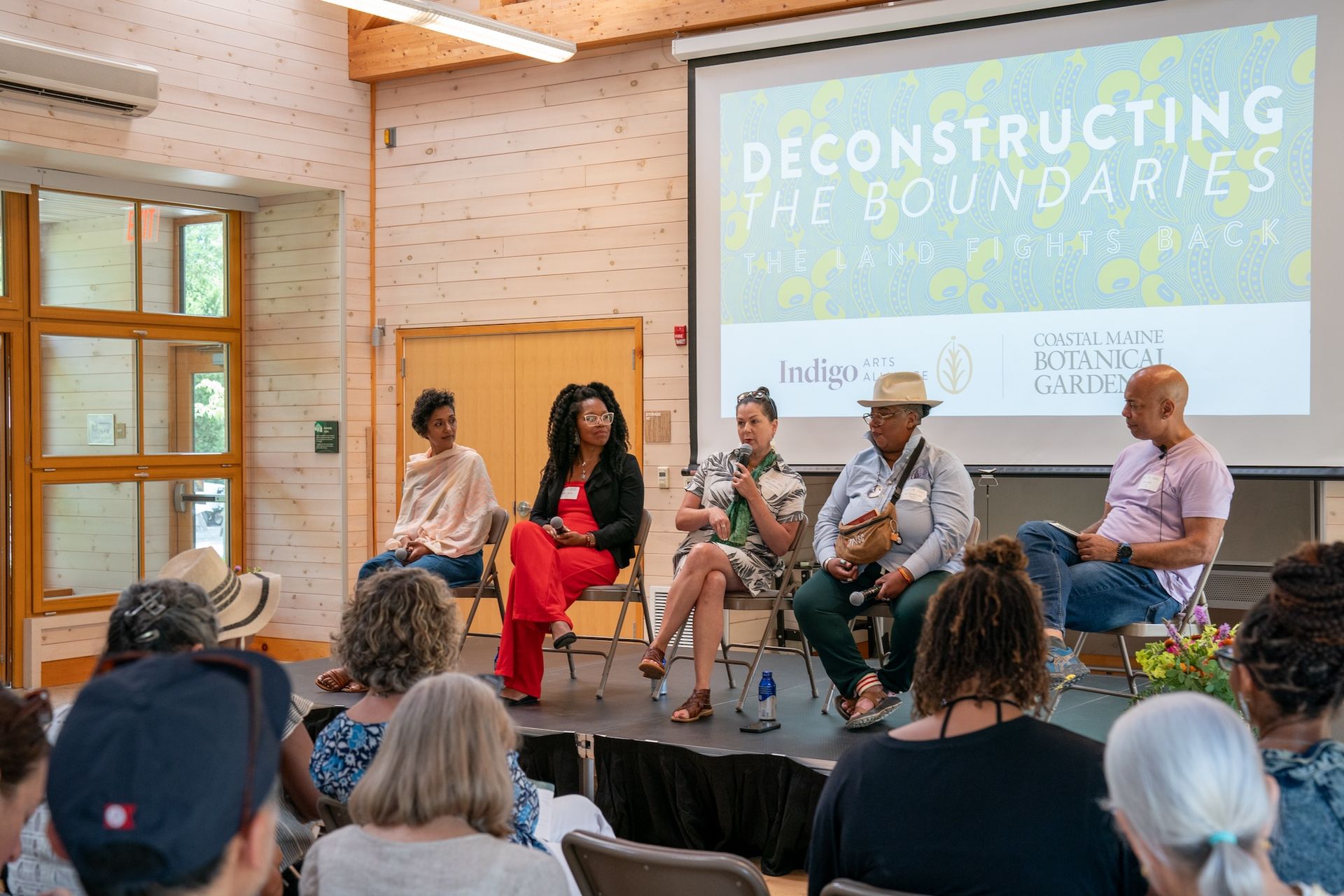
Speakers at “Deconstructing the Boundaries: The Land Fights Back”, 20 July 2024 Photo: Sofia Aldino, courtesy the Coastal Maine Botanical Gardens
“Historically, botanical gardens were extracting plants from the lands they were colonising—that’s a heavy history to think about and say, ‘How can we do better in 2024?’” says Gretchen Ostherr, president and chief executive of the gardens. “We have to centre our work in relationship with the community. We need to listen first. We need to let others lead. We are changing the way we operate.”
As an example, Ostherr noted that admission to the gardens is free to Wabanaki people. The organisation also worked with the Wabanaki Public Health and Wellness team to create a new garden space using Indigenous practices and values. And, of course, the gardens engage Indigenous artists and leaders like Tsouhlarakis and Perley-Dutcher.
“When an organisation you love shows that they can do even better, that’s phenomenal,” Tsouhlarakis says. “Even more, it shows that it’s a reasonable expectation for all organisations to do better.”


