

“It is not the subject of the image that is important, but the spiritual reality that it embodies.”
The Language of Light, Matter, and Inner Awakening
Contemporary abstract painting often searches for ways to express experiences that resist literal depiction. Within this field, Marianna Balog, known artistically as Mana, has developed a visual language centered on spiritual awareness, emotional movement, and the hidden forces that shape human perception. Her paintings do not aim to reproduce visible reality. Instead, they explore the interior landscape of human consciousness, where memory, intuition, and sensation converge. Each canvas becomes a site where matter and energy meet, allowing color, texture, and movement to communicate states of being that words cannot easily describe.
The visual construction of Mana’s works reflects a constant dialogue between physical material and transcendence. Layers of paint accumulate on the surface through repeated gestures of application, scraping, and rebuilding. These surfaces are not smooth pictorial fields but tactile terrains marked by traces of time and action. Thick pigment, carved textures, and energetic marks create compositions that appear alive, almost breathing. The viewer is not merely observing an image but encountering a space charged with accumulated moments, where emotional intensity becomes embedded in the structure of the painting itself.
Such an approach positions abstraction as a method of spiritual exploration rather than stylistic experimentation. Mana describes her practice as a search for energies rather than forms. Vibrations that exist within space and within the human mind become the underlying subject of her work. The paintings therefore move along the boundary between the visible and the invisible. They invite viewers to reflect on their own internal experiences, transforming the viewing process into a moment of recognition and connection with something larger than individual perception.
Mana: Painting as Meditation and Energetic Dialogue
For Mana, the act of painting resembles meditation more than controlled design. The creative process begins when a particular emotional and physical signal emerges, indicating that a work needs to come into existence. Rather than approaching the canvas with a predetermined composition, she allows instinct and subconscious impulses to guide movement, color selection, and structural development. This method creates an environment where the painting evolves through interaction rather than calculation. Conscious control gradually retreats, leaving space for intuitive gestures to shape the visual outcome.
Her personal motto expresses the essence of this philosophy: “It is not the subject of the image that is important, but the spiritual reality that it embodies.” This statement clarifies why the paintings rarely reference recognizable subjects. Instead of depicting landscapes, figures, or objects, Mana focuses on the emotional and energetic qualities that exist beneath outward appearances. Each composition acts as an inner gateway that encourages reflection on connection, remembrance, and the discovery of inner light. The completed image becomes a reminder that human consciousness remains linked to a broader spiritual dimension.
Color functions as a crucial carrier of meaning within this system. Mana associates specific hues with particular states of awareness and emotional resonance. Blue represents depth and ancient memory, suggesting vast spaces of contemplation. Gold symbolizes the manifestation of inner illumination, while red conveys vitality and life force. Green represents living connection and the regenerative power of nature. Texture, meanwhile, represents time itself. The layered surface records experiences that shape and preserve emotional memory, transforming paint into a visual archive of lived moments.
Material Surfaces and the Presence of Process
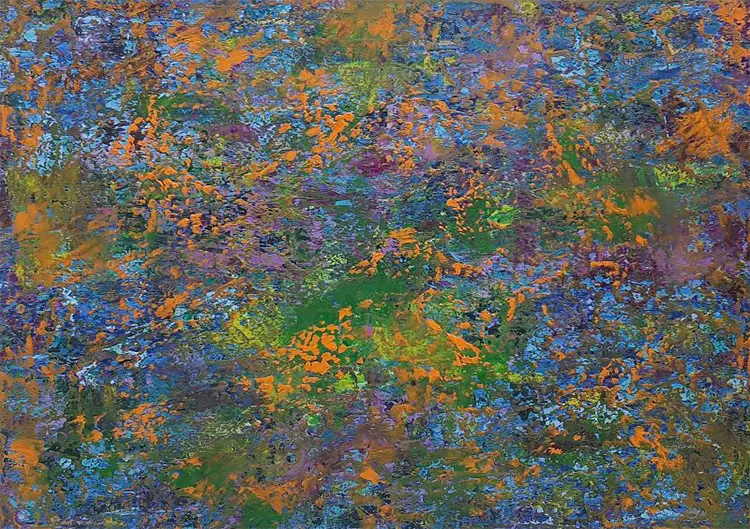
A defining feature of Mana’s artistic practice lies in the physical intensity of her surfaces. She frequently works with a palette knife, building substantial layers of pigment that are later scraped, reshaped, or partially removed. These actions reveal earlier stages of the painting beneath the surface, exposing the evolution of the work rather than hiding it. The canvas therefore retains evidence of decisions, revisions, and resistance encountered during the creative process. Every mark contributes to a visual narrative that documents the journey from the first impulse to the final form.
This emphasis on process encourages viewers to engage with the artwork as an experiential object rather than a finished illustration. Standing several meters away from the painting allows the energetic structure of the composition to unfold more clearly. At this distance, color fields and directional movements merge into a unified rhythm that can be felt intuitively. The paintings do not demand analytical interpretation; they invite emotional participation. Meaning arises through the interaction between artist, artwork, and observer, forming a shared space where perception and feeling intersect.
Music also influences the rhythm of Mana’s compositions. Her experience playing piano and guitar introduces elements of harmony, tension, and tempo into her visual language. Sounds often accompany the studio process, shaping the atmosphere in which the paintings emerge. Rhythmic patterns, tonal contrasts, and dramatic crescendos translate into sweeping gestures, layered color transitions, and dynamic structural balances on the canvas. The connection between sound and image forms a subtle yet persistent foundation for her work, allowing visual compositions to echo musical expression.
Mana: Emotional Landscapes and the Transformative Power of Color
The individual paintings created by Mana illustrate how abstract language can communicate complex emotional narratives. In “On the Way Home,” flowing diagonal bands of blue, green, yellow, and red move across the canvas like shifting landscapes seen during travel. These merging layers suggest both movement and introspection, transforming the idea of returning home into a metaphor for personal balance and self recognition. The painting captures the emotional rhythm of journeys, where memories, environments, and feelings move together through time.
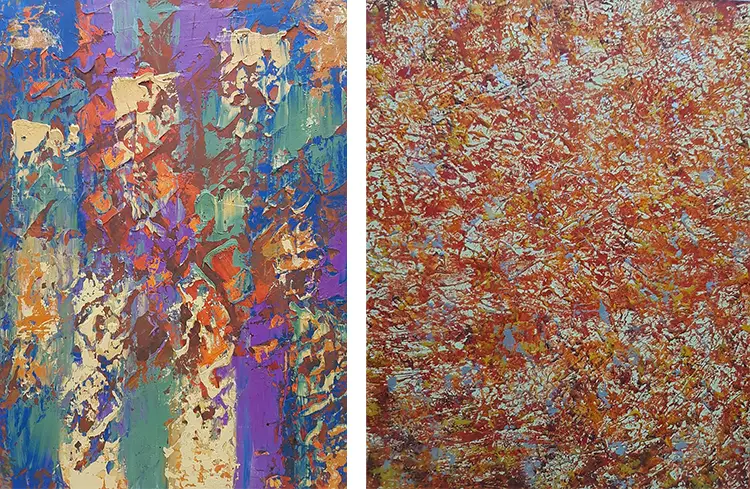
Other works explore nature as a symbolic expression of inner life. “The Good of Nature” presents green tones that evoke growth and renewal, while a warm golden brown center suggests sunlight nourishing the earth. Thick textures recall forest trunks and dense foliage, creating the sensation of standing within a quiet woodland environment. “Flowery Meadow” uses vibrant blues, purples, turquoises, and oranges to recreate the exuberant vitality of a blooming field. Dynamic brushstrokes and layered paint give the impression that flowers are dancing in the wind, celebrating the freedom and abundance of the natural world.
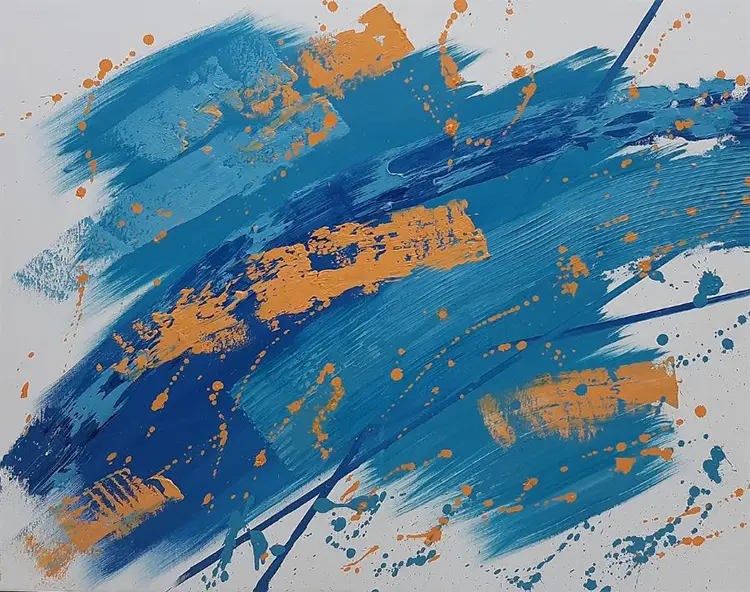
Several paintings highlight moments of transformation and illumination. “The Light” radiates from a bright yellow center surrounded by intense reds and oranges, suggesting the emergence of hope and renewed energy from darkness. “Freedom” bursts with energetic splashes of color on a vivid blue base, expressing liberation through spontaneous movement and layered gestures. Works such as “Glow,” “Turquoise Dream,” “Pond Roses,” “My Self,” “Vesuvius,” and “Exotic Feeling” continue this exploration of emotional landscapes, where volcanic eruptions, shimmering water, tropical atmospheres, and inner reflection become visual metaphors for the complexity of human experience. Through these compositions, Mana transforms abstraction into a language capable of communicating vitality, reflection, and spiritual awakening.
The post Mana: Transforming Emotion Into Luminous Abstraction appeared first on AATONAU.


