

Van Gogh’s pleasures at home were smoking his pipe and drinking coffee. This explains the prominent coffee pot depicted in a still life made in the kitchen of the Yellow House. He had bought the pot just a few days earlier, to help equip his new home in Arles. Still life with Coffee Pot was painted on 16-17 May 1888, two days when it was raining and he needed to work indoors.
In the Yellow House Vincent finally had a proper home of his own, after living for years in shared accommodation or modest rented rooms. Writing to his brother Theo on 10 May 1888, he reported that he had “bought what I need to make a little coffee or broth at home, and two chairs and a table”. It was probably on this table that he assembled his still-life composition.
Coffee played an important role in Vincent’s domestic life. A month after completing the painting he wrote to his sister Wil, acknowledging that he drank “large quantities of bad coffee”, enjoying its “cheering effect”. To Theo, he referred to the importance of “a pipe or black coffee with cognac”. Later that year he recommended to his Parisian artist friend Emile Bernard that one should “smoke your pipe and drink your coffee in peace”, in order to paint well.
The dark-blue enamelled vessel in Van Gogh’s picture consisted of two parts: boiling water would be poured in the narrower top, with the coffee grounds placed below in an internal metal filter, and then the drink would have dripped down into the bulbous pot.
Van Gogh used the rear ground-floor kitchen of the Yellow House as his studio, so all the objects in the still life would have been readily to hand. Alongside the coffee pot, there is a blue-and-white chequerboard milk jug, which has been identified by art historian Alexandra van Dongen as a late 19th-century work from the Sarreguemines factory.
Two coffee cups appear in the painting, suggesting a visitor might be arriving. The royal blue one on the left has gold edging. The decorated cup on the right, placed on an orange earthenware saucer, is majolica, a fashionable late 19th-century ware, as is the large jug on the right. Two oranges and three lemons complete the composition.
Van Gogh’s sketch of Still life with Coffee Pot with colour notations, in his letter to Emile Bernard from around 7 June 1888
Van Gogh Museum, Amsterdam (Vincent van Gogh Foundation)
A slightly different coffee pot appears in a painting, The Blue Coffee Pot, by Van Gogh’s colleague Bernard. In June 1888 Van Gogh sent Bernard a sketch of his own picture with colour notations, which might have inspired his friend to paint his own version (their tables are at the same angle). But it seems more likely that Bernard’s still life had actually been done a few months earlier and that Van Gogh had seen it in Paris just before his departure for Provence. If so, Van Gogh’s little sketch represented an acknowledgement of his debt to Bernard.
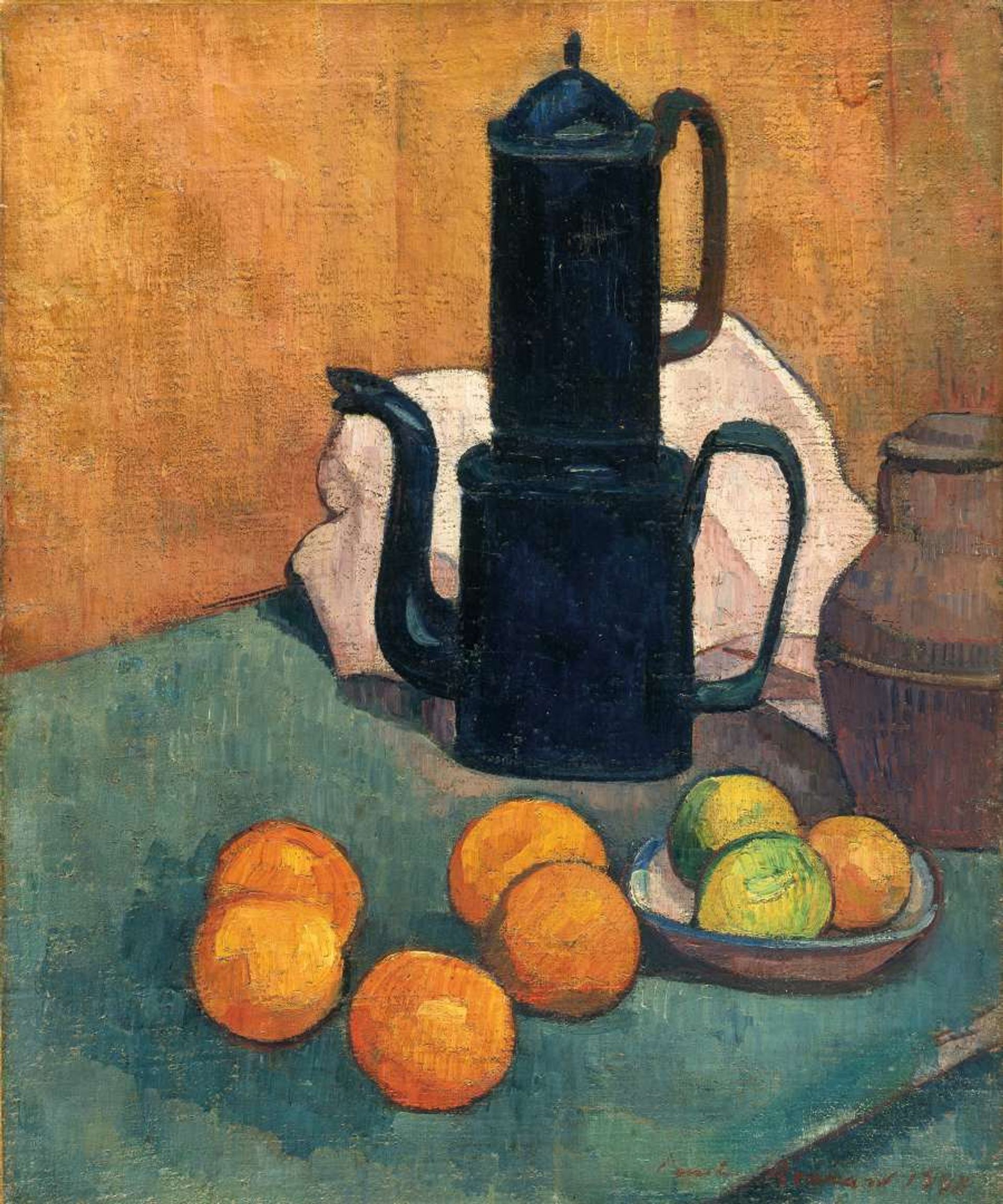
Emile Bernard’s The Blue Coffee Pot (1888)
Kunsthalle Bremen (Der Kunstverein in Bremen)
The yellow background of Van Gogh’s still life might suggest that he depicted a wall of the Yellow House, but this was the colour of the exterior; its interior was whitewashed. Van Gogh, like Bernard, deliberately used yellow to contrast with the colour of the tablecloth. Van Gogh’s tablecloth was originally a strong blue, but the pigment has now faded to a whitish hue. As Van Gogh explained to Bernard, Still life with Coffee Pot represented a complementary “variation of blues enlivened by a series of yellows ranging all the way to orange”.
What is unique in Van Gogh’s whole oeuvre is the orange border that he painted around the image and then the white “false” frame on the outer part of the canvas. When placed against a whitewashed wall, this would have had the effect of blending the picture into the surrounding architecture. It is likely that when he finished Still life with Coffee Pot, Van Gogh immediately hung it in his kitchen.
Van Gogh was pleased with the picture, signing it with a prominent “Vincent” in red in the upper-left corner. Along with The Harvest (June 1888), he observed that the still life “absolutely kills all the rest” of his Arles works.
In 1972 Still life with Coffee Pot was bought by Basil and Elise Goulandris. Basil, a Greek shipowner, died in 1994, followed in 2000 by his wife, and the painting is now owned by a family trust. Their museum, run by the Basil & Elise Goulandris Foundation, opened in Athens in 2019, with the still life one of its major attractions.
As for Van Gogh, perhaps he drank too much coffee. In March 1889, a few months after he had mutilated his ear, Vincent wrote to Theo to pass on advice he had received from Dr Félix Rey, who was treating him in Arles’s hospital: “Rey says that instead of eating enough and regularly I have been particularly sustaining myself with coffee and alcohol. I admit all that, but it will still be true that I had to key myself up a bit to reach the high yellow note I reached this summer.”
The pinnacle of Van Gogh’s “high yellow note” was reached in August 1888, when he painted the Sunflowers.
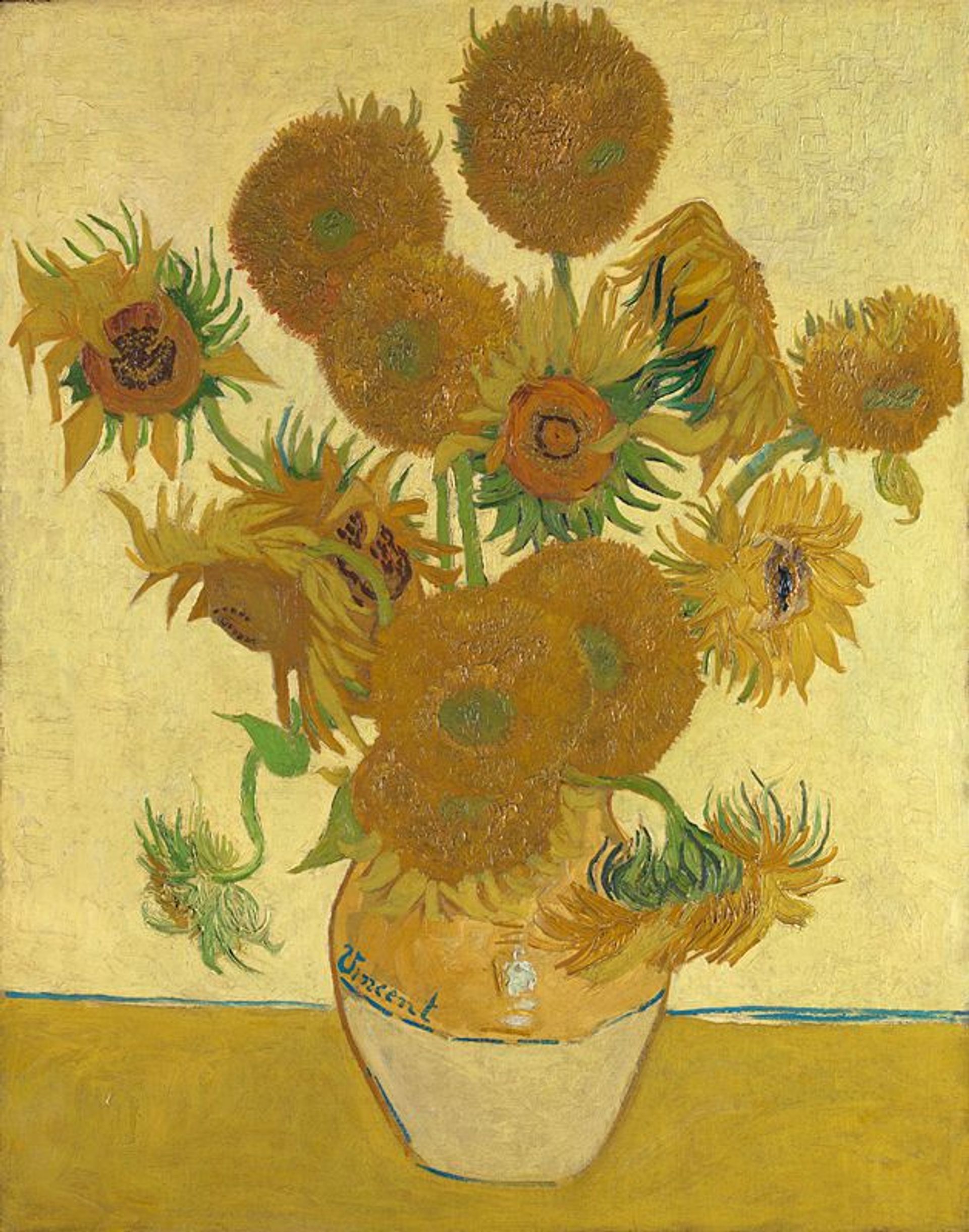
Van Gogh’s Sunflowers (August 1888)
National Gallery, London


