

Now an essential stop in the ever-growing circuit of international art fairs, Frieze Los Angeles is back at Santa Monica Airport for the fourth time, the fair’s seventh edition overall and the first since Frieze was acquired by Ari Emanuel’s live events venture Mari. Frieze’s fair director for the Americas, Christine Messineo, says the new parent company’s expertise in live events “very much fits within our realm”, adding that “not much has changed for us besides sitting within an organisation that knows how to support events in entertainment and sports”.
This year’s Frieze Los Angeles brings together nearly 100 galleries from 22 countries. Many of the gallery sector’s biggest international players, with or without Los Angeles outposts, are back at the fair, including Gagosian, Pace, Thaddaeus Ropac, Lisson, White Cube, Perrotin, David Zwirner and Hauser & Wirth. Leaders of the local scene are also out in full force, among them Roberts Projects, David Kordansky Gallery, Château Shatto, Commonwealth and Council, The Pit and Matthew Brown.
“What an art fair like ours does is to bring collectors together with galleries and art lovers,” Messineo says, describing Frieze Los Angeles as a “gathering point across the city’s calendar and if you’re remotely connected to collecting, you will be at the fair”.
Hometown exhibitors echo her sentiment. Anat Ebgi, whose namesake gallery also has a New York location, describes Frieze Week as a “very concentrated moment of international visibility” and that reflects the “distinct” quality of the city’s collecting community. She recommends out-of-town visitors use the fair as an “anchor point” to explore the local scene, describing her gallery’s stand this year as a “marquee to tease” its programming, with a group presentation of new work by Anabel Juárez, Sarah Lee, Ileana García Magoda, Soumya Netrabile, Erin Wright, Sarah Ann Weber and Jemima Murphy.
Clare Woods’s The Last Stage (2025) at Night Gallery, which has devoted its stand to the British artist. The works are based on Woods’s photographs of The Huntington’s botanical gardens in San Marino Courtesy the artist and Night Gallery
Another local heavyweight, Night Gallery, has devoted its stand to the British painter Clare Woods’s aluminium panels with floral compositions rendered in explosive colours—in this case, they are based on her own photographs of the Huntington’s botanical gardens in San Marino. The gallery’s owner, Davida Nemeroff, says the fair offers “unique opportunity” to gather a “spread-out and diverse” audience “under one tent”. She also hopes international visitors will look beyond stereotypes about Los Angeles being “superficial, because the art scene here is anything but”.
The San Francisco-based dealer Jessica Silverman, another Frieze Los Angeles regular, has doubled her stand’s size this year. The decision, she says, “communicates the business we’ve been able to do out of the fair and throughout the year from the relationships we’ve developed from previous years”. A portion of Silverman’s expanded footprint is devoted to a capsule solo exhibition of works by the Detroit-based painter Beverly Fishman, whose energetic abstractions reference pills and overall pharmaceutical products in their rounded, geometric forms.
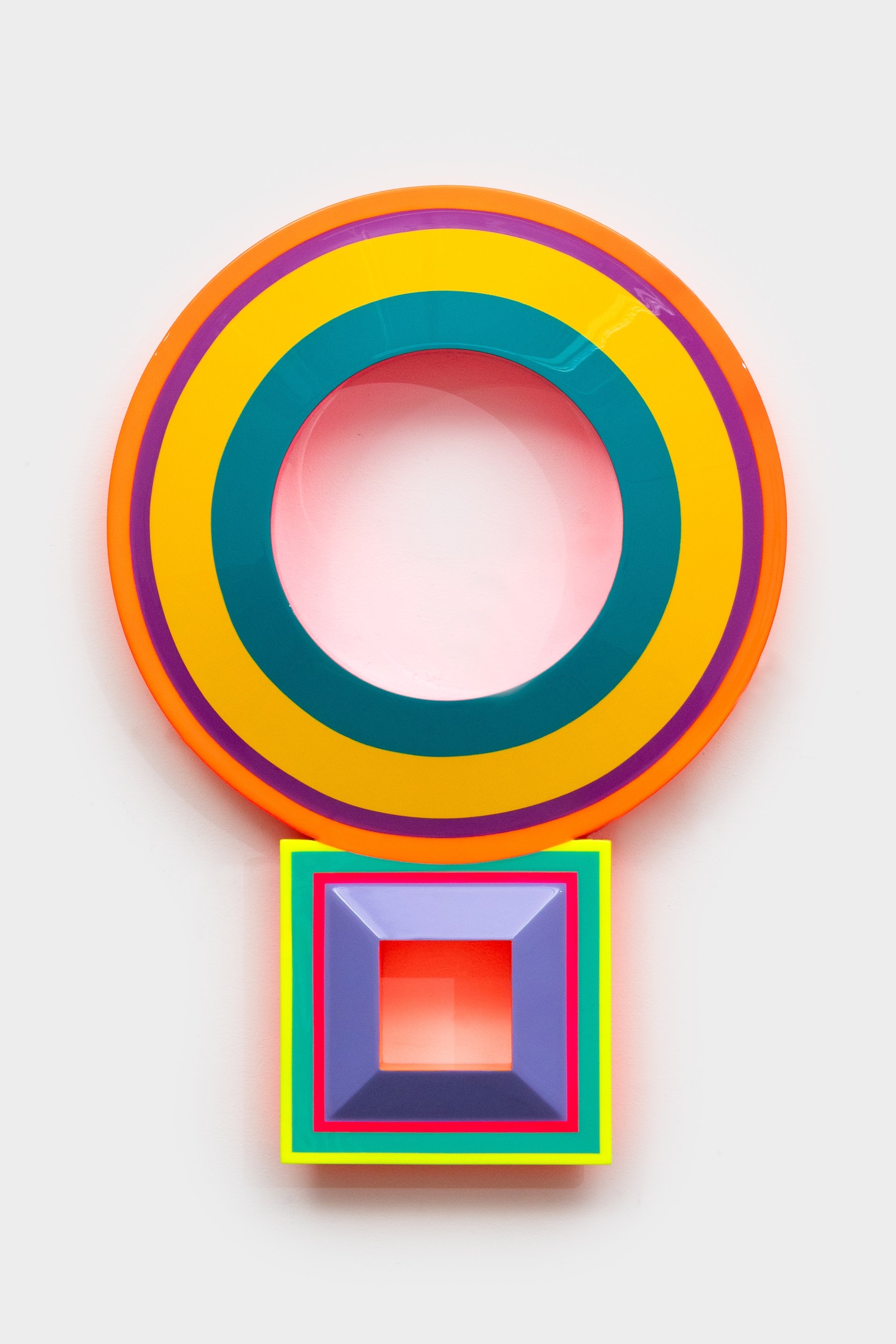
The Detroit-based artist Beverly Fishman’s Liberation, Energy (2025) will be featured on Jessica Silverman’s stand at Frieze Los Angeles Courtesy the artist and Jessica Silverman, San Francisco; Photo: Tim Johnson
Besides significant exhibitor numbers from the US, Europe and Asia—particularly Korea thanks to Frieze’s annual Seoul edition—a handful of Latin American galleries are traveling to court West Coast collectors and institutions. Among them is Nara Roesler, the Brazilian gallery with a New York outpost. The gallery’s stand features a who’s-who of its roster, with works by Tomie Ohtake, Vik Muniz, Amelia Toledo and others. Daniel Roesler, a partner in the gallery, says it is back at Frieze Los Angeles for the fourth time because it is an “opportunity to reach a new audience”. He cites the city’s “exceptional institutions” and the fair’s “intimate” scale, which generates a “strong presence of West Coast collectors compared to the global audience in Miami”.
First-time exhibitors at the fair this year hail from a broad geography such as Cardi (which has locations in Milan, London and Ibiza) and El Apartamento (of Havana and Madrid), as well as the New York-based gallery Fort Gansevoort. The Montréal-based gallery Bradley Ertaskiran is making its debut at the fair with a two-artist stand pairing large-scale paintings of enigmatic interiors by Margaux Williamson and abstract, otherworldly sculptures by David Armstrong Six. The gallery’s co-founder, Antoine Ertaskiran, says the moment is “right for the gallery to engage more directly with the West Coast context”.
Beyond the stands, the fair has once again transformed the Santa Monica Airport campus with a range of indoor and outdoor interventions. The programming includes Frieze’s fourth collaboration with the New York-based non-profit Art Production Fund, titled Body and Soul. As part of the programme, the artist Cosmas & Damian Brown will lead a workshop with children painting metal plates and bowls, which they will then incorporate into Brown’s multi-sensory public commission, Fountain: Sources of Light (2026). For her outdoor intervention, the Los Angeles-based artist Shana Hoehn has created the sculpture Deadfall (2026) from a tree sourced through the Santa Monica Urban Forest programme that she has transformed so that it appears to have sprouted cheerleaders’ legs.
Messineo likens the fair’s atmosphere to the early years of Frieze New York, when the fair took place on Randall’s Island and most visitors arrived by ferry and wandered along the Harlem riverfront to reach the tent. “People stay for a long time, sitting on the picnic tables outside,” she says of the Los Angeles expo. “This is one of those fairs where you actually like to see people and most importantly artists show up, too.”
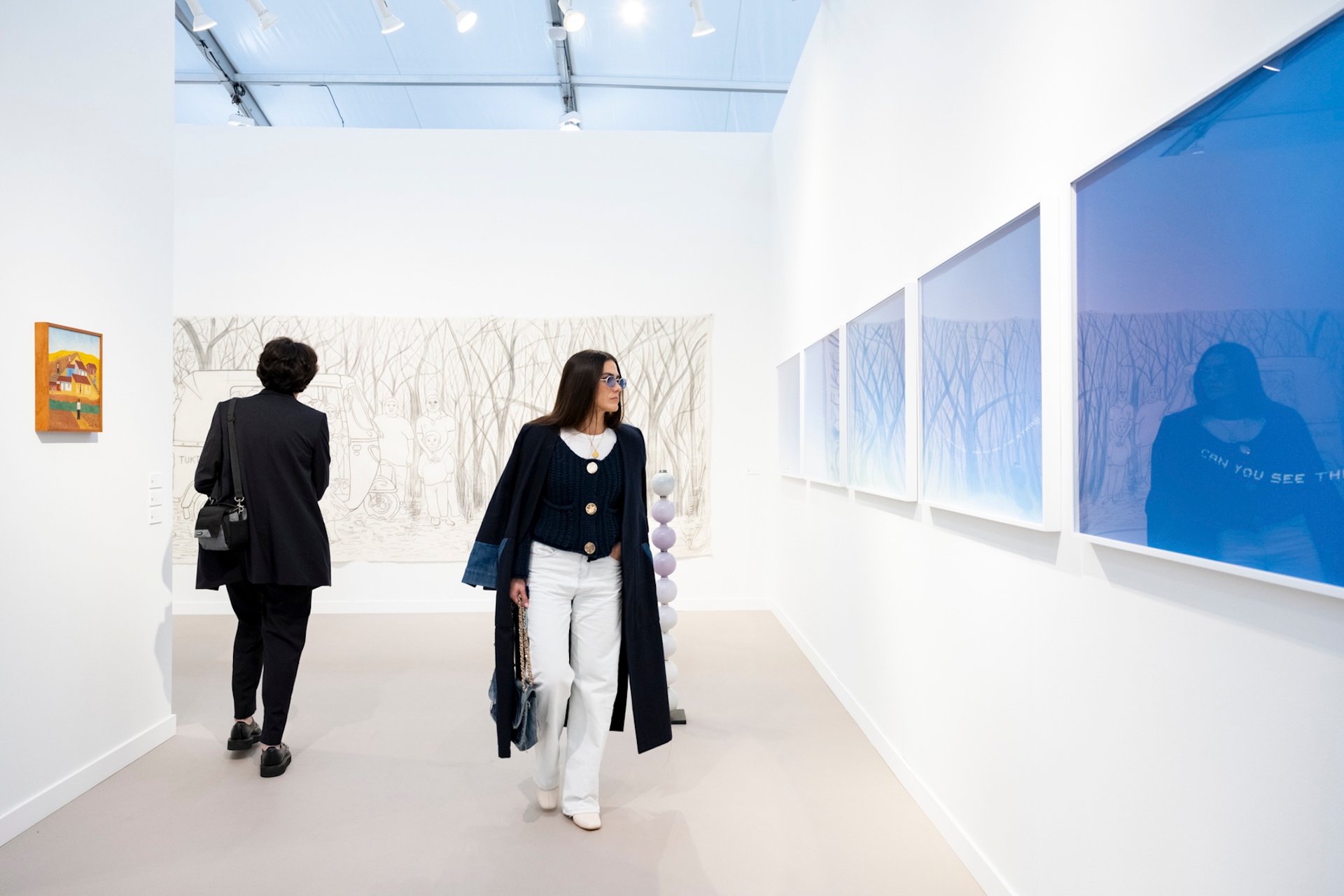
Visitors to the 2025 edition of Frieze Los Angeles Photo: Casey Kelbaugh/CKA
The fair comes at a charged moment, for the Los Angeles community at large and the local art scene in particular. The number of galleries in the city has shrunk since last year’s edition, with the closure of longtime local spaces like LA Louver and Blum, and with a handful of international and New York-based galleries closing their Los Angeles spaces—among them Sean Kelly, Tanya Bonakdar, Southern Guild and Michael Werner Gallery. Meanwhile the city has also been on the front line of US president Donald Trump’s anti-immigrant policies, with Immigration and Customs Enforcement (Ice) agents conducting aggressive raids around Los Angeles since last summer.
The art community’s stance on Ice is front and centre at the fair, with a neon installation at its entrance by the Los Angeles-based artist Patrick Martinez featuring slogans like “Then They Came For Me” and “Deport Ice”. Through the fair’s partnership with the media agency Orange Barrel Media, Martinez’s works will also be displayed on billboards around the city during the fair.
Messineo says she is confident in the fair’s ability to bind and buoy its constituent communities. She says that the word “resilience” was often used during last year’s edition, which took place weeks after deadly and devastating wildfires struck parts of the city. “That emotion was threaded throughout the entire year,” she says. “We need to highlight the efforts of these ecosystems.”
- Frieze Los Angeles, 26 February-1 March, Santa Monica Airport, Santa Monica, California


