

The artist Dana Awartani will represent Saudi Arabia at next year’s Venice Biennale, with Antonia Carver as the curator and Hafsa Alkhudairi as the assistant curator, it has been revealed.
Awartani is a leading figure within the current generation of Saudi artists. Often working in collaboration with artisans, she focuses on cultural heritage and craft traditions—some of which she herself has trained in.
She received a BA from Central St Martins in London but says that while there, she resisted people’s expectations about the kind of work she would make, as an Arab woman artist. She subsequently studied Islamic geometry at the Prince’s School of Traditional Arts and then undertook an ijaza—a formal Islamic certification—in Turkey, learning the technique of illumination.
Her work continues to oscillate between these two poles, and though she says it is too early to say what she will make for Saudi Arabia’s Venice pavilion, she hints that it will be informed by cultural heritage and the ideas associated with it.
Still from Dana Awartani’s I went away and forgot you. A while ago I remembered. I remembered I’d forgotten you. I was dreaming (2017), performed in a traditional house in Jeddah’s Al Balad neighbourhood
Dana Awartani
“When people talk about heritage sites in places where they’re from, it’s not just brick and mortar or stone buildings,” she says. “It’s a place that holds memory. It’s a place that gives them a sense of belonging—part of your everyday fabric of life. Especially in the Middle East, we still live with our heritage. You still have people living in Al Balad [Jeddah’s Old Town], in its old houses, or in Syria and Palestine, people will still sit in the coliseums and have shisha.”
Awartani was born and raised in Jeddah, to a Saudi father and a mother who is half-Palestinian and half-Syrian. Her work has responded to recent conflict in the Middle East. As part of her show earlier this year at the Arnolfini, in Bristol, she re-made the tiled floor of the Hamam al-Sammara, a bathhouse in Gaza said to date from the 14th century. The building was reportedly destroyedby Israeli strikes on the conclave in 2023.
Standing by the ruins (2025) was the second work of this type that she has made; at the first Diriyah Biennale, in Riyadh in 2021, she re-staged the tiled pattern of the Grand Mosque of Aleppo, which suffered extensive damage in the Syrian Civil War. For both pieces, Awartani worked with traditional mud-brick makers in Saudi Arabia, asking them to omit the hay that typically binds the bricks together so that cracks form throughout the pattern, emphasising the vulnerability of the sites.
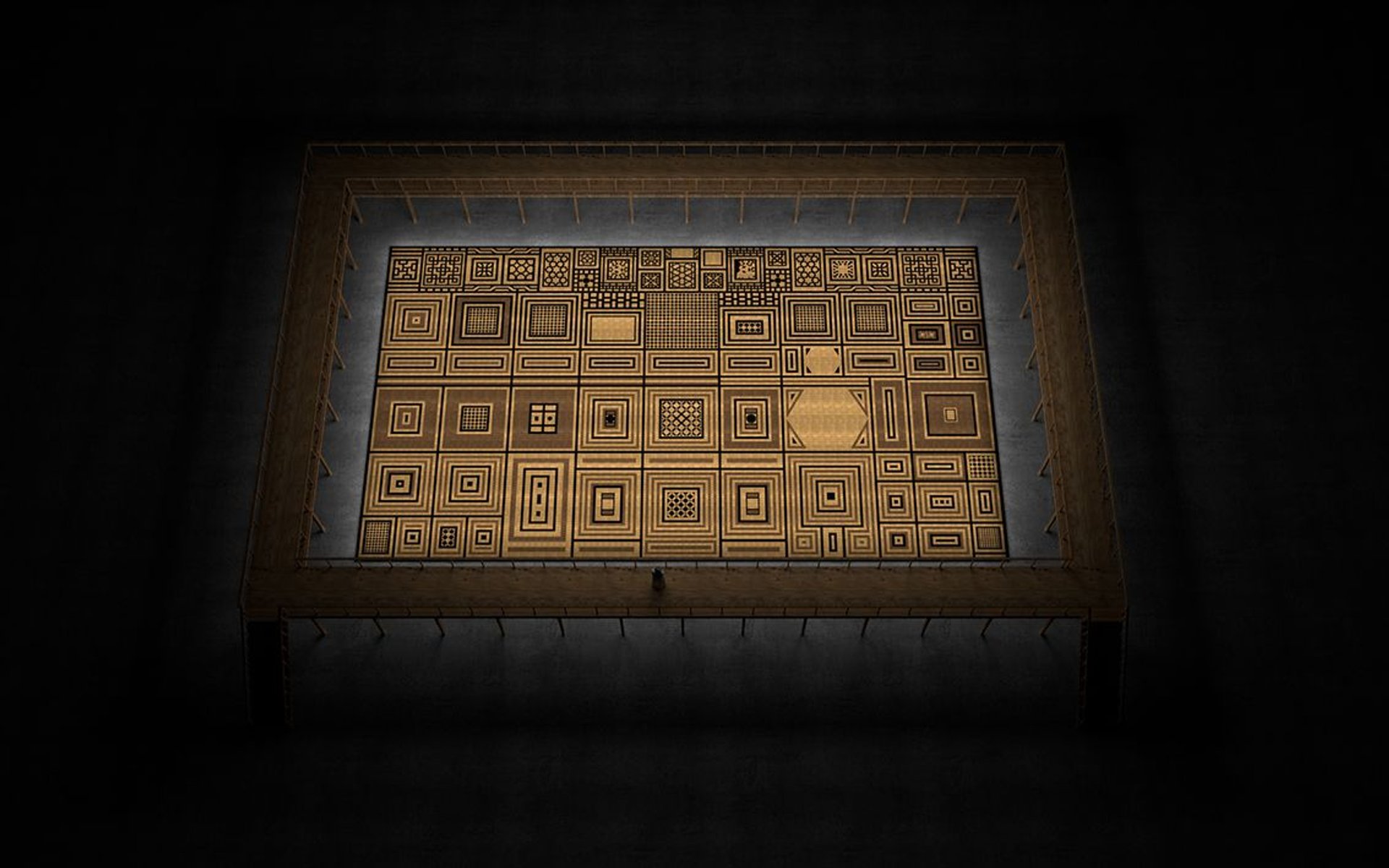
Dana Awartani, Standing on the Ruins of Aleppo (2021) © Diriyah Biennale Foundation and the artist
“One of the things that I really love about Dana’s practice is its capacity to move between the micro and the macro,” Carver tells The Art Newspaper. “Dana’s work exposes all the textures, meanings and fragilities within the organic materials she uses, and then moves from that to the macro of our shared cultural heritage. In the art world, contemporary art is being produced at the same time as cultural destruction is taking place. It feels very important to represent that sense of collapse between the ancient and contemporary at the Venice Biennale.”
Carver, a well-known figure in Saudi Arabia and the Gulf, is the director of Art Jameel, the philanthropic foundation that oversees the Jameel Arts Centre in Dubai and Hayy Jameel in Jeddah. Alkhudairi works on contemporary art commissions in AlUla, the cultural and tourist destination in Saudi Arabia’s northwest, while also pursuing other curatorial and research projects.
The Saudi pavilion is organised by the Visual Arts Commission, part of Saudi’s Ministry of Contemporary Art. This will be the fourth art pavilion by Saudi in its new permanent space in the Arsenale.


