

Doug Aitken’s performative works often feel like “happenings”, and his new multi-channel work Lightscape (2024) is no exception, especially when it has live musical accompaniment. In the darkened, cavernous space of the Marciano Art Foundation, several hundred people recently gathered to watch images flashing on seven large screens arranged around the perimeter, while two pianists played minimalist music in the centre. The work starts—more or less, as different images are often shown on different screens—with a cowboy riding out of the desert, and is soon intercut with a bearded man, then a young woman, driving into and around Los Angeles, passing shops and high-rises. Propulsive motion is followed by calm interludes, and vice versa.
A still from Aitken’s multi-channel work Lightscape, which explores “the collision between technology and nature” © Doug Aitken Workshop
The project started with words and music. Around four years ago, Aitken began working with the Los Angeles Master Chorale and Grant Gershon, its artistic director. In early conversations with the artist, Gershon recalls talking “about searching and about the original American myth of progression westward and what that means in the 21st century”, adding: “It’s about our relationship with nature as it stands right now, the complexities of what’s going on in the modern world, and the collision between technology and nature.” He brought singers to Aitken’s studio, and they improvised songs based on the artist’s word prompts, which were recorded.
In Lightscape we begin to recognise about a dozen characters who recur throughout. They include a woman (played by Natasha Lyonne) who spends a night at a high-rise hotel with her boyfriend, an older woman who lives in a posh mid-century Modern home overlooking a swimming pool, her gardener who tends the jungle growth beyond the pool, and a young woman who dances at night in a parking lot and later appears as a worker in an Amazon-like warehouse. The latter is played by Daphne Fernberger, one of the lead dancers at the L.A. Dance Project, who was introduced to Aitken’s project through storyboards and music at the artist’s studio. “I was getting a visceral sense of the energy behind the project,” she says.
Aitken’s concurrent exhibition at Regen Projects, Psychic Debris Field, echoes some images seen in Lightscape but also goes into different directions. The artist recently discussed these two related projects.
The Art Newspaper: Did the film or the artwork at Regen Projects come first?
Doug Aitken:It all happened simultaneously. I started working on the Lightscape project about four years ago, and I was looking at creating this kind of Gesamtkunstwerk, this artwork that was ignoring the separation between media and using anything and everything it needed. I started, actually, with music, and I started writing a song cycle. And it was a series of chapters that told a larger story, addressing the idea of the modern landscape and our habitation within it. [I was working] with the Los Angeles Master Chorale. And then the pandemic happened, and I kept working on it. And the Los Angeles Philharmonic reached out to me, and they said, “We’d love to collaborate.” I said, “I’m kind of writing this narrative cycle.” So we started working together, and that allowed us to take the music even wider.
Los Angeles is constantly evolving. It’s like sand that goes through your fingers and it’s never something that I can completely grasp
Then that work started to build into the installation that became Lightscape, with film and moving image. It was very organic and seamless, how these different media flowed into each other. The story itself was starting to become clearer to me. I realised that I did not want to rely on traditional drama, and I wanted to see if it was possible to create a very fragmentary, very non-linear narrative, something that, to me, really expresses the way we see the world. [For the visuals] I actually started with the landscape. I didn’t start with characters, I started with topographies, almost like an Earthwork.
Where did you shoot the desert scenes, such as the beginning when a man rides out of the desert on horseback?
That was all Death Valley and around Trona, in the Eastern Sierras. And then [I thought] “let’s take a different direction and go into a robotics factory, a space that’s completely homogenised and sealed, and the machines are doing all the work”. And so I started looking at this idea of it as a fascinating journey,
The first time I saw Lightscape, I walked into it towards the latter half, and then I watched again from the beginning. But it didn’t feel like you had to necessarily see it from beginning to end.
I was interested in making a work that didn’t really have a beginning or an end. It was something you could fall into. And you could find one strand that would lead you somewhere else. And it would look at this idea of this incredible connectivity that we have in our world, which is really being alive.
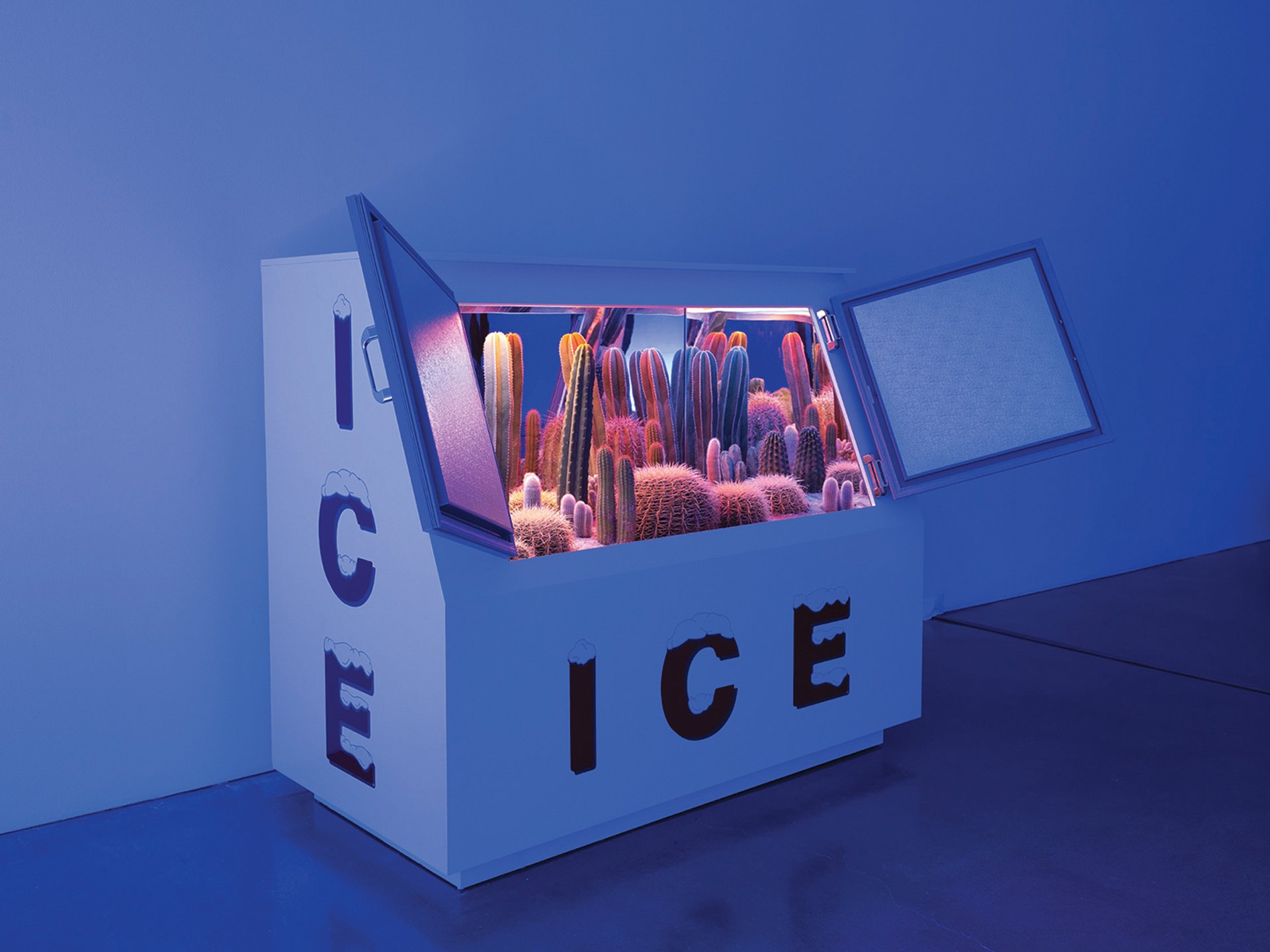
Microcosmos (Ice Machine) (2024), with live cactus plants, from Aitken’s exhibition at Regen Projects © Doug Aitken; courtesy of Regen Projects, Los Angeles; 303 Gallery, New York; Galerie EvaPresenhuber, Zurich; and Victoria Miro, London
Have your feelings about Los Angeles changed over the years? By the end of Lightscape, I felt it was kind of a love letter to Los Angeles.
The most dynamic thing about Los Angeles is it’s forever changing. It’s constantly evolving. It’s like sand that goes through your fingers. It’s never something that I can completely grasp in its entirety, and makes me keep coming back for more. It makes me kind of addicted to this strange, dark magic that the city holds.
• Doug Aitken: Lightscape, Marciano Art Foundation, Los Angeles, until 15 March
• Doug Aitken: Psychic Debris Field, Regen Projects, Los Angeles, until 22 February


