

Denzil Forrester has weird timing. In 2016, less than a week before the election that gave Donald Trump his wretched first term in the White House, the Grenadian British artist made his US debut at White Columns. This year, the 67-year-old artist’s return to New York just two weeks before an even more crazy-making election created an element of foreboding. Forrester was infectiously optimistic at the opening of Two Islands, One World, a 41-year survey of paintings and drawings (1973 to 2024) curated by Sheena Wagstaff. Or so said Forrester’s dealer, Stephen Friedman. “Selected,” replied the Metropolitan Museum’s chair emerita of Modern and contemporary art. “Not curated.”
Most of the paintings that Friedman is presenting in Tribeca, with Andrew Kreps Gallery, depict scenes of close community: underground reggae dance clubs that Forrester frequented in London in the 1980s, and snapshot-like views of his siblings at work in their single mother’s home business, making handbags. Sewing machines are a central feature of several paintings at Kreps that fairly vibrate in pink, lavender, orange and blue. At Friedman, the darker nightclub scenes are crowded with commingling figures. Faces are indistinct but it’s clear there’s a party going on.
Denzil Forrester, Tutti-Frutti, 2024. © Denzil Forrester. Courtesy the artist and Stephen Friedman Gallery, London and New York. Photo by Todd-White Art Photography.
Forrester brings a transporting sense of space to his work, allowing him to squeeze cubistically stylised bodies into a single perspective. He gives that mashup a twist in the show’s one outdoor scene, Death Walk (1983), where helmeted figures drag the limp body of another man down a dark alley towards a police van. Here, the view is at once aerial and from the rear, making the subject look as if he is floating above the street, free as a bird.
Forrester imagined the scene but based its narrative on an actual incident involving Winston Rose, a close friend with a mental illness who was killed in police custody in 1981. No charges were filed, and the death was never explained. It motivated Forrester to write his graduate thesis at the Royal College of Art on police violence towards London’s Afro Caribbean population, a situation later dramatised by Steve McQueen in his 2022 Amazon Prime series Small Axe (named after the Bob Marley song).
While Forrester was telling me this story, I couldn’t help thinking of Michael Stewart, the Black graffiti artist who was arrested in 1983 by New York City transit police for tagging an East Village subway wall and then beaten badly enough to cause his death. No officers were sentenced. Forrester wasn’t aware of either Stewart or the painting that Jean-Michel Basquiat made to memorialise his friend (The Death of Michael Stewart, 1983), but the parallels were striking to both of us.
Gripping work
In a side room, Wagstaff had placed a single, mural-size canvas, Funeral of Winston Rose (1981). To my eye it is the most gripping work in the show—partly because Forrester set the funeral in a nightclub. “I put the coffin where the DJ booth would be,” he says, with no small pride. The coffin lid is half pulled back. Rose’s wife is leaning over the body. Friends—again, seen from a slightly elevated position behind them—crowd the open casket. “I put in this boat,” Forrester adds, gesturing toward a sailing vessel at the top of the picture, “to take Winston to his next life.”
I was reminded of Emmett Till, the Black teenager from Chicago who was shot to death and mutilated by a white mob in Mississippi in 1955, supposedly for whistling at a white woman. Till’s mother insisted on an open casket to show the thousands at the funeral—and the nation that saw the photographs—the full horror of what had transpired. It jumpstarted the Civil Rights movement. Yet that same image only brought heat to Dana Schutz for her empathetic but more abstract rendering, Open Casket (2016), shown at the 2017 Whitney Biennial. Clearly, our histories are entwined and our cultures are not that far apart.
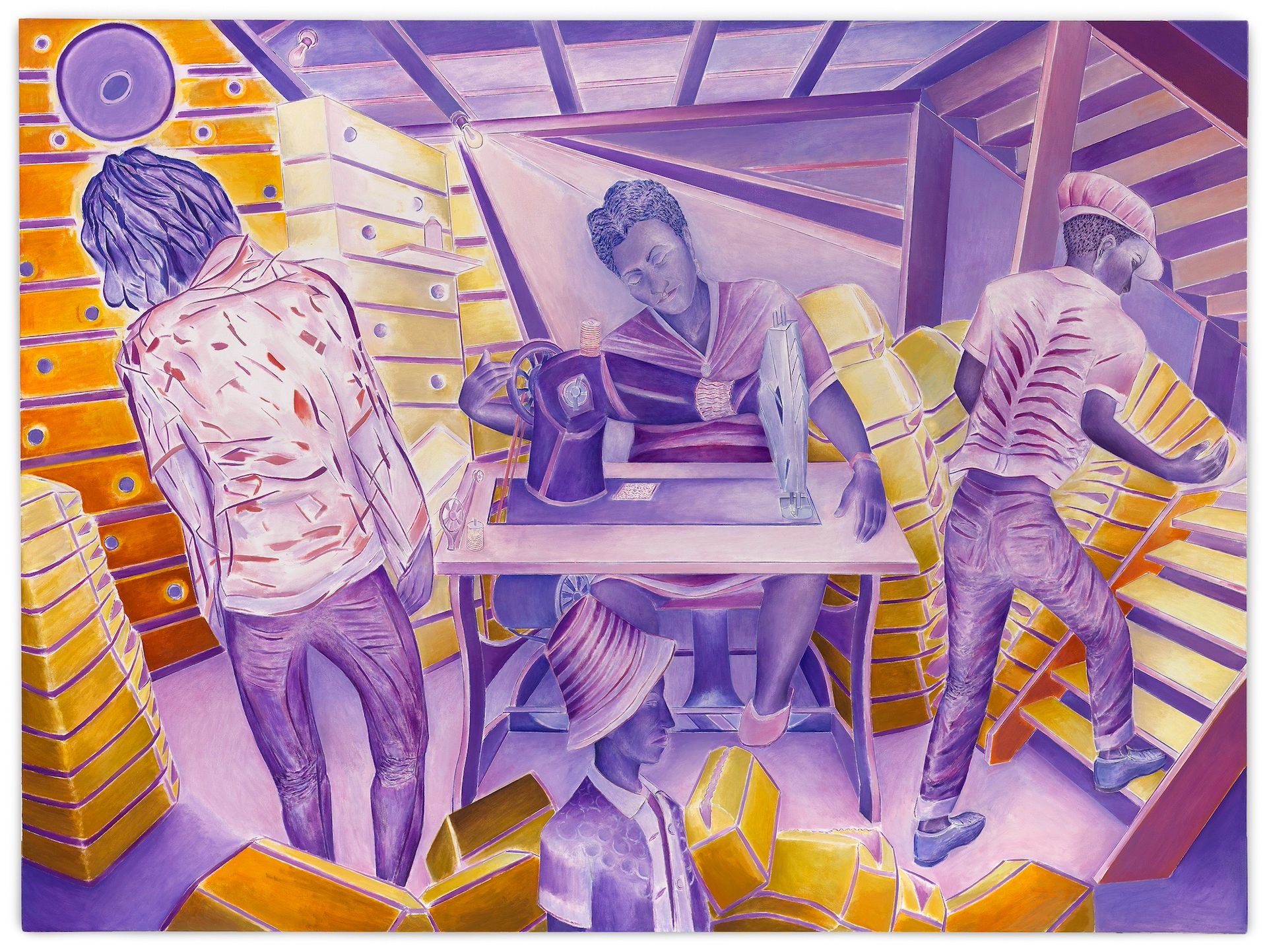
Denzil Forrester, Eula & Sons (TBC), 2024 © Denzil Forrester. Courtesy the artist and Stephen Friedman Gallery, London and New York. Photo by Todd-White Art Photography
The galleries’ dinner for Forrester and his wife, the artist Phillippa Clayden, took place at a nearby Chinese restaurant. “Several years ago, Denzil commented that the clubs he continues to frequent [in Cornwall, where he lives now] are a continuation of city life with spiritual fulfilment,” Wagstaff noted in her toast. “He added…that due to ‘the deep hypnotic and ancestral beat, dub music makes one feel purified, strong and free of the complicated network we live in’.”
To that I say, amen! The minute Wagstaff sat down, White Columns director Matthew Higgs made a beeline for a rented deck to spin dub-music records for the guests. In an instant, I found myself on my feet and dancing with the exuberant Forrester. He was still at it when I left. Yes, I thought to myself, as my election jitters faded, dancing is a salve. Combine it with an artful telling of social history, and whatever happens next, you can light the dark.
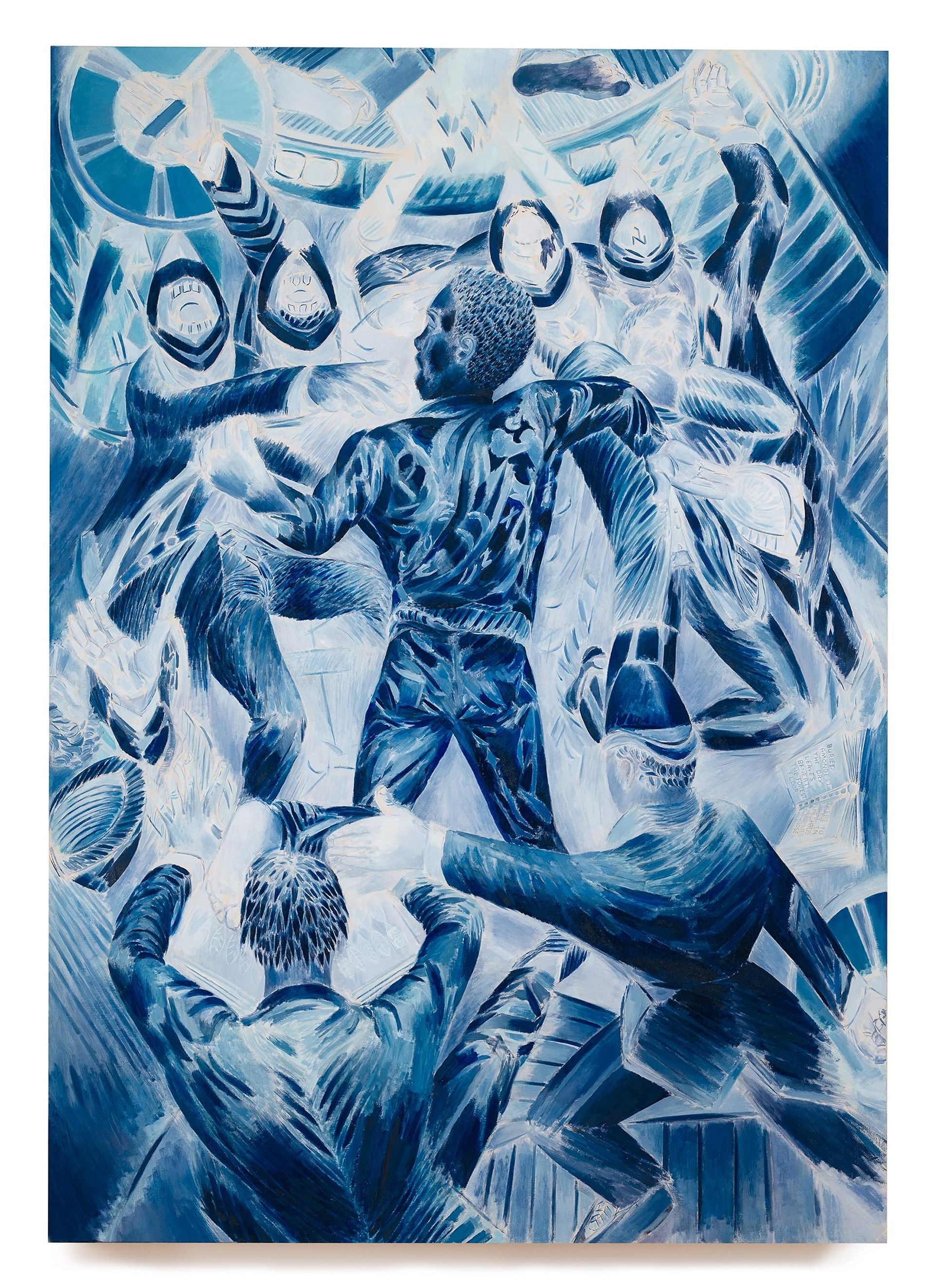
Denzil Forrester, Blue Jay, 1987. © Denzil Forrester. Courtesy the artist and Stephen Friedman Gallery, London and New York. Photo by Todd-White Art Photography.
- Denzil Forrester: Two Islands, One World, until 18 December, Stephen Friedman Gallery and Andrew Kreps Gallery, New York


